Category: fire ecology

  • Burning branches — flammability and shoot architecture

    Burning branches — flammability and shoot architecture

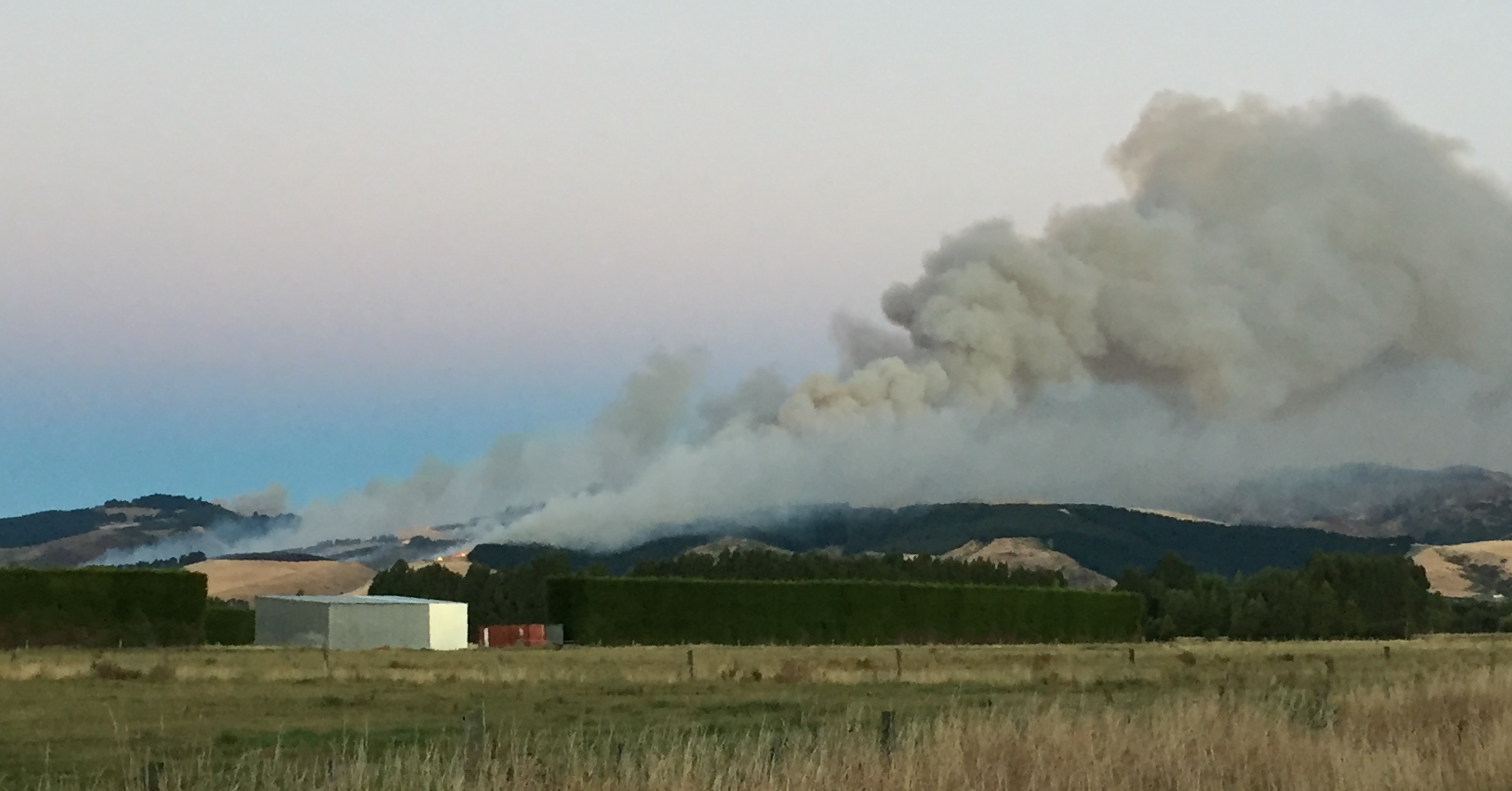
    In mid-February 2017, at about ten at night, I walked out to the street outside my south-Christchurch home and took a photo of the hills to the south-east. A large vegetation fire was stretched across the hills, which were lit black and orange, with strips of flames and glowing smoke. The blaze was at least 4 km away, but the blackness flattened the scene, and the fire and smoke seemed above me almost, and growing. You could almost believe the hills themselves would burn down.

    The Port Hills fire approaches the city. Image by Joe Potter Butler.

    I took that photo on the fourth day of the 2017 Port Hills fire. It took more than 60 further days for the fire to be fully extinguished. A life was lost, 1600 ha of land was burned, and nine houses were destroyed. Like many people in Christchurch, I was left wondering, why did it burn so fiercely and for so long? Why did this ridge burn, but not that gully? Why did some trees recover, and send out new shoots, while others perished?

    Along with floods, earthquakes, and other things, fires like the 2017 Port Hills fire are described as “natural disasters”, but how natural was this fire really? Prior to human settlement — which began around 800 years ago — fire in Aotearoa was rare. NZ was mostly covered in relatively moist, old growth forest. Because of this history, few New Zealand plants are fire-adapted. However, in Aotearoa and globally, wildfires are becoming more damaging and more frequent, threatening life, property, and ecosystems.

    Understanding what plant species burn, how they burn, and why, is crucial to understanding and managing fire risk across the modern Aotearoa landscape. A recent paper sought to investigate these questions and was led by Azhar Alam, with Sarah V. Wyse, Hannah L. Buckley, George L. W. Perry, Xinglei Cui, Jon J. Sullivan, Dylan W. Schwilk, and Timothy J. Curran.

    Most studies have assessed flammability (how easily they burn) of plant species by looking at leaf flammability in isolation. Azhar felt that there were limitations to this approach; that on its own leaf flammability didn’t fully capture how a fire really behaves when burning a plant in the real world.

    The authors preferred to assess shoot flammability. “Shoot” here means the young branch and branchlets of a plant, and all the leaves that are attached. The authors felt that — compared to just leaves — shoot flammability would better describe how a plant ignites and burns, and, in particular, better captures canopy flammability.

    This is important. Canopy flammability strongly influences how easily a fire moves from tree to tree or shrub to shrub. If we want to understand — and even predict! — how a fire might move through a stand of pines, gorse or kānuka, compared to a stand of old growth native forest.

    Aftermath on the Port Hills. Image from Adrian Paterson.

    Rather than just burning the shoots of a bunch of plants and recording the relative flammability of the species, the authors were interested in recording the effect of shoot architecture on flammability. “Architecture” here means how many branches and how tightly branched the twigs and leaves of a shoot are. For example, Kapuka has a few, large leaves with little branching, whereas korokio has many, small leaves and lots of thin, interlacing branchlets.

    The authors collected six shoots each from 65 plant species that you commonly find in  Aotearoa forests and gardens, including 35 indigenous species. 

    For each shoot, a number of leaf and shoot architecture traits were recorded. It was these traits that the authors predicted would show a strong relationship to flammability. The leaf traits recorded were:

    size of the leaves (total area),

    thickness of the leaves,

    leaf surface for each gram of leaf mass,

    dryness of the leaves.

    The shoot architecture traits recorded were:

    branchiness of the shoots (measured both as how many main branches each shoot has, and also how many branches the shoot has when you count all the branches the main branches have, all the branches those branches have, and all the branches those branches have and so on,

    twiggyness of the shoots (measured by twig mass per given volume of shoot),

    proportion of flammable mass (fuel) there is in a given volume of shoot,

    The shoots were all burned on a “plant barbecue” and their flammability was recorded.

    But what exactly is flammability? And how do you measure it?  There are four key factors that determine flammability of plant shoots:

    How quickly do shoots ignite? Ignitability.

    How much heat do they release once alight? Combustibility.

    How long do they burn for? Sustainability.

    How much of each shoot is consumed by the fire? Consumability.

    The results of these burning tests were clear. All shoot architecture traits and leaf traits were strongly related to shoot flammability.

    Among the shoot architecture traits, greater “branchiness” was shown to increase a shoot’s ignitability, consumability, and maximum temperature, while a greater amount of flammable mass (fuel) for a given volume of shoot was shown to increase a shoot’s fire sustainability and consumability.

    Fire glow on the Port Hills. Image by Adrian Paterson.

    Of the leaf traits, leaf dryness was key. In fact, leaf dryness increased all aspects of flammability more than any shoot architecture or leaf trait. Leaf thickness decreased flammability across the board.

    While leaf architecture traits were not as significant as leaf dryness in affecting shoot flammability, they were still significant. Demonstrating their importance is crucial for improving the management of fires and fire risk. Plant traits are already used in fire behaviour models to predict what fires will do.

    Including shoot architecture traits in these models has the potential to improve their power and precision. Understanding what a fire is likely to do gives us the power to change what it will do by planting low-flammability tree species to create fire breaks,  or buffering properties with lawn or pavement. This knowledge will save property, ecosystems, and even lives.

    If you drove through Arthur’s Pass, in the South Island this summer gone (2024-25), you probably drove past the charred and blackened beech trees and snow tussocks near Castle Hill; evidence of a fire that burned through 1,000 hectares of scrub, grassland and forest last December. This is a scene we can expect to see more and more in Aotearoa in the coming decades. Improving our ability to anticipate and manage fires and fire behaviour will only grow in importance as we move further into our new climate future.

    This article was prepared by Master of Science student Joe Potter-Butler as part of the ECOL608 Research Methods in Ecology course.


  • Fire-resisting superpowers in plants

    I don’t know what you like to eat at barbecues, but I like some nice roasted veggies! What I don’t fancy are burned broccoli or charred cauliflower. Who would want to eat that, right? Do you have an idea what causes huge amounts of burnt veggies each year? It’s wildfires!

    Seasoned vegetables,
    by polaristest (Flickr)

    With 8-11% of wildfires globally occurring on agricultural land you can imagine that these cause a lot of unenjoyable vegetables. Agricultural wildfires mostly derive from accidental ignition from machinery use or through the escape of fires initially deliberately lit for management purposes. Because 38% of land worldwide is used for grazing and cropping, there is a lot of potential for fire, which highlights the importance of reducing the fire risk to secure our major food sources.

    We don’t have to go far to realise the significance of this topic, as Canterbury accounts for around 20% of New Zealand’s total farmland, roughly 2,600,000 hectares of land. That is about the size of 3,700,000 rugby fields! Canterbury has a climate characterised by low precipitation and dry winds, good ingredients for an easily flammable outdoor barbecue.

    Local wildfires take away many people’s chance to roast their veggies themselves as well as causing a huge amount of economic and ecological loss. But what if we could use farmland for fire prevention? What if some crops actually had the superpower to fight against wildfires, or at least survive them?

    Canterbury NZ, by Simon (Flickr)

    There is a lot of information on how to plant mindfully, using low-flammability plants to create buffer zones that allow us to keep wildfires under control and stop them from spreading. Those ‘green fire breaks’ were tactically planted after the Port Hill fires in 2017 to prevent history from repeating itself. As green fire breaks can only help reduce the impact of wildfires to some extent, planting smart on farmland might add to the best practice, especially in fire-prone areas like Canterbury.

    That is exactly what was tested in a study by Lincoln University in 2023. Masters student Tanmayi Pagadala, with colleagues Azhar Alam, Tom Maxwell, and Tim Curran, tested 47 different agricultural plants for their flammability superpowers, following a simple recipe.

    Ingredients:
    – 47 different shoots and plants of the following groups: cereal crops, forage crops, fruit trees, grazing forbs, pasture grasses, weeds, pasture legumes, vegetables, and wine grapes.

    Utensils:
    – Infrared laser thermometer
    – Lighter
    – Plant barbecue (“a 44 gallon drum cut in half with a grill on top”

    Plant barbecue
    (Image by Hanna Hoeffner)

    Instructions:
    – Heat the grill by turning on the burner (125-199 °C)
    – Place your sample on the grill in a horizontal position and leave for 2 minutes
    – Turn on the blowtorch for 10 seconds to ignite the sample
    – Wait until the plant stops burning

    Following this recipe, one can evaluate the ignition time, the maximum temperature reached, the burning time, and how much of the sample was burned.

    After many days of barbecues, Tanmayi’s team was able to tell which plants have the superpower to resist fires better than others. Fruits and cereal crops had significantly higher flammability compared to vegetables, weeds, winegrapes, forage crops, grazing herbs, pasture grasses and legumes. Or, to make it more understandable, easily flammable crops dry faster, are generally dryer, and retain more dead material. Veggie superheroes were bell peppers, spring onions, and potatoes.

    Tanmayi’s team created “A fire-wise mixed cropping farm system” as a guideline for purposeful planting on farmland. The idea of fire-wise cropping is similar to green fire breaks. Using low-flammability native tree, grass and legume species as boundaries around higher flammable crops. 

    Broccoloid, by CaptainEdawardTeague (deviantart)

    Higher flammability species are then protected from wildfires that start outside of the farmland and also prevent fires started on the farm from spreading to neighbouring properties. While you must consider other factors, like local environmental conditions, economics, and goals like enhancing biodiversity, this approach can add to existing green fire breaks. By redesigning farms, we can utilise the fire-resistant superpowers of some species to safely plant non-super-powered plants and minimise increasing the wildfire risk.

    Even though this research was conducted in New Zealand, many of the species tested are common crops worldwide. Therefore, their superpowers could come in handy in many places with continuously increasing fire risks, putting veggies at the forefront of the fight against wildfires!

    This article was prepared by Master of International Nature Conservation student Hanna Hoeffner as part of the ECOL608 Research Methods in Ecology course.


    Pagadala, T., Alam, M. A., Maxwell, T. M., & Curran, T. J. (2024). Measuring flammability of crops, pastures, fruit trees, and weeds: A novel tool to fight wildfires in agricultural landscapes. Science of the Total Environment906, 167489. https://doi.org/10.1016/j.scitotenv.2023.167489

  • Fighting fire with farming: flammability of pastures and crops

    The Port Hills are a highly valued geographical feature of Chirstchurch. Located southeast of the city, they are home to a wide range of activities, including rock climbing and mountain biking, as well as being popular among walkers and joggers. Vegetation throughout the Port Hills is varied, containing a range of tussockland, pine forestry blocks, native scrub, farmed grassland, gorse and broom scrub and small pockets of remnant forest.

    On the 14th of February 2024, over 700 hectares of land was ravaged by wildfire in the Port Hills of Christchurch, New Zealand. Over 80 residents were evacuated, and around 130 firefighters with 12 helicopters were involved. Drought conditions and vegetation structure contributed to this event, but could the damage caused by the blaze have been reduced? Could grazing these hills with livestock have reduced the amount of tall dry grass present which fuelled the fire, or could different pasture or shrub species have helped to reduce the flammability of the Port Hills.

    A recent paper from Lincoln University’s own Tanmayi Pagadala, Azharul Alam, Tim Curran and Tom Maxwell has highlighted the differences in flammability between different pasture, crop, weed and shrub species found commonly on farms throughout Canterbury.

    Marley’s Hill on fire. February 15 2024. (Image CC BY-NC by Jon Sullivan)

    A good range of scientific work is available which has investigated the flammability of various plant species in New Zealand, but this has been mainly focused on species in natural areas (both native and exotic), rather than in agricultural environments. Gorse, eucalypts, pines and long grass are well known to be extremely flammable, so why is it that certain areas of the port hills were allowed to return to their same fuel rich state following the 2017 blaze which destroyed over 1600 hectares? It must be acknowledged that efforts were made to replant some of the previously burnt areas in green firebreaks and others in less flammable native species, which were shown to survive the previous blaze in well-established areas.

    Species that regrow following a fire are often also very flammable (eg. gorse and pine). Unfortunately, a significant proportion of the burned land was in pines for forestry, which has since been replanted and will likely create another significant fire risk for the foreseeable future. Continuing the efforts of plant firebreaks of less flammable tree species throughout the Port Hills, as well as within pine forestry blocks, should not be underestimated.

    Individually these breaks may not appear significant, but a thorough network of them throughout the Port Hills could be exactly what is needed to slow the spread of the next blaze and allow firefighters to gain control sooner. Minimising the presence of long, rank grass could also help to slow the spread of the burn.

    Could additional efforts be made in to reducing the presence of long rank grass through the addition of cattle to grazed areas which would trample and eat this dry plant material? Or perhaps planting more drought tolerant, water-efficient forages which can be grazed down during dry periods to minimise the fuel loading of grasslands could be beneficial.

    Dry, rank grass fuelling the blaze on Christchurch’s Port Hills. (Image CC BY Francis Vallance)

    There is a huge range of flammability in different crop and pasture species common to Canterbury farming systems. Assessments carried out on Lincoln University’s trusty ‘plant BBQ’ tested 47 different plant species and varieties common throughout Canterbury farms (see table below), including cereals, forage crops, fruit crops, forage herbs, forage grasses, forage legumes, vegetable crops, weeds and a range of wine grape varieties.

    Unsurprisingly, the majority of forage and pasture species showed very low flammability, as did some vegetable crops and wine grapes. Cereal crops behaved as expected, showing high flammability as they matured and dried off. Surprisingly, apple trees, pears and raspberries showed a high degree of flammability.

    Table of plant species and their relative flammability assessed by Pagadala and colleagues

    The slope of the Port Hills, and an average annual rainfall of 700 mm, means that using low flammability crops like potatoes or peas is not practical. There are, however, a range of pastoral species that show the potential to be beneficial in reducing the flammability of farmland. Forage crops, herbs, legumes and grasses all showed very low flammability scores, which is due to their high moisture content and quality traits meaning they carry very little dead material (the ideal fuel for fires).

    Knowing these flammability scores in addition to the the drought tolerant traits of species, such as lucerne, cocksfoot, red clover, plantain and chicory, raises the question: why are these species currently not implemented throughout the fire prone Port Hills as a method of reducing fire risk? Yes, these forages will become flammable if they are allowed to turn to a reproductive state. However, their drought tolerance and palatability will allow them to be well grazed during dry periods and not contribute to the fuel loading of hills anywhere near the amount that browntop and other native grasses will.

    Chicory next to native pasture in Taranaki. (© Blake Gunn – used with permission)

    The photos above paint a picture of a potential solution to the Port Hills fire woes. At the very least, an effort should be made to ensure that flammable biomass throughout the Port Hills is minimal. Minimising the presence of flammable species, such as gorse and pines, through manual removal or switching to planting less-flammable alternatives, such as native shrubs, are some potential solutions.

    Preventing the planting of pine plantations near the city and other populated areas seems like another fairly logical solution to reducing the fire risk in populated areas, as does surrounding these potential high-risk areas with low flammability and native shrub species. Another area of focus could be to focus more on the management of cattle and/or sheep to intensively graze the hillsides and ensure that a bank of highly flammable fuel does not build up over time. Intensive grazing will not only prevent grass banks from building up, but the ‘hoof and tooth’ activity from grazing may also prevent other flammable species, such as gorse and broom, from re-establishing.

    Lucerne transforming a Central Otago farm system (© Allister Moorhead – used with permission)

    Functional firebreaks could also be of huge benefit to these hillsides. In areas where tractor access is possible, consideration should be given to the establishment of drought-tolerant, low-flammability species, such as red clover, chicory, or lucerne. These will create ‘green zones’ throughout the hillsides that could slow the spread of the next inevitable fire, especially compared to the current vegetation which is prone to turning to a dry, reproductive state over summer.

    To wrap up, logic suggests that previous fires in 2017 and 2024 on the Port Hills, in combination with the presence of flammable vegetation, make another blaze in the future almost inevitable. The findings from recent research on the flammability of pasture and crop species commonly found on Canterbury farms, combined with modern grazing regimes present a real opportunity to significantly reduce the fire risk on the Port Hills. The use of firebreaks planted with native, low flammability species around high risk areas such as pine forestry blocks, along with the protection of existing pockets of native scrub/forest should also help to reduce the fire risk on the Port Hills.

    This article was prepared by Master of Science postgraduate student Kaylee Spain as part of the ECOL608 Research Methods in Ecology course.

    Reference article:
    Pagadala, T., Alam, M. A., Maxwell, T., & Curran, T. (2023). Measuring flammability of crops, pastures, fruit trees, and weeds: A novel tool to fight wildfires in agricultural landscapes. Science of the total environment, 906(1). https://doi.org/10.1016/j.scitotenv.2023.167489

  • Every pyromaniacs dream… the science plant BBQ

    In recent decades, climate change has been a cause for social and environmental transformation. For example, the inclusion of words such as ‘eco-anxiety’ to the Oxford English Dictionary shows the growing apprehension we have about the future of our climate. Next time you are feeling overwhelmed as a result of the environment, you’ll have the perfect word to describe it! The reasoning behind part of this social shift is due to ecological impacts caused by events such as rising sea levels, ocean acidification and wildfire. 

    When I was growing up, we lived on the outskirts of Rangiora. I was 7 years old when I experienced uncontrolled fire for the first time; the boundary trees of a farm I could see from my bedroom window went up in flames. After a couple of hours, and a team of fire fighters, the blaze was put out. This event was minuscule compared to the damage caused by the Port Hills fire in 2017, which burnt 1,660 hectares of land, or 1,646 rugby fields, over a worryingly 66 days.

    The Sugarloaf transmission tower is threatened by multiple fires burning out-of-control in the Port Hills south of Christchurch, New Zealand (Left), Image by Ross Younger from Flicker.
    Orroral Valley Fire viewed from Tuggeranong, Australia (Right), Image by Nick D from Wikimedia Commons.

    More recently, our neighbours across the ditch experienced one of the worst fire events in history. The Australian Bushfires of 2019/20 burnt a whopping 18.626 million hectares of land; equivalent to too many rugby fields to count!

    The impacts of wildfire go beyond immediate destruction. Long term effects include challenges for biodiversity and human health. Additionally, the economic toll of wildfires can be extremely pressing. The Port Hills fire alone cost $7.9 million NZD to suppress; I would hate to think of the cost imposed by the Australian Bushfires. Throughout these events, astounding acts of courage were witnessed, whilst land, infrastructure and, regrettably, lives were lost; but could these events have been prevented or the severity of damage lessened? 

    Though recent fires in New Zealand may not be as severe as those witnessed overseas, further destructive fire events are looming. Future conditions likely to be more common in much of New Zealand are hotter temperatures, lower rainfall and windier conditions: a recipe for a fiery landscape. One of the key factors that impacts the scale and intensity of fires is vegetation and their corresponding fuel loads. For example, a plant with a low moisture content and high dead material percentage will, in theory, pose a higher risk if fire were present. However, little research in New Zealand, or worldwide, has put this to the test empirically. 

    Sarah Wyse from the University of Canterbury and her team of scientists acknowledged this knowledge gap and took it as an opportunity. “A quantitative assessment of shoot flammability for 60 tree and shrub species supports rankings based on expert opinion” was published in the Journal of Wildland Fire in 2016. The aim of this paper was to quantify the shoot-level flammability of 60 native and exotic plant species found in New Zealand and compare these results with rankings derived from previous studies. 

    Plant barbeque in action! Image by Georgina Woods

    One of the key pieces of equipment required for this study was a plant barbeque; yes you heard me right. Built out of a 44-gallon drum, the plant barbeque is every pyromaniacs dream. Rather than just burning components of a plant, this study burnt whole shoots (maximum 70 cm long) which preserved much of the plant’s structure. Each sample was left on the grill for 2 minutes to create the same environment as if an approaching wildfire. Once the sample had heated, it received direct flame from a blow torch for 10 seconds. Following this, measurements, such as ignition time, burning time and maximum temperature, were recorded. Overall, this approach creates more realistic wildfire conditions and much more ecologically significant data.

    The study found species such as gorse, manna gum and kūmarahou to be high in flammability whereas species such as whauwhaupaku, hangehange and kotukutuku were low in flammability. These findings have contributed to paving the way for the development of mitigation tools, such as green firebreaks. Green firebreaks are strips of vegetation comprised of plant species that are low in flammability. This reduces the spread of fire, making our landscapes more resilient. As well as this, they contribute to encouraging native biodiversity to flourish.  

    This is only the beginning for plant flammability, which has scope for future research. One of the co-authors of this project, Tim Curran from Lincoln University, has a goal to make this data set and future research known worldwide. Further investigation is going to continually contribute to the existing valuable pool of knowledge, tackling the challenges that continue to threaten humankind.

    As we experience the consequences of climate change, it is normal to feel that creeping sense of eco-anxiety, but this research may help you ease those nerves. Knowing more about a problem is always helpful. So, whilst Sarah, Tim and other keen researchers help expand what we know about plant flammability, I’d save your marshmallows for another day; perhaps we won’t end up as a ball of flames after all. 

    This article was prepared by Bachelor of Science (Honours) student Georgina Woods as part of the ECOL608 Research Methods in Ecology course.

    Citation: Wyse, S. V., Perry, G. L. W., O’Connell, D. M., Holland, P. S., Wright, M. J., Hosted, C. L., Whitelock, S. L., Geary, I. J., Maurin, K. J. L., & Curran, T. J. (2016). A quantitative assessment of shoot flammability for 60 tree and shrub species supports rankings based on expert opinion. International Journal of Wildland Fire, 25(4), 466–477. https://doi.org/10.1071/WF15047

  • Blow-torching plants for hot evolutionary insights into flammability

    Who would have thought that it is possible to get funding to torch dried plants on a grill, for science! The results are now in a scientific journal, contributing insights regarding the evolution of flammability in plants.

    My 8-year-old self would have been delighted, that is for sure. Then I was already very interested in biology. I also had some ‘slightly’ pyromaniac tendencies. I conducted my own ‘research’ on the flammability of various household materials, such as cardboard, candles and scrap wood from my dad’s workshop in the basement.

    My parents were probably a little too tolerant in this regard. They provided me with a relatively safe ‘lab’ environment that basically consisted of an inflammable tray, made of aluminium. This I could deploy in the garden to conduct my rather opportunistic experiments. My parents watched cautiously with a bucket of water in reach.

    Luckily, everything turned out well, I did not burn down our house or anything of significance and instead grew up to focus on Biodiversity, Ecology and now Nature Conservation during my time at school and university. The only relic of my childhood experiments is a propensity to seek out excuses to (safely) ignite a campfire while hiking, to hone my caveman skills and to ‘impress’ my friends.

    Dracophyllum rosmarinifolium, the inaka or common grass tree, Photo CC0 1.0 by Leon Billows, iNaturalist NZ

    This brings us to the recent publication of Xinglei Cui et al., that was published earlier this year in Forest Ecosystems. Xinglei is a former PhD student on plant flammability at Lincoln University – now working at Sichuan Agricultural University, in Chengdu, China. He worked in collaboration with other researchers from China and New Zealand, among them LU’s Adrian Paterson, Kate Marshall and Tim Curran.

    Xinglei wanted to solve the question of whether the presence of different environmental conditions (for example altitude above sea level) could explain differences in the flammability among individuals of the common grass tree or inaka (Dracophyllum rosmarinifolium). This plant was chosen since it occurs throughout the South Island and can live in very different habitats, from rocky slopes to plateaus and valley floors. Inaka also shows diverse shapes and sizes – a lot of variability among the same species.

    Previous research, mostly focused on relating flammability of plants to fire frequency in their natural range, showed that species like gorse become more flammable when there are more fires. This has inspired macabre sounding hypotheses such as ‘kill thy neighbour’ or ‘born to burn’, and other good death metal sounding titles! While this might sound contradictory, some plants take an evolutionary advantage from being highly flammable, if being flammable kills your neighbours and provides open space for your pyromaniac offspring.

    Coming back to our grass tree, we are not sure how flammability evolves without the regular presence of wildfires, like in New Zealand. This question becomes especially relevant considering rising temperatures and weather that becomes more and more unstable through climate change. Areas of the world are now burning where fire used to be rare. Answering this question could help to understand where and why the risk of wildfires could be higher in regions of New Zealand that experience increasing periods of ‘wildfire weather’ conditions.

    To test this, the researchers had the chance to use a device that looks suspiciously like it could be used for a nice barbecue after finishing the scientific experiments. Not only does it feature a regular gas burner, but also an awe-inspiring blow torch, based on the design of an older publication and adapted to New Zealand safety standards by Sarah Wyse in 2016. Shoot samples from eight different South Island locations, each with different environmental and habitat conditions, were tested regarding their burning qualities. After 24 hours of air drying, they were preheated for 2 minutes before trying to set them on fire. Then, duration, temperatures and the amount of the plant that got burned in the process were measured – what a task!

    Flammability among plants from the eight locations varied a lot, although every single sample caught fire. The sample from Mt Arthur in the north of the South Island was most flammable, while individuals from the Homer Tunnel in Fiordland were least flammable. However, the influence of the habitat conditions from those eight sampling conditions turned out not to be related to the flammability of the grass tree.

    What do these results tell us about the evolution of flammability in the common grass tree, if environmental conditions don’t seem to have an effect on it? Xinglei and his colleagues concluded that flammability of this plant is more likely to be a by-product, an indirect result in the evolution of other characteristics of this plant, since it grows – in areas without a natural wild fire regime.

    In any case, the authors highlight that it is important to continue this type of research to understand and manage the risk of wildfires in light of climate change. This may help us to understand where wildfires are likely to occur in New Zealand and to react and plan accordingly. Many further questions have to be solved. For example, is the current flammability of the grass tree passed directly on to the next generation and why are flammability traits so different among individuals of the same species.

    There are many more projects to come and more importantly, many chances to safely live out your pyromaniac tendencies! I’m keen, and I have my own tray!

    This article was prepared by postgraduate student Jan-Niklas Trei as part of the ECOL 608 Research Methods in Ecology course in her Master of International Nature Conservation degree.