Do I need to apologise for the overly alliterative title? The excessive use of P’s aside, this title is still ridiculous, who has seen a polka dot pasture? Or a pinstripey paddock? They sound like a figment of Dr. Seuss’ imagination!
But they’re not, it’s science – an ingenious recipe, mixing landscape design, with a pinch of ecology, and a tablespoon of agriculture. Let’s get cooking!
When did we (and by we I mean the human race/ Homo sapiens/ mankind/ womankind/ humanity/ Earthlings), when did we decide that livestock grazing pastures were to be squares of fenced grass? It was probably somewhere around 12,000 years ago when we stopped being nomadic and started agricultural farming.
Fenced grass pastures work, they have been working for thousands of years. But times they are a’changing (insert a “back in my day…” quote here). The human population (no more we’s, it’s getting serious now) has swelled into the billions (8,286,120,266 at the time of writing), requiring massive agricultural landscape expansion to sustain us.
There is no better example of this than where I live; the Canterbury Plains of Aotearoa New Zealand. Less than 0.5% of Canterbury Plains’ native bushland has survived the ever-expanding agricultural and residential landscapes. This is where we run into our big pinch of ecology – if we were to put the native plants and animals back, where would they go?
The answer – into polka dots, patches and pinstripes.
I’ll explain what the patterns are about, as I know you’ve been waiting patiently. They are landscape design patterns of native woody plants within an agricultural livestock pastural setting. They are the answer – cohabitation of native habitats and productive farming, all within one landscape.
Lincoln University‘s multi-disciplinary researchers, James Eggers, Shannon Davis, Crile Doscher and Pablo Gregorini, are the large brains behind this pioneering conceptual design. In their study, they list ideal native woody plant species that can be used to both enhance livestock welfare and restore bush habitats for native birds.
Now we’re cooking with renewable energy, and we’re baking three cakes in one pan – through increasing foraging opportunities for livestock, providing shade and shelter for these livestock, and establishing native bird sanctuaries. Wow!
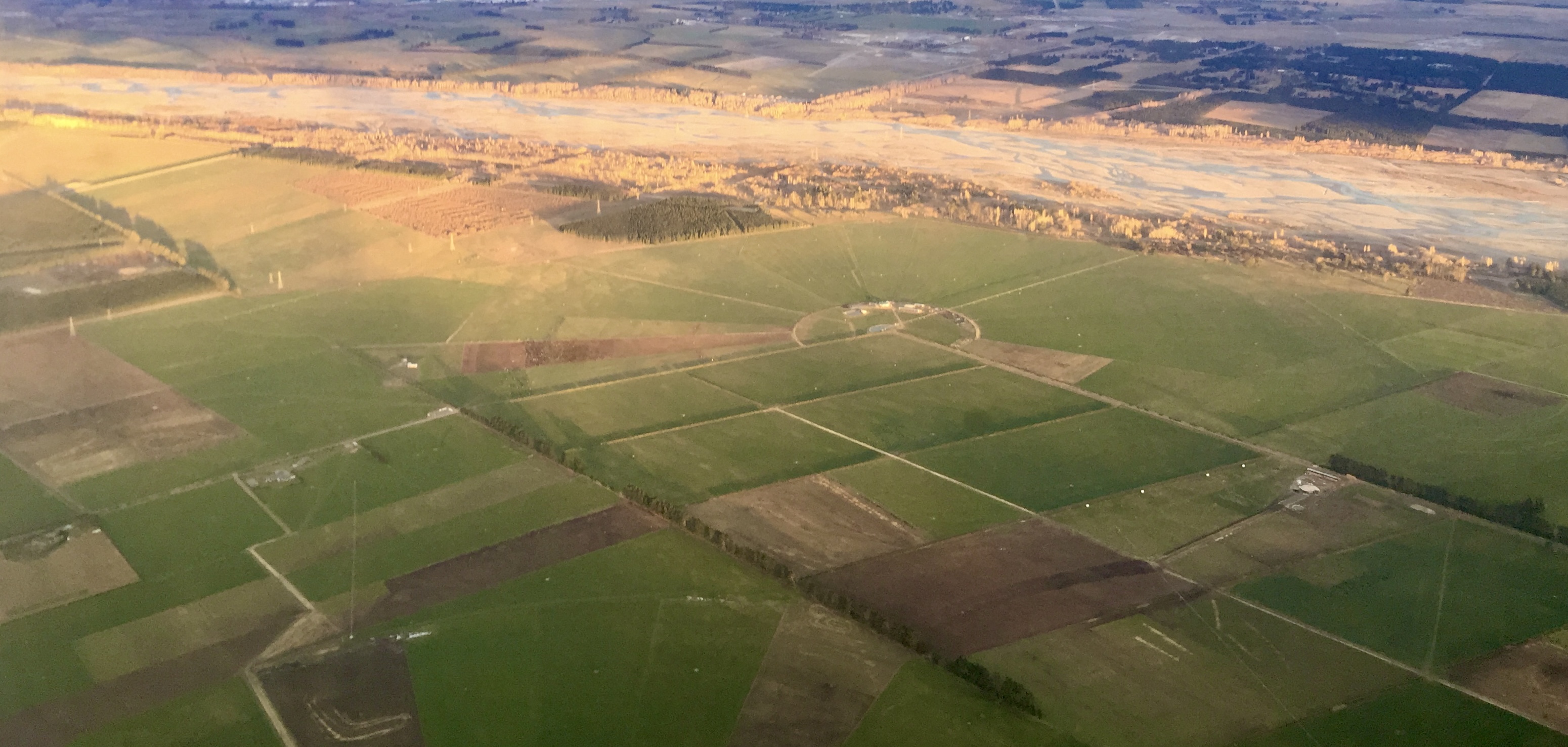
Picture this – you’re a farmer and this is your Canterbury Plains farm. Nice, right! You have multiple grass paddocks where you graze sheep and cattle. In reality, this is Lincoln University’s Ashley Dene Farm which was used as a case study for this research, but in this virtual Blog, it’s yours.
Figure 1: Aerial view of Ashley Dene Farm Image © 2023 by J. Eggers et. al. Licensee MDPI, Basel, Switzerland. CC-BY 4.0

Let’s say you want to increase foraging opportunities for your livestock. You know that foraging woody vegetation has long been recognised as beneficial. Woody vegetation tolerates poor soils and weather conditions. It provides a range of nutrients and medicinal properties for optimal livestock health. Also, a diversity of forage enhances livestock consumption and can lengthen the grazing season. Finally, foraging allows livestock to exhibit natural browsing behaviour, thereby boosting welfare.
Lucky for you, thanks to this research, we have a list of optimal foraging native shrubs and small trees (shorter plants for livestock access) selected for palatability, tolerance for browsing and growth rate. Now for the fun part – how to arrange these plants. We have three patterns…

Polka dots (or patches): vary in size and are placed within pastures. The central area is fenced to prevent overgrazing and to accommodate natural seedling regeneration.
Figure 2: Polkadots. Image © 2023 by J. Eggers et. al. Licensee MDPI, Basel, Switzerland. CC-BY 4.0
Spreading: balances access to forage, preventing over browsing through the use of a central fenced off strip. It preserves maximal grazing pasture by running along pre-existing fence lines. Livestock can be moved between paddocks/sides of the spreading forage to allow for regeneration on one side whilst the other is browsed.
Figure 3: Spreading. Image © 2023 by J. Eggers et. al. Licensee MDPI, Basel, Switzerland. CC-BY 4.0


Pinstripes (or just stripes): maximises foraging opportunities and is compatible with farming that uses large machinery. The stripes are within a single paddock, placed 40 m apart for optimal browsing, and temporary fencing is used to designate/restrict feeding areas.
Figure 4: Stripes. Image © 2023 by J. Eggers et. al. Licensee MDPI, Basel, Switzerland. CC-BY 4.0
Back to your hypothetical farm, you now have an amazing amount of native forage for your livestock. However, with your farm being on the Canterbury Plains, it is constantly hounded by northeasterly, hot northwesterly, and cold southwesterly winds. Your animals need shelter. Shade and shelter for livestock reduces heat/cold stress, excess moisture loss, improves animal wellbeing, increases feed intake and lamb survival rate.
Here is a native solution with multiple benefits, no more English hedgerows that provide little to no food for wildlife. Native trees and dense shrubs are selected for their height, shade, canopy, and provision of shelter. Unlike the foraging designs, these shelter patterns are fully fenced off to allow for optimal plant growth without the pressure of grazing.

Straight shelter: a pretty straight-forward design (see what I did there) providing shelter in areas of limited space.
Figure 5: Straight shelter. Image © 2023 by J. Eggers et. al. Licensee MDPI, Basel, Switzerland. CC-BY 4.0
Meandering shelter: similar to the straight design, however, with a greater width to act as a wildlife corridor and habitat.
Figure 6: Meandering shelter. Image © 2023 by J. Eggers et. al. Licensee MDPI, Basel, Switzerland. CC-BY 4.0


In-paddock shade trees: taller trees are placed through paddocks, in groups or individually, to provide shade. There is no underplanting to allow for a cooling breeze.
Figure 7: In-paddock shade trees. Image © 2023 by J. Eggers et. al. Licensee MDPI, Basel, Switzerland. CC-BY 4.0
Ah, that’s nice. Now your sheep and cattle are well fed and comfortable. The productive capacity of your farm is in order. But, you also care deeply about native wildlife and want to do everything you can to protect them (but not with a loss of productivity for your farm). Is this possible? Well, let’s see…
James and his team designed native bird bush habitats around a wetland corridor, an area of pre-existing mature trees, and a densely planted area. Densely planting native bushland are better at dealing with edge effects, reducing the distance that light and sound pollution can travel into the patch, and increasing bushland’s suitability for sensitive birds (like kererū). The mature trees act as nurse species for the native seedlings and the wetlands will breed waterborne insects – an additional snack for many bird species.
Whilst the forage and shelter plantings were determined by the needs and landscape of the farm, placement of bush habitats required consideration of the wider landscape. Preference was given to the native bird habitat locations as they had specific requirements. Native bird habitats must connect to a wider established ecological network for birds to be able to travel to the site (within 5-25km distance dependent on the bird species). Amazingly, native bird abundance can almost quadruple with the addition of restored bushland to agricultural landscapes. This research identified ultimate native plants that provide bird food sources and nesting sites.


So now you have an ideal farm! It balances livestock productivity and native bird habitats through adding an abundance and variety of native plants (an increase of 30% woody vegetation in the case study farm). And yes, there may be a reduction in the grazing land area, but, this is offset by increased forage vegetation, combined with fallen organic matter improving soil health and productivity. The addition of native bird habitats will likely have little impact on farming operations.
Forage patterns can be integrated into shelter patterns to maximise land use for grazing. Likewise, forage plantings can be placed next to bush habitats to create multifunctional areas. Shelter and forage plantings can complement the bush habitats, by acting as wildlife corridors, edge habitats, and increase plant species diversity. Your imagination is the limit when it comes to combining and implementing the design patterns, however, site specifications, soil types, climate conditions, livestock density, paddock use, and wildlife reserve proximity need to be considered… so maybe your imagination isn’t the limit, as every farming landscape has different specifications.
We are achieving an agricultural ecological landscape in one location, with broader ecosystem benefits. Restoring and integrating native habitats into farming practice can encourage others to follow, and together we can support the revival of native birds to our currently fragmented landscape. This research kneads together two strong cultural identities of Aotearoa New Zealand – its rich farming history and outstanding natural biodiversity – fortifying and concentrating both.
As these Patches, Polka dots, and Pinstripes do sound like a Dr. Seuss story, it is only appropriate to end with,
“Unless someone like you cares a whole awful lot,
nothing is going to get better.
It’s not.” – Dr. Seuss’ The Lorax
So thanks to all of you reading this, farmers or not, I know that you care a whole awful lot.
This article was prepared by Klara Royster, Master of International Nature Conservation student, for an assignment in ECOL608 Research Methods in Ecology.


