Category: molecular ecology

  • Election special: of questionable character

    Election special: of questionable character

    Hoisted from 2011 – another election year

    It is election time here in New Zealand. In 2011 we have been spared much of the usual hoo-hah because of the recent (and spectacularly successful) Rugby World Cup dominating the news as well as the Canterbury earthquakes before that.

    One of the tasks that we will have on Election Day is to find out what New Zealanders think of our voting system. We moved away from a winner takes all ‘first past the post’ system 15 years ago but there is a push to bring this back.

    The problem with ‘first past the post’ is that you can become the government despite winning less than half the overall vote, and once you are in, you can act as if you won 100%. Other systems encourage representation in proportion to the amount of votes you won.

    What has this to do with ecology? Well it turns out that there are similar issues when it comes to analysing large molecular data sets. Such data sets can tell us about the evolutionary history of a group of species: who is related to who and when their last common ancestor lived.

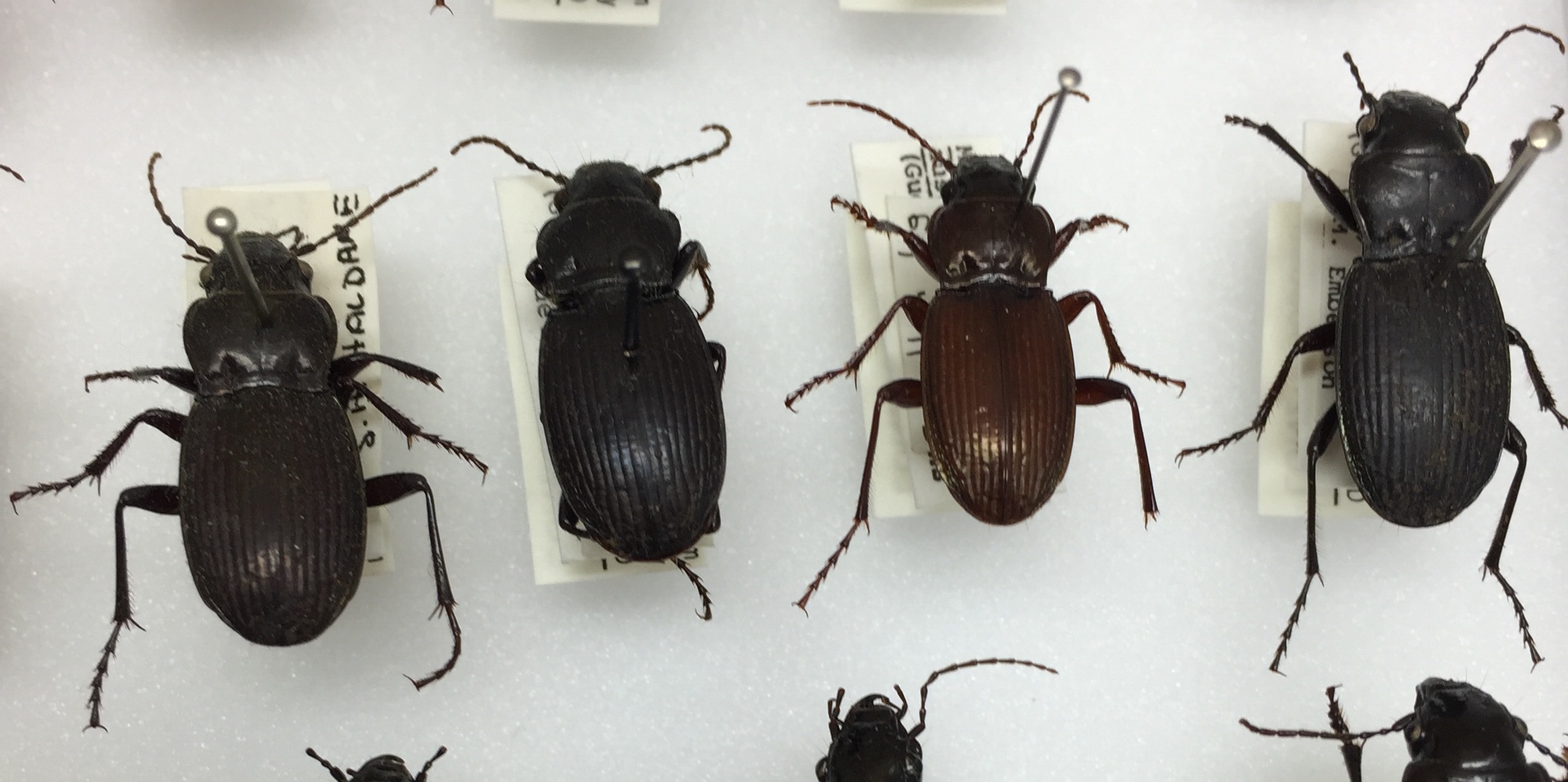
    The world is full of choices. How do we select the right one? Image by Adrian Paterson.

    A problem here is that most of the methods for finding these patterns tend towards the first past the post ideal. The evolutionary tree is built from the strongest signal and other signals are ignored.

    Rob Cruickshank (formerly of Lincoln University and now at University of Canterbury)has explored the issue of character conflict within molecular data sets in a recent issue of Zootaxa. Ideally, a data set should contain one signal, that of the evolutionary history for that group.

    Unfortunately there are a number of factors that can introduce other signals, such as convergence, parallel evolution, human error, high rates of change and so on. So within your data set there are usually competing signals, much as within society there are competing political parties.

    Most analyses simply find the signal with the most votes and this is proclaimed the winner. However, Rob points out that there are several ways to find smaller strength signals to further analyse, after all one of these might be the true answer of how species are related.

    For example, the fantastically named ‘spectral analysis’ looks at each signal in the data and shows how much support there is (how many characters agree with this signal) and what conflict they have (how many characters disagree with this signal).

    Sometimes the signal with the greatest support has a lot of conflict as well whereas the next largest signal has none. Given that we might expect the correct phylogentic signal to have little conflict then this might encourage us to look further than the loudest signal.

    This would be like being given two votes: one for the person/party that you wanted to support and one for the person/party that you especially didn’t want. If the leading candidate is also the one with the largest conflict then maybe they are not as good for consensus politics as the next candidate with a much lower conflict score.

    Certainly, in the world of species relationships determined by molecular characters, this might be something worth considering. It may also be worth considering in our elections, given the coarseness of our political discourse.

    This EcoLincNZ article was written by Adrian Paterson in 2011. In upgrading to a new site it was lost. I am uploading and lightly editing some of these old articles to let new readers access them. MMP has endured another 15 years and we are in the midst of figuring out the winner of 2026.

  • Fairy penguins of Oz

    Fairy penguins of Oz

    Unearthed Gems – EcoLincNZ articles from the last two decades see the light again! From 2008…

    The blue penguin (Eudyptula minor) is found around New Zealand’s coastlines and in many parts of south-eastern and western Australia (where they are sometimes known as fairy penguins). Over the years there have been many different suggestions put forward to explain the regional variations seen throughout the range of this species.

    Early researchers hypothesised that each geographical region of New Zealand contained a subspecies of blue penguin. Molecular data from gene regions is often ideal for examining these kinds of hypotheses. A study in 2002 found only a little support for regional differences but a lot more support for major differences between blue penguins in New Zealand and Australia.

    Image by Julie Paterson.

    In a follow-up to this study Adrian Paterson, Rob Cruickshank, Gabby Drayton (Lincoln University) with Jonathan Banks (then University of Waikato) examined the regional genetic variation of blue penguins across Australia. Samples were taken from a western Australian and Victorian populations (which are thousands of kilometres apart).

    The team examined the fast evolving control region and the slower evolving cytochrome B gene regions of the mitochondrial DNA from each penguin sample.

    The western Australian individuals were found to be the same as the Victorian samples implying that there is a high level of gene flow between east and west Australia (more than from the east and west coasts of New Zealand, for example).

    The study also confirmed that Australian and New. Zealand blue penguins are very different genetically and may warrant becoming recognised as separate species in the future.

    Curiously, this study also agrees with the earlier study by placing the birds from Otago, New Zealand with the Australian birds rather than the other New Zealand populations. This result is hard to explain at present and will provide impetus for further studies.

    This was the second EcoLincNZ article uploaded and was written by Adrian Paterson. In upgrading to a new site it was lost. I am uploading some of these old articles to let new readers access them. Adrian is currently working on little penguins for the first time since this time in 2008!

  • Enemies with benefits

    Enemies with benefits

    The idea of ‘friends with benefits’ is reasonably widespread and understood. Having good interactions with others will often lead to even more productive outcomes. But what about ‘enemies with benefits’? Are there times where your enemy can give you some positive benefits?

    Invasive species cause ecological harm worldwide, threatening biodiversity, disrupting nutrient cycling and displacing native species. Pacific islands, with their characteristically high rates of endemism, experience out-sized effects from plant invasions (Bellard et al. 2014). In biodiversity hotspots, such as New Zealand, exotic invasive plant species now outnumber native species in area and in number.

    But, how do they do it?

    New Zealand habitats are prone to invasion by exotic plant species. Why is this?

    A study by Lauren Waller and other Lincoln University and University of Canterbury colleagues, published in Journal of Ecology attempts to find some answers. Lauren shows that exotic plants may gain their competitive edge by accumulating enemies in the soil and sharing them with neighbouring native plants, a phenomenon that plant ecologists call pathogen spillover.

    Lauren set up a large mesocosm (self-contained area) experiment. These were areas where new species could be added to a known group of native species in a very manageable process. The health and growth of all plants could be measured and microorganisms both present at the start and brought in on the introduced plants could be identified.

    Lauren expected exotic plants to experience improved growth due to escape from pathogens (leaving the burden of enemies behind when they come to NZ). This assumption comes in large part from two well-known hypotheses, the Enemy Release Hypothesis and the Evolution of Increased Competitive Ability (EICA) Hypothesis. Enemy Release states that exotic plants can gain incredible success when they move to a new location lacking the enemy pressure they experienced in their home range, particularly co-evolved specialist enemies. EICA goes a step further to suggest that if exotic plants can escape enemy pressure in their new range, those plants will have more resources to allocate to growth over defence.

    Somewhat supporting Enemy Release, exotic plants did not appear to suffer much from specialist fungal pathogens. However, exotic plants did associate with generalist pathogens. Also, in support of Enemy Release, exotic plants did not appear to allocate resources to defence. Instead, exotic plants appeared to tolerate generalist pathogen pressure without reducing their growth.

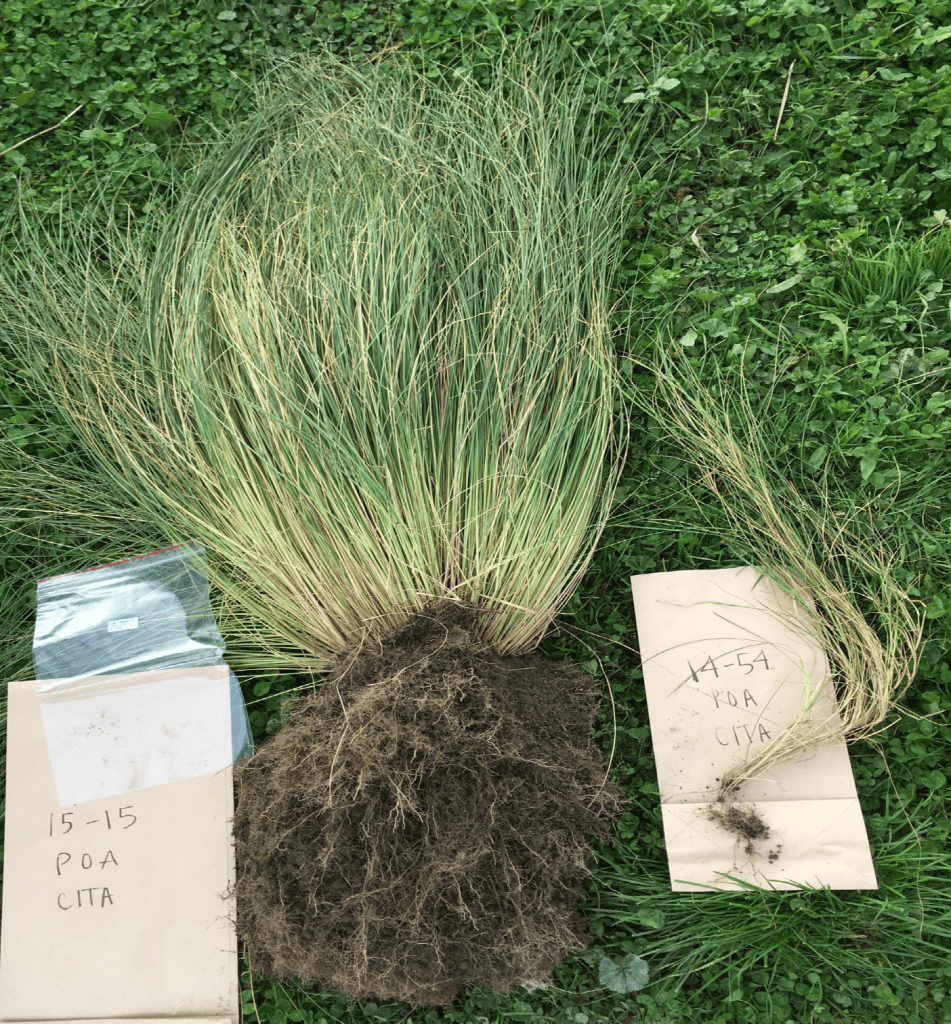
    Native Poa grown in a native versus exotic dominated plot.

    Lauren did not expect to see big impacts by exotic plants on native plants, and boy, did they! Native plants just wasted away when grown with exotic plants. It was very sad to watch. This photo shows an example of a native bunch-grass, grown with all native neighbours (left) or in communities dominated by exotic plants (right).

    What explained the out-sized effect of exotic plants on native plant growth? Our network analysis showed that exotics not only accumulated and tolerated generalist pathogens, but they shared their pathogens with native plants. Native plants did not appear to have the same tolerance for this enemy pressure like the exotic plants did. 

    We started by asking ‘are there times where your enemy can give you some positive benefits?’. It turns out that yes there are times when your enemies can help you a lot. In this case if species cause you problems it will be OK for you if they cause competing species even more problems! With invasive species, your microbial enemies can do you a good turn but taking out the opposition.

    Now that’s a real enemy with benefits!

    Lauren Waller and Adrian Paterson wrote this together (and not as enemies!). They are lecturers in the Department of Pest-management and Conservation.

    Bellard, C., Leclerc, C., Leroy, B., Bakkenes, M., Veloz, S., Thuiller, W., & Courchamp, F. (2014). Vulnerability of biodiversity hotspots to global change. Global Ecology and Biogeography, 23(12), 1376-1386