Category: Outreach

  • How to help lizards in your back yard/paddock

    How to help lizards in your back yard/paddock

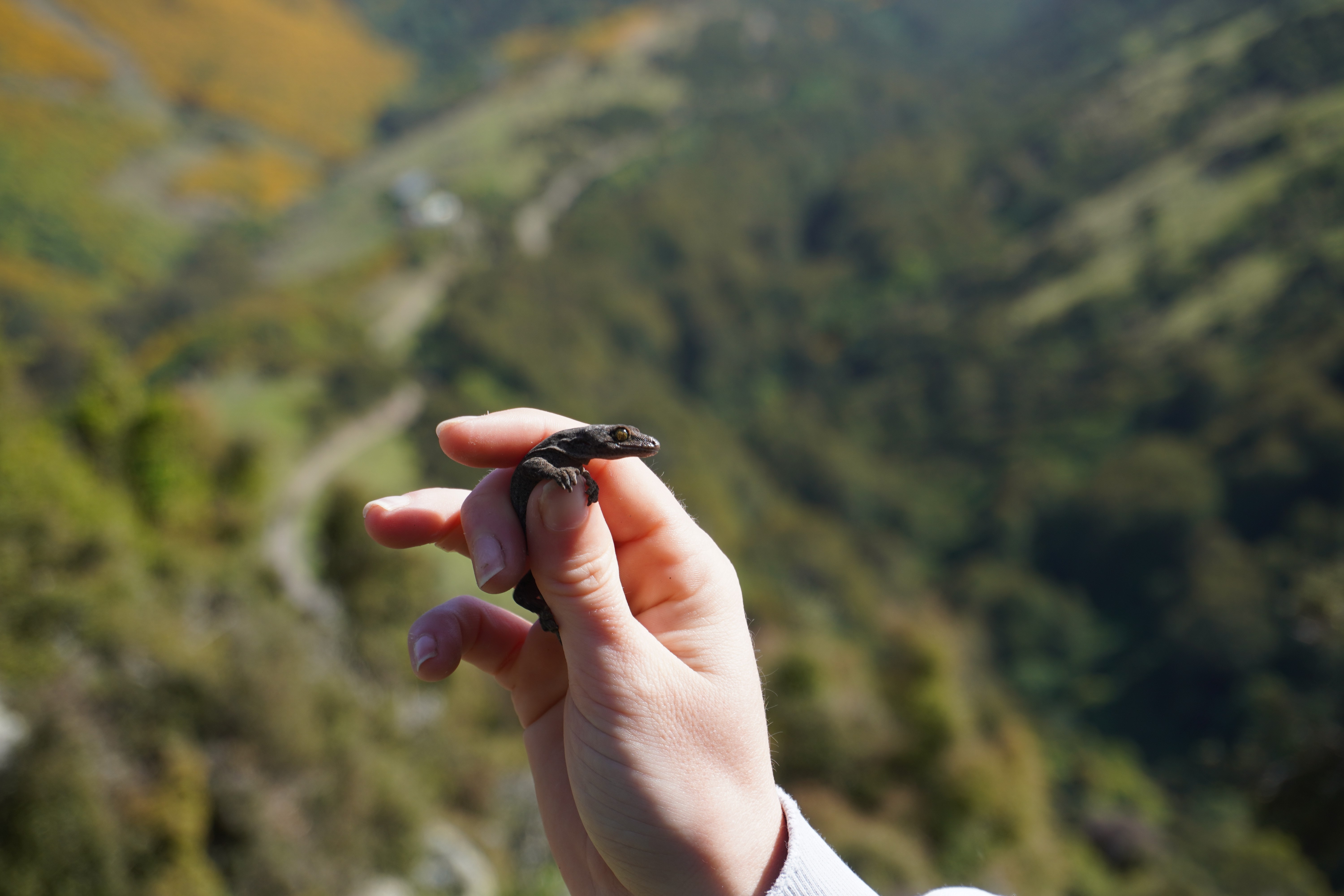
    Has your cat ever brought in a nice present only for you to find it’s a lizard? Have you seen a lizard scutling away on a nice sunny summer’s day while walking around the garden? Well, you may have lizards residing in your back yard!

    In New Zealand we have over 125 different lizard species, 76 are skinks and 48 are geckos, all but one one skink species is native. Of these 126 species, 49 (~36%) are Threatened and a further 67 (~50%) are At Risk (Hitchmough et al., 2021). Therefore 86% of our lizard species are threatened by various factors, such as predation, urbanisation, habitat fragmentation, and agricultural intensification.

    We all need to play our part to ensure that lizards do not continue to decline.

    There are simple tools we can use that can help the lizards in our back yard. Skinks love to hide under rocks and in small gaps when startled. Geckos love to live in tight crevices, like spaces in wood, stone and even in various human-made structures (e.g. power boxes and garages).

    We can create structures called Artificial Retreats (ARs) that mimic these natural retreats that lizards love so much. Artificial Retreats are a tool that we can easily implement that can support vulnerable lizards.

    Currently, artificial retreats have been designed for scientific monitoring and are commonly constructed from roof-cladding Onduline sheets, which isn’t an easily accessible or cheap material. My thesis investigated two other alternative designs that are constructed in a manner that is easily accessible to landowners and public members keen to do their part in lizard conservation.

    One AR type was constructed from a stack of three bricks (Figure 1) that have a 10 mm wooden dowel stuck between each layer so that the lizards can easily move between them.

    The second was constructed from two plywood sheets (Figure 2), bolted together, with the 10mm dowel in between the sheets.

    The third was the common Onduline design (Figure 3). I tested these ARs across Canterbury farms located at Cleardale Station in the Rakaia Gorge, as well as Flea Bay and Goughs Bay on Banks Peninsula.

    I captured 26 lizards to test in the three AR designs and there was no preference among the three. However, the geckos at Cleardale Station preferred some designs more than the Flea Bay lizards. At Flea Bay, the lizards were more commonly found in the brick (46%  of all geckos) whereas at Cleardale they didn’t use the brick ARs. At Cleardale Station, a equal number (17%) were found in both Onduline and wooden ARs. At Flea Bay, 17% lizards were captured and only 4% of lizards were found in the Onduline design at Flea Bay.

    Depending on the location of the property and the species of lizards present, there will be differences in which AR they prefer. Having an option of several different AR designs is preferable. 

    During the field trials I found that the ARs did not withstand heavy stock (cattle)interactions and were frequently interfered with. However, I did not have any problems with ARs placed in sheep paddocks.

    Landholders can implement any or all three of the designs into their property and all have a chance of lizard occupation. A variety of designs means that landholders can choose which AR design to use based on what available materials they have.

    Having a choice of AR designs make it accessible to whomever wants to conserve lizard species on their properties without having to spend large amounts of money or spending valuable time having to source the materials to construct the AR.

    Key design components and considerations when planning and building lizard ARs.

    • The ARs need to have at least one gap that has a 10mm gap.
    • Placed in an area where lizards or their poo have been seen.
    • Recommended not to be placed in a paddock in cattle.

    Acknowledgements: A massive thank you to the financial support for this project from The Brian Mason Trust and the North Canterbury Forest and Bird Trust.

    Reference

    Hitchmough, R., Barr, B., Knox, C., Lettink, M., Monks, J., Patterson, G., Reardon, J., van Winkel, D., Rolfe, J., & Michel, P. (2021). Conservation status of New Zealand reptiles, 2021.  

    Written by Sam Fitzgerald, a MSc student in the Department of Pest-management and Conservation at Lincoln University.

  • 500 not out!

    Recently, we ticked past the 500th article posted to EcoLincNZ. In many ways it is just a number, but it is sufficiently round to make me think about what we have achieved.

    Jon Sullivan and I put the original site together in 2008. Blogging was the new thing and we thought that it might be a great way of getting information out about the cool research being done at Lincoln University by the ecologists (and ecology adjacent researchers). Our aim was to provide biology school teachers with examples of cool ecology done here in New Zealand, as well as to build a resource to show to prospective postgrads about what types of research they could do.

    Sixteen years later, after a several of re-designs and shifts of providers, a couple of big earthquakes, and life in general, we have quietly and steadily kept accumulating articles. I quickly realised that Jon was going to handle the technical side and I would have to write the bulk of the articles. Currently, I have done about 220.

    A world cloud of the first 500 articles in EcoLincNZ. ‘New’ ‘Zealand’ ‘species’, not surprisingly, are ahead of the rest!

    The first article was on 29th July 2008. I posted on the different meanings of Gondwanan. I still like this one. It showcases a paper and makes a good point. Later that day (and probably for the only time) I posted a second article about how fairy penguins and little penguins are genetically distinct.

    The following year Jon and I had the idea that we would incorporate this writing into our Research Methods course and have the each postgraduate student produce an article about research done at Lincoln and uploading it to EcoLincNZ. The first article was by Phil Cochrane on May 15th, 2009 about hatching failures in native bird populations that suffer from inbreeding. We now have 183 of these postgrad projects.

    I think that this has been a good learning experience (not only do the students write their blogs in a series of drafts but they also provide feedback on each others’ articles). It also means that we have a wider variety of topics for EcoLincNZ as many of the students are not ecologists and will pick papers of more interest to them.

    In addition to the usual articles I started a Sandwalk series in 2010 where I have a cartoon of Darwin pacing his favourite walk and a reason why he may have taken so long to publish ‘The Origin of Species’ (well actually why he would have taken so long if he lived today). I have put out one or two a year since.

    This is what 16 years of blogging does to you!

    Another common theme is my interest in all things Tolkien. In 2014 I decided to write an article on how Tolkien had made me an evolutionary biologist. I drew some analogies and examples from Tolkien’s work to explain some points. That was fun and so I have continued with these types of articles till today.

    Some newer topics have started to build nicely: agroecology (30), community conservation (39), plant pathology and wine (40), soil (19), fire ecology (14) and threatened species (43).

    There are many common themes that we have talked about in our articles. As this is a blog written by the former Department of Ecology and now Department of Pest-management and Conservation there should be no surprise that Biodiversity is a theme of 117 (23%) of the articles, Conservation is a theme of 97 (19%), and Wildlife Management has 82 (16%).

    In terms of taxa, plant ecology has done well (65 articles) compared to bird ecology (29) and invertebrate ecology (40). My own areas have been well catered for: behaviour (67), species distributions (44), monitoring (48) and biogeography (17).

    After so many articles do I have any that I particularly like? I did like the two that I wrote about the value of our insect collection, especially as it was at a time when it was under threat of being closed (On the value of collections: pinning down the answer; On the value of bespoke collections: regional natural history collections are important too!).

    I enjoyed writing my Tolkien-flavoured articles. I also had fun with the article about Ursula le Guin’s Earthsea (A weevil of Earthsea: Finding the true name for the fourth beetle) as names are so important in this work and Earthsea is a bit New Zealand-like. My favourite title was The beetle that joined the stones about a beetle group that moved from living under bark into living in crevices on high mountains. Or maybe it was ‘Kate Bush and the smelly stoats‘ where I combine my love of the songs of the great singer with some recent mammal research?

    Where to from here?

    We haven’t really done this for the internet traffic. With a few changes in provider it makes it difficult to look at popular articles over the 16 years. Certainly traffic was higher in the early teens than it is now but we still get a steady stream of visits every day and articles from all eras are still read.

    The five most read over the last year or so are ‘Sitting on the Fence: Are Predator-Proof Fences a Solution to New Zealand’s Biodiversity Challenges?‘ (Dafna Gilnad, 2017), ‘Kawakawa, the ‘holey’ herb of Aotearoa‘ (Wendy Fox, 2021), ‘Why wasps and bees hover over cabbage plants’ (Wesis Pus, 2015), ‘I see you: Sauron and the panda‘ (Adrian Paterson, 2023), ‘Measuring the burn‘ (Adrian Paterson, 2016).

    Blogging declined worldwide in the 2020s as podcasting became more popular, but there seems to have been a mild blogging resurgence in 2024. So I think that we will keep on doing what we are doing. We tried a few podcasts in 2017/18 and this could be something to look at a little more. The online world continues to change. With AI around the corner it is not obvious what the value of these short articles will be in 5 years, perhaps worthless, perhaps really valuable.

    I guess as long as I enjoy writing the articles and we think that there is value in postgraduates writing this way, we will continue on. I wasn’t expecting to be doing this 16 years on. 500 has a nice ring to it. 1000 sounds even better!

    Adrian Paterson is a lecturer at Lincoln University and the Head of the Department of Pest-management and Conservation. He has interests in molecular biodiversity, conservation animal behaviour and biogeography. He quite likes writing these short articles about cool ecological science and his experiences.

  • And we’re back!

    As you may have noticed EcoLincNZ has been offline for the last three months. It seems that we were victims of a nasty hack that meant that we had to migrate and rebuild the site, over Christmas and the summer break.

    Jon Sullivan has been outstanding in getting virtually all of our material into the new site.

    It did make us ponder about whether we wanted to continue with our research blog, after all blogs are not as popular as they once were. However, we like this format and we have developed some good teaching/learning tasks around this kind of creative writing. And hopefully, dear reader, you obtain some value from what we do.

    So, EcoLincNZ is back and we look forward to providing more overviews of ecology-related research projects done by Lincoln University.