Category: bird ecology

  • Kiwi: now in 3D

    Kiwi: now in 3D

    ‘Coming soon in 3D!’ Periodically throughout my life movie-makers have dabbled with making films that we can watch in three dimensions. You would get your special glasses before the movie session and then sit there wondering when to put them on until the action got going.

    To be honest I don’t remember many of the movies that I saw like this. The Avatar movies have always had the option and I watched at least the second movie this way. Spears and monsters would lunge out of the screen at you.

    Other than that I am drawing a blank. This is not to say that every 3D movie is bad but just that 3D on its own doesn’t make a film more memorable.

    Avatar Adrian! Look out for the arrow!

    I don’t even dislike the experience despite having to wear the 3D glasses over my own glasses. There is something immersive about dodging things ‘coming out of the screen’. However, I seldom choose this option if 2D is available. It all seems a bit too much like work perhaps?

    Adding a third dimension can help with appreciating scale and movement though. It can also help with identifying who’s who in the screen – there’s just a bit more information that your brain can use.

    Identifying individuals is a big deal in biology, especially conservation. When you have a small population you are interested in individuals. How are they doing? Are they breeding? Who do they hang out with?

    Of course, for many species there are not a lot of features to differentiate between individuals. They are similar in height, uniform in coloration, and have similar behaviours.

    To make them more distinctive we could always band our target with bright colours or paint an obvious mark on them but this involves capturing and interacting with the individual. This causes a great deal of stress and catching individuals is not always simple.

    Ideally we could use cameras to take pictures that we could measure features in that are unique to an individual. Two dimensional pictures require an individual to be in an exact place with an exact orientation for this to work. So this is not a reliable method.

    Bit wait! … Coming soon in 3D!

    It turns out that if you take pictures with different devices from slightly different angles at the same moment then you can much more accurately calculate measurements on individuals. At least in theory.

    Jane Tansell with her trusty kiwi dog. Picture from Jane Tansell.

    Jane Tansell, a recently completed PhD student at Lincoln University, and her supervisors, Adrian Paterson and James Ross, set out to see if we could use this idea to identify kiwi. Kiwi populations and individuals are difficult to measure. They are nocturnal, usually found in scrubby terrain, are reasonably featureless, and spend a lot of time in burrows. We can use trained dogs to find them but this is quite stressful for kiwi. We can listen to their calls during the night but this is difficult to split into different individuals and certain parts of the population don’t call anyway.

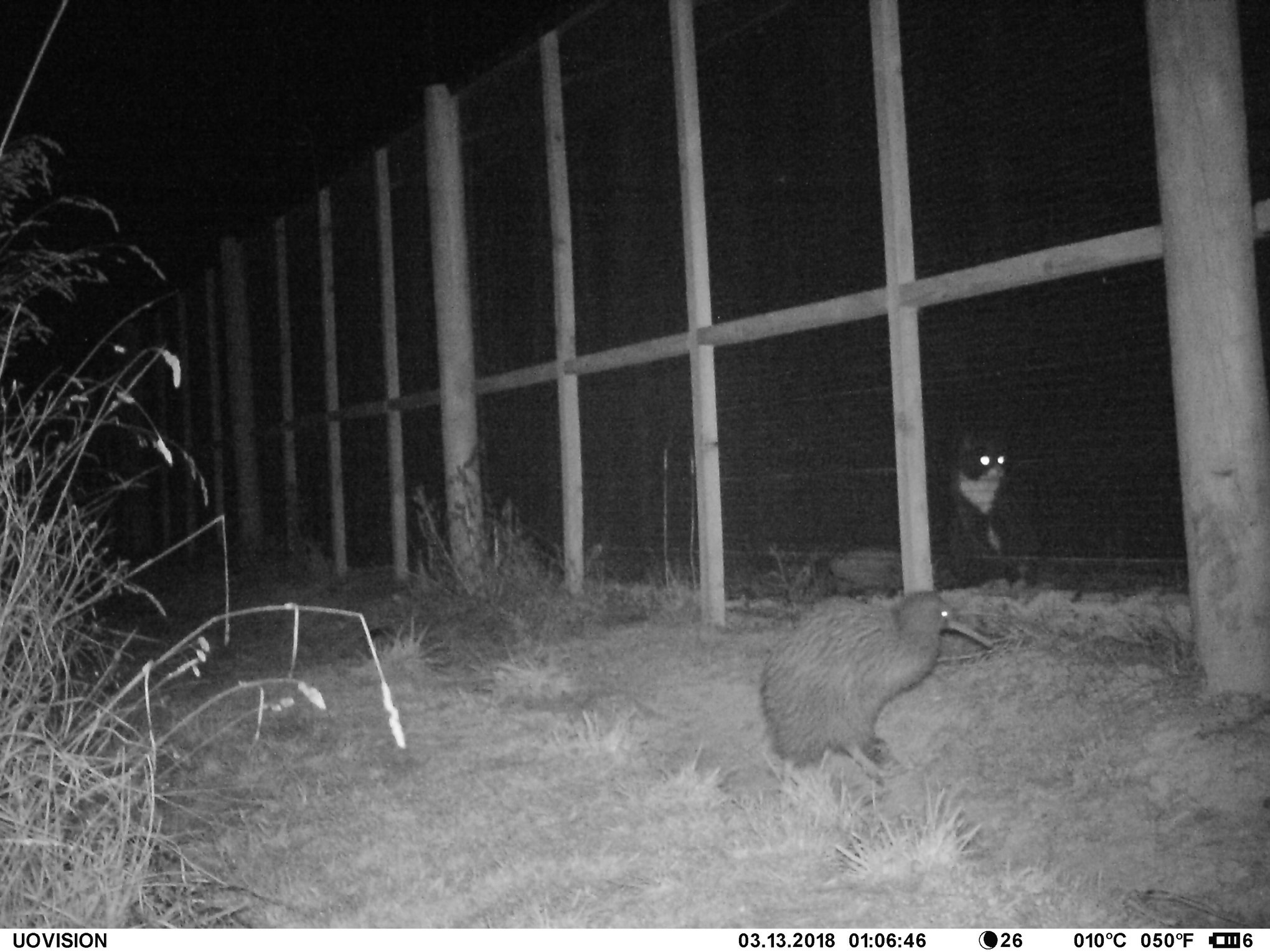
    Trail cameras have been used to successfully locate kiwi. Jane wondered if she could pair cameras 12-25 cm apart, taking images that could be used to essentially create a 3D image of features on each bird. Jane knew that kiwi bills vary between individuals and can be used as an ID.

    Jane worked with the more technically literate Maurice Kasprowsky and Tom Gray to cobble together the cameras and get them to work together.

    Jane, as reported in NZ Journal of Zoology, first tried the setup on a taxidermied kiwi in good light conditions. She found that the cameras could be used to measure the bills to within 1.5% of their actual length. This was a great achievement and would certainly be able to determine individuals.

    In theory we should be able to photograph kiwi and recognise them by measuring their bills. Image from Adrian Paterson.

    Jane then set up field trials with live kiwi. In the real world, with low light and moving birds the cameras were less efficient. At worst they were terrible but often they were within 3-4% of the actual bill length. This is not good enough to replace current field identification methods but it was still quite impressive given the relatively jury-rigged setup.

    Improvements in cameras, especially 3D cameras, are happening quite quickly. With some more trial and error Jane should be able to start reducing the error enough for this to be a viable noninvasive method for following kiwi in the field.

    While this is not as exciting as an arrow flying at you from an Avatar movie, this use of 3D does have real world uses that will help with understanding a national icon!

    The author, Adrian Paterson, is a lecturer in the Department of Pest-management and Conservation at Te Whare Wānaka o Aoraki Lincoln University. Adrian is a kiwi but unfortunately has no bill to measure.

  • The three bird-iteers: all for monitoring and monitoring for all!

    The three bird-iteers: all for monitoring and monitoring for all!

    My time at Lincoln University has taught me that when it comes to bird monitoring, the most common practice is the 5 minute bird count (5MBC). This method is a simple and effective way of counting birds within a specific area by recording sightings and calls. Much of the time, using 5BMC, it is likely that you will not see the bird you are hearing, which is why being able to identify New Zealand birds just by sound is a very good skill.

    Lincoln University legend Jon Sullivan did a study on different bird data collection methods that could also mahi together to build a more accurate picture of birds in an area. The study focused on wider Christchurch, beginning in 2003, and recorded patterns in bird species within the area.

    One method that was used was the stationary method , which is pretty much the same as the 5MBC but is extended to 20 minutes. The other method used was the ‘mobile method’, also known as the ‘line-transect method’, where you collect data while moving at a fast pace, perhaps by bike, car, or running.

    Now to the fun stuff – birds!!

    In Jon’s study there was a focus on three bird species, which I call the three bird-iteers (with apologies to Alexandre Dumas). These are the grey warbler, fantail and the bellbird. These endemic birds are very adaptable to recent changes for forest bird species.

    Grey Warbler

    The grey warbler (Gerygone igata, riroriro) are found throughout New Zealand. They are small, grey/brown with a more pale shade of grey for the face to throat. They weigh approximately 6.5 g (lighter than a mouse) and their diet consists of insects and spiders.

    Grey Warbler (Gerygone igata)

    Grey Warbler. Photo CC BY Mikullashbee, Flickr

    Fantail/pīwakawaka

    Fantails are one of my many favourite bird species, as they love to follow humans around when you are on bush walks. Fantails are able to adapt to environments that have been changed by humans, which is not very common for New Zealand native birds. Fantails (Rhipidura fuliginosa, piwakawaka) are often found in open native bush, exotic plantation forests, orchards and gardens. Their diet consists of insects, especially small species. Fantails are a small bird about the size of a house sparrow, but what makes them so distinctive? Well the answer is in their name…. Yes their tails, like their name suggests they have a long tail that fans out like a well a fan.

    Fantail

    Fantail. Photo CC By Chris S, Flickr

    Bellbird/ Korimako

    Bellbirds(Anthornis melanura, koromiko)are commonly found in the South Island. These birds have a short, curved beak and are green with a slightly forked tail. Bellbirds, similar to Tūī’, have a distinctive song, it is like a high ringing that’s also kind of smooth, and the repeat the same tune. Bellbirds reside throughout native and exotic forest, scrubs and shelter belts of New Zealand. Their diet is nectar from native and exotic plants, although they do consume fruit in late summer and autumn. Also their diet consists of honeydew that’s found on beech trees.

    Bellbird

    Bellbird. Photo CC By Glenda Rees, Flickr

    Back to the study

    Jon Sullivan wanted to understand how nature responds to a forever changing world. He collected distribution and abundance information for many species with these three species being the focus. This is where the methods came into play as a standardised method and a repeatable one is needed to accurately tell us if a species is present or not. The methods talked about above were to work alongside each other.

    Around 100,000 bird counts were collected. The approach used helped to summarise data that was from one location, a certain time each week, and one daily route. The results showed that this approach was effective and just as effective as the 5 minute bird count. Counting birds while riding your bike along a road was just as effective at estimating and following trends as more traditional methods.

    Fantails, grey warblers, and bellbirds (but not to the same extent as the other 2) are majorly restricted to their forest biotopes and native plantings, particularly in spring.

    Like any good study, more data are needed to get a better and clearer understanding. This could create a good opportunity at Lincoln University to teach students doing ecology to learn how to use different techniques besides just the 5MBC methods. Then we too can collect decades long information on our favourite birds.

    This article was prepared by postgraduate student Caitlan Christmas, Masters of Science in Ecology and Conservation, for an assignment in ECOL608 Research Methods in Ecology.

    Sullivan,JJ(2012). Recording birds in real time: a convenient method for frequent bird recording https://researcharchive.lincoln.ac.nz/server/api/core/bitstreams/04dc8df3-2e34-4fe9-96a6-ea8a505ad0cc/content

  • Wings of change: Protecting parrots where they belong

    Wings of change: Protecting parrots where they belong

    I had always wanted a parrot as a kid.

    My obsession was inspired by Meena, a Bangladeshi animated TV series created by UNICEF, where the protagonist, Meena, had a clever parrot named Mithu who could speak and even help with homework from school. In the very first episode, Meena wishes to go to school, but her parents don’t think it is worth educating a female, a sad reality in many Asian countries, even now.

    Determined to learn, Meena finds a creative solution: Mithu goes to class for her, memorising the lessons and teaching her later. Having grown up with this story and often seeing parrots caged in people’s houses, I had subconsciously believed that parrots were meant to be pets, friends to humans rather than untamed animals.

    That belief was shattered the first time I saw a flock of parrots flying freely in the jungle. As I saw them calling to one another, I came to see that they were more than simply colourful birds living in cages; they had families, friendships, and a world of their own.

    And then another surprising revelation struck me: Mithu wasn’t even a parrot; he was a parakeet! I discovered the distinction during my first birdwatching trip as an undergraduate. In that moment, I realised how early influences, particularly those from television, can shape, and sometimes mislead our views of the natural world.

    Indian Rose-Ringed Parakeet
    A caged rose-ringed parakeet © Geoff McKay / Flickr

    This memory came flooding back as I read about kea (Nestor notabilis), a playful and highly intelligent alpine parrot of New Zealand. Unlike the caged parakeets of Nepal, kea are renowned for their curious nature, a trait that has both fascinated and frustrated humans. Kea are unique among parrots. Their sharp intelligence and flexibility have allowed them to survive in the harsh alpine conditions of the South Island of New Zealand.

    Using observations in a plantation-native forest matrix, a team of researchers led by Aitken in 2023 conducted a study in the Whakatipu Kā Tuka (Dart-Rees Watershed) area and discovered that kea were commonly seen in plantation forests. These birds, although strongly associated with alpine and native forest habitats, spent a surprising amount of time in exotic plantation woods, probably because these managed landscapes offered new foraging options.

    Aitken also tracked individual kea and mapped their home range and habitat use using VHF (Very High Frequency) radio transmitters that were attached to three individuals as lightweight backpacks. This method confirmed the keas’ active usage of plantation forests, not only for foraging but also as part of their usual range, and helped to better understand how they navigate various settings over time.

    This kind of fine-scale tracking is relatively new for kea and adds an important layer to our understanding of their behaviour in human-modified landscapes. However, it is worth noting that catching wild kea for such work is not a small feat – thanks to their sharp beaks and mischievous personalities!

    Kea
    A kea in its natural habitat CC BY-NC-SA 2.0 fremat/Flickr

    Kea are opportunistic omnivores that consume a wide variety of foods, ranging from seeds, native fruits, nectar, to even meat from dead animals. Jodanne Aitken, a PhD student at Lincoln University, found that although kea frequently fed on seeds from Pinus radiata trees in plantation forests, their poop told a fuller story. The faeces was full of insects and other invertebrates, showing just how flexible and opportunistic their diet really is. In plantation forests, they take advantage of exotic tree species and the insects that come with them.

    In contrast to many birds that avoid human-dominated landscapes, kea seem to do OK in them; curious and always eager to explore.The study also found that kea were more active in the morning and that their behavior changes with seasons, possibly linked to food availability or breeding. What’s truly fascinating is how their sharp intelligence allows them to survive not just in harsh alpine conditions, but also learn how to make the most out of new environments, like the pine plantations.

    Jodanne in action detecting kea. Image by Adrian Paterson

    Just like Mithu, the parakeet from my childhood who memorized lessons for Meena, kea are constantly learning from their surroundings. It is this intelligence, combined with their bold and exploratory nature that makes them such incredible survivors.

    While plantation forests provide new foraging grounds, they may also expose kea to new threats. This raises a vital question: are we simply giving kea new places to forage, or are we asking them to survive in habitats that may not fully meet their needs? Human-modified landscapes, while rich in opportunity, also bring risks such as increased exposure to toxins like lead or conflict with people. These findings offer hope for kea resilience in human-altered habitats, while also informing future forest management practices.

    On the other hand, the parakeets of Nepal, such as the Alexandrine and Rose-ringed parakeets, are often kept as pets, and their social skills and intellect are used for human entertainment rather than for their survival. The thought of birds with such intricate habits and close social ties being denied their natural life saddens me.

    Wild parakeets form large flocks, communicating and interacting in their own ways across wide-ranging Himalayan landscapes. Unfortunately, they face growing threats from habitat loss due to urban expansion, deforestation and especially the illegal pet trade. In fact, both Alexandrine and Rose-ringed parakeets are among the most commonly trapped and sold birds in south Asia. Without stronger awareness and conservation action, their role as seed dispersers and forest connectors may be lost.

    While it is heartbreaking to see parakeets in cages, it is crucial to remember that simply releasing pet birds into the wild isn’t the solution. Doing so can introduce diseases to native bird populations or create invasive species that disrupt ecosystems, as has happened in parts of the world where feral parrot colonies now compete with native wildlife. The real solution is prevention: parrots should never be taken from the wild in the first place. Instead, our focus should be on protecting their habitats and fostering respect for their role in nature.

    What if we saw Nepal’s parakeets not as possessions but as individuals with a right to freedom? Kea, despite facing habitat loss and human-wildlife conflicts, still roam wild, adapting to changing landscapes. Their ability to explore, learn, and interact with their environment is a reminder of what many of Nepal’s parakeets have lost.

    An AI generated image of Nepal’s parakeet and New Zealand’s kea in their natural habitat © OpenAI

    Kea’s willingness to venture into plantation forests for sustenance demonstrates their adaptability, but they are not immune to human pressures. Habitat changes, exposure to toxins, and climate change are pushing their predators higher into alpine zones, creating new challenges for their survival.

    Meanwhile parakeets in Nepal often face shrinking natural habitats with fewer options for survival. While kea find new ways to navigate a changing world, Nepal’s parakeets are being held back by cages or by degraded ecosystems. If we could foster the same appreciation for the natural behaviors of our own native birds, perhaps we could shift away from the practice of caging them and towards efforts that protect their wild populations.

    Kea are naughty, sometimes destructive, but ultimately, they are wild; free to roam and explore. Nepal’s parakeets deserve the same fate. Instead of keeping them as pets, we should prioritize protecting their habitats, enabling them to play and be curious in the Himalayan forests of Nepal. The lesson is clear: birds, whether in Nepal or New Zealand, belong in the sky, not behind bars.

    This article was prepared by Master of Science student Naresh Shrestha as part of the ECOL608 Research Methods in Ecology course.

    Read full research article here:
    Aitken, J., Paterson, A., Ross, J., Orr-Walker, T., & Young, L. (2023). A preliminary study of kea (Nestor notabilis) habitat use and diet in plantation forests of Nelson, New Zealand. New Zealand Journal of Zoology. https://doi.org/10.1080/03014223.2023.2251904

  • Keeping up with the Kiwis: Translocations and their forever holiday homes

    Keeping up with the Kiwis: Translocations and their forever holiday homes

    New Zealanders, also known as the ‘kiwis’, are known for tramping up great mountains, and travelling around the globe. For the actual kiwi bird, their adventures are limited to islands and protected environments. Even our New Zealand mascot, Goldie the kiwi, manages to ‘fly’ all around the world, which I’m sure would make the national birds jealous.

    That’s not to say that actual kiwi don’t get around. Our national icon is the most translocated bird in New Zealand. We have been translocating kiwi since not long after the Treaty of Waitangi (1840) due to predation and habitat loss, often with limited success. When we try our hardest to save populations through transfers, most or all birds die. So, we created protected (fenced) sanctuaries that allow a safe environment for kiwi and other native species to thrive. But after decades of conservation work and relocating kiwis out of their homes to a safer habitat, are they truly happy in their new homes?

    Fenced Sanctuary – Zealandia. Image by Russellstreet

    Methods for successful translocations have been developed. Methods, including the introduction of Operation Nest Egg (ONE), allows the hatching chicks to become mature before releasing into the wild. These methods has required the involvement of community groups, iwi and hapū. However… there are no resources that include information from past kiwi translocations, so we don’t know the past outcomes, whether they were effective, or how to improve them — which is wild!

    Researchers at Lincoln University, Peter Jahn and James Ross, and other colleagues reviewed 102 kiwi translocation projects (mainly from the last four decades — older information having been lost or ‘poorly documented’), and they examined the mitigation translocations and rehabilitation releases. But how do you define a ‘successful’ translocation?

    We can’t assume that if we release birds into a new environment that everything will magically lead to success. We must investigate if the kiwi population can settle in, grow in numbers and maintain a healthy balance on their own for it to succeed long-term. The primary goal of translocations is to “establish or restore a population with a high probability of persistence”. Unfortunately, kiwi behaviours have made it hard to grow a population, as they are irregular breeders and take several years to reach sexual maturity.

    To address this, objectives were set for releases:

    • To grow all kiwi populations by at least 2% per year.
    • To sustain genetic diversity, each translocation will have at least 40 unrelated individuals released (a ‘founder population’).
    • A minimum timeframe of 15 years is required for the population to grow (and adapt to its new environment).

    By collecting data and analysing the translocation trends over the decades, we can better understand how different projects affect the survival of kiwi taxa.

    Stewart Island Brown Kiwi (Tokoeka). Image by Jake Osborne

    Since 1863, there have been 102 translocations, with an impressive 76 kiwi translocations just in the last 20 years. Translocated kiwi species included: Rowi, Great Spotted Kiwi, Little Spotted Kiwi, Tokoeka, and Brown Kiwi. Most of the release sites (63% since the 1860s) were in the North Island or on offshore islands (sorry Lincoln — too much farmland). However, 20 of these projects’ reports do not exist or are unavailable. But here’s what is fascinating… just over half of the translocations (58%) introduced kiwi taxa where they were not seen before (a giant leap of ‘kiwi-kind’)!

    In the past, effects to reduce harm for the kiwi were deemed as an ‘emergency’ to secure populations. Recent translocations cited ecological restoration and supporting kiwi taxa across different areas as a priority (which supports natural differences, and resilience – perfect for long-term conservation outcomes)!

    Unfortunately, not all kiwi species have received the same level of attention. Those with more attention are spoilt with support (more management) and obtain an improvement in their conservation status. Other kiwi species are not as lucky, such as the Great Spotted Kiwi, Fiordland Tokoeka and Rakiura Tokoeka, as their conservation status has worsened. So even though translocation effort aims for an improvement in kiwi populations, other factors, such as population sizes and lack of predator control, make this already difficult job… even more challenging.

    If you look at past scientific literature on initial survival of released birds, these translocations will be reported as ‘successful’, which seems good, right? But are they ‘self-sustaining populations’? Only one project (Zealandia) has been considered as ‘successful’ due to having an increased population. Even worse…. there is little information on the genetic make-up of the new population (which defeats the purpose of becoming a long-term project).

    Little Spotted kiwi at Zealandia. Image by Kimberley Collins

    For future translocations, the number of releases should be adjusted (by changing the total number kiwi released in a specific area) depending on the situation — for example, when there is a low founder population, or a high mortality rate. If a population is not looked after, this can result in reduced fitness and genetic variability. Having a database that holds the records of all the kiwi translocations would make it easier to analyse the factors that could influence kiwi populations.

    So, what does the future hold for kiwi translocations? The main recovery goal, which was “restoring former distributions of all kiwi taxa”, has shown an increase in populations through translocations. Translocations have created new populations on islands, which can “fill in the gaps” in nature, which is a huge win! Guidelines suggest releasing 40 kiwi into a new population and that they are not related to the ‘founder population’ (this number can vary depending on specific factors to maintain high diversity).

    As translocations start from newly established populations, it’s only through time that we will see if kiwi populations can further grow and maintain sufficient genetic diversity.

    This article was prepared by Master of Science student Jessica Przychodzko as part of the ECOL608 Research Methods in Ecology course.

    Jahn, P., Fernando Cagua E., Molles, L. E., Ross, J. G., & Germano, J .M. (2022). Kiwi translocation review: are we releasing enough birds and to the right places? New Zealand Journal of Ecology, 46(1): 3454. https://dx.doi.org/10.20417/nzjecol.46.1

  • Invasive predators may alter the personalities of New Zealand’s native birds

    • A recent study published in the New Zealand Journal of Zoology suggests that introduced invasive mammalian predators are changing the personalities of native birds.
    • Researchers compared two populations of kakaruai/South Island robins in similar forest habitats, one from the predator free island of Motuara and one from the main island, where introduced predators are present.
    • In the experiment, robins from the main island were more shy and less bold when they could pick up presented food items close to the researchers.
    • This suggests that a selection pressure from introduced predators favours individuals that are less bold and more cautious, potentially shifting personality traits of individuals in populations under predation pressure in the long term.
    Petroica australis. (C) Copyright Maximilian Hanschmann - all rights reserved.
    Petroica australis in the Hawdon Valley (Arthur’s Pass). (C) Copyright Maximilian Hanschmann – all rights reserved.

    New Zealand’s robins are well known for their curiosity driven behaviour, but they are at risk and the populations are declining.

    The small birds only weigh 35g and can survive up to 17 years – given that they are safe from invasive predators.

    While still occurring on the main islands and doing better than many other species endemic to New Zealand, that evolved in the absence of any mammalian predators, the robins struggle to survive since several predatory mammal species have been introduced to New Zealand by humans.

    During their evolutionary history in New Zealand, the birds never needed to coexist with these predators and as such act in a naive way towards them, making them an easy prey for ship rats, possums, stoats, weasels and feral cats.

    Introduced predators are a big problem for robins, even if populations survived until now, they are struggling where predators are present, a fate they share with almost all remaining native bird species. Predators will prey on eggs, nestlings, fledglings and adult females in the nest, leading to skewed sex ratios, where there are many more males than females in the population. The risk of nest predation is seven times higher where mammalian predators are present, and the life expectancy of adult birds is reduced by roughly 75% compared with areas free of predatory mammals.

    Petroica australis on the West Coast of South Island. (C) Copyright Maximilian Hanschmann – all rights reserved.

    In a recent study published in the New Zealand Journal of Zoology, researchers looked at different populations of the kakaruai/South Island robin (Petroica australis) to assess the impact of mammalian predators on their behaviour.

    Individuals in two different populations, living in a similar native (kanuka Kunzea ericoides dominated) forest habitat but with a different exposure to introduced mammalian predators, were studied. One population lives on the predator free island sanctuary of Motuara and originates from a population that was never under the influence of mammalian predators, except for rats. The other population lives in two connected patches on mainland New Zealand, close to Kaikoura and is exposed to mammalian predators present at the site, including feral cats, stoats, ferrets, weasels, rats, mice and possums.

    The aim was to assess the boldness of the robins or the willingness to take risks, which can vary among individuals within a species and can be influenced by environmental factors.

    A robin in Nina Valley. Image from Adrian Paterson

    To assess the propensity to take risks (known as the ‘shyness-boldness’ continuum) of the birds, mealworms were presented as food items at different distances to the researchers (proximity as a risk). It was then noted how long a bird took to pick the first item up (approach time) and how long a bird took to pick up all the food items (handling time). The quicker the bird approached and the more time it spent close to humans, the bolder it was considered.

    The results showed that robins not under influence of predators had a significantly bolder personality. They were much more likely to quickly come as close as 30cm to the researchers and spent more time handling the food as robins that live on the mainland, under the predation pressure of various introduced mammals.

    These findings suggest an evolutionary selection pressure against bold individuals in the robin populations that are exposed to introduced predators. The predation risk has the potential to select for certain personality traits that correlate with reduced predation risk, favouring shyer birds.

    The findings highlight the big impact of introduced predators, influencing the behaviour and possibly evolutionary outcomes. Individuals that are more cautious around predators are less likely to get killed and have a greater chance to have more offspring, promoting their personality traits in the next generations. These effects are likely not limited to robins, but likely also apply to other struggling native bird species that survived until now.

    The researchers also point out the importance of considering behaviour in conservation actions, as shy individuals should be chosen for reintroduction or supplementation programs in areas where predators are present, to increase the chance of survival.

    Robin and trail camera in Nina Valley. Image from Adrian Paterson.

    What you can do:

    • Spread the word! Talk with other people about biodiversity issues and how to solve them.
    • Value the unique native ecosystem of New Zealand and its vulnerable species.
    • Promote no-go areas where birds breed and in core areas of vulnerable ecosystems.
    • Lobby for better regulations and environmental standards.
    • Use your vote in elections to support the effort to safe New Zealand’s unique, but highly endangered biodiversity.
    • Control predators on your property. Help others controlling predators.
    • Plant native plants from your region. Remove non-native plants, even if they are “pretty”.
    • Participate in citizen science (e.g. iNaturalist) and help to detect various species.
    • Be a responsible cat owner: cats should be microchipped, registered and unable to reproduce uncontrolled. Consider walking your cat on a leash or ensure it can’t leave your property. New Zealand’s native species are exceptionally vulnerable to predation! Feral populations are not only a huge issue for non-adapted, vulnerable species, but also an animal welfare problem for the feral cats.
    • Be a responsible dog owner: dogs should be microchipped, registered and unable to reproduce uncontrolled. Walking your dog on a leash reduces the negative impact on wildlife. Dogs are among the gravest threats for adult kiwi, as they can kill a kiwi by just giving it a playful push (kiwis don’t have a sternum and are incredibly vulnerable). Ensure the dog can’t leave your presence.

    This article was prepared by Master of International Nature Conservation student Maximilian Hanschmann as part of the ECOL608 Research Methods in Ecology course.

    Read the full study here:
    White, R., Rossignaud, L., & Briskie, J. V. (2023). The bold bird gets the worm? Behavioural differences of South Island robins (Petroica australis) in relation to differing predation risk. New Zealand Journal of Zoology, 51(2), 334–349. https://doi.org/10.1080/03014223.2023.2255165

  • When grapes lead to war

    Would you steal a loaf of bread to feed your hungry family? Fair enough. What about a couple of grapes to save yourself the misery of wasting nine dollars on sour fruit?

    Grapes, waiting to be sampled.
    © Colin Jensen

    “Try ‘em before I buy ‘em,” is my dad’s usual response to that question, as he pops grapes from three different bags one-by-one into his mouth. A red one here, a green one there, maybe even a dark purple if the season is right. In spite of earnest pleadings from embarrassed children and grocery store placards, there would be no purchase of grapes unless a thorough investigation of both quality and taste had been completed. 

    As weird as it may sound, it turns out my dad is not alone in his grocery store grape grabbing. A quick google search yields numerous articles, blogs, polls and debates on the topic. A more recent article used an extensively rigorous survey of 40 people on Facebook to tackle the question, with results showing that half of respondents advocated for, and actively participated in, grape sampling while shopping. As for the other half? Some seemed to side with this NZ Herald article which refers to grape samplers as both thieves and stealers, while others suggested that this type of behaviour is a “hanging offense”. As a conservation biologist, I am not typically one for philosophical debates, so I’ll leave the ethics of grape sampling and capital punishment up for you to decide. 

    Unfortunately, a jump back into the conservation sphere does not make me immune to grape stealing dramatics. As it turns out, nature, just like the produce aisle of my parent’s local grocery store, is home to its own collection of fruity felons. Among those felons is the European starling. You may know starlings for their incredible vocal range, beautiful coloration, or the massive flocks (or mumurations) they sometimes form (check them out if you haven’t). But to winemakers in New Zealand, starlings may be more well-known for being “vicious” and “wasters of fruit.” Unfortunately the problem that starlings cause in vineyards is nothing new, and in fact, it was this very problem that was the inspiration for research at Lincoln University over 20 years ago. 

    European Starling CC courtesy of Eric Ellingson on Flickr

    Flashback to 1999 – Napster is in its heyday, Brittney Spears’ “Baby One More Time” is on the radio, and, besides a little bit of Y2K hysteria, life is good. Amidst the excitement of a new millennia, researchers Yuki Fukuda, Graham Hickling, and Chris Frampton from Lincoln University were hard at work trying to solve the problem of the grape stealing starlings. To do so, they tested out two devices designed specifically for scaring birds away from agriculture areas – the Peaceful Pyramid and eye-spot balloons. The Peaceful Pyramid, as the name suggests, was meant to be a “peaceful” alternative to other more aggressive bird deterrents like “noisy gas guns”. It featured a rotating pyramid with mirrored sides, which would reflect rays of sunlight towards incoming birds. The goal was to overload the birds vision to the point that they would no longer have the desire to land and feed. The eyespot balloon was a large balloon with yellow and black patterning designed to mimic the eyes of a large predator. 

    Peaceful Pyramid
    © Great Expectations

    Both devices were tested at a vineyard in Dunsandel, and at the University vineyard here in Lincoln. Although both were found to scare starlings away from the grapes initially, within a few days almost all the birds had become habituated to both scarers, and they quickly became ineffective. Ultimately, it was determined that both the eyespot balloon and the Peaceful Pyramid were not practical methods for protecting vineyards. Although these researchers did not find a solution to counteract the stealing starlings, they at least helped re-affirm the idea that anti-bird measures need to be thoroughly tested before they are trusted for protection. 

    In the 24 years since the research at Lincoln was done, there has been no shortage of innovation and testing of bird scaring devices. There has also been some work (here and here) on what birds are doing in the vine-yards. Among the myriad of devices tested, we have seen air cannons, chemical repellents, introduced falcons, large-scale netting, and a few of my favourites, the sci-fi sounding laser scarecrow (unfortunately, this doesn’t look as cool as it sounds), and the RobotFalcon (fortunately, this does look as cool as it sounds). 

    All of these projects have had the same goal: deter birds from pillaging in agricultural settings. Unfortunately, despite each of these ideas producing some level of protection, they all come with limitations. One is too expensive, another is too time and labour intensive, and some only work in good weather. For many, it seems as if finding a fix-all solution to the crop stealing problem is a fruitless endeavour. If it’s not the Peaceful Pyramid, and it’s not the laser scarecrow, then really what more can we do? 

    Well, researchers from the University of Sydney think that they have finally found the answer. (If you have been surprised by any of the bird scaring techniques already described, you may want to sit down for what comes next). Like something out of a Stanley Kubrick film, these researchers have employed techniques that they can only describe as “psychological warfare.” 

    The weapons of war used in this study consist of a stuffed bird attached to a drone (UAV), which is flown through the vineyard whilst playing recorded distress calls of pest birds from a loudspeaker (see image below). The idea is that visual and auditory stimuli on their own are not effective long-term. By tapping into the birds psychology through visual (dead bird) and audio (distress call) cues, they might be able to trigger the birds anti-predator behaviour, and keep them away for good.

    Early results show that crop damage in areas patrolled by this flying fearmongerer are up to four times less than areas which used visual scarers alone. It also appears that this system is just as effective as large-scale netting (currently the most effective way to protect grapes), but is much more cost effective. While these results are preliminary, and further testing is still needed, it seems that hope may be flying (and screaming) in on the horizon. 

    © Zihao Wong – UAV bird scarer as used in: Psychological warfare in vineyard: Using drones and bird psychology to control bird damage to wine grapes

    So there you have it. Starting with a couple of grapes at the grocery store, we end with a weapon of war designed to create fear and confusion. While we may not be any closer to answering the debate about grocery store grape sampling, we at least seem closer to solving the grape stealing starling situation. Will psychological warfare finally be the fix-all solution? Perhaps, but only time (and research) will tell. 

    As for me, I still don’t quite understand what it is about grapes that causes both the starlings and my dad to lose all sense of self-control. Maybe with 24 more years of research, innovation and whatever military tactic comes after psychological warfare, we will finally find that out. I am sure it will be a wild ride. 

    This article was prepared by Master of International Nature Conservation student Colin Jensen as part of the ECOL608 Research Methods in Ecology course.

    Citation: Y. Fukuda , C. M. Frampton & G. J. Hickling (2008) Evaluation of two visual birdscarers, the Peaceful Pyramid® and an eye‐spot balloon, in two vineyards, New Zealand Journal of Zoology, 35:3, 217-224, DOI: 10.1080/03014220809510117

  • Kea pine for a new home?

    Kea, our smart alpine parrots, are sometimes a little too clever for their own good. They are a species struggling to maintain large and healthy populations. Part of their problem is that they are very curious and seem to be fascinated by what humans do, and more importantly, often live in human-influenced habitat. This is not such a good trait when it leads them to interact with hazards like lead or toxins, nor is it useful if they find human ‘junk’ food.

    This curiosity is also not helpful when we want to study kea. Many of the approaches that work with other bird species just fail for kea. Instead of going about their business they come and see what you are doing, and that’s not great for understanding key aspects of their life histories.

    Spot the kea at the top of the tree! Image by Adrian Paterson.

    I has some first-hand experience with researching kea about twenty five years ago, when I was a newly minted Lincoln University lecturer. I was helping Kerry-Jayne Wilson to supervise a masters student, Mark Jarratt. Mark was interested in how much lead, and other nasty waste, the kea were finding in the local Arthur’s Pass area, and consuming, in their habitat. For example, lead was present in paints, shotgun pellets and rubbish in the tips and kea were often observed eating it.

    Mark had to catch kea to take blood samples to check for lead contamination. Catching kea can be fairly challenging. They are not easily fooled and they can learn by observing others. Adding to the difficulty was that we had to keep the birds in captivity for an hour or so as part of the procedure. And this was a problem.

    We initially used a cage. We would capture a kea, put it in a holding cage, and then go and try and capture the next one. However, each kea would often figure out how to escape the cage. We would return to find a cage open and our patient free (and not likely to be so easily caught again). So then we took the cage with a kea into a small hut nearby, thinking that if the bird got out of the cage then they would at least be in the hut. Unfortunately, some of the kea managed to figure out how to open the windows in the hut. Moral: don’t work with animals smarter than you are!

    So, when PhD student Jodanne Aitken came to James Ross and me and wanted to do a project on kea, I was a little hesitant. However, Jodanne is nothing if not persistent, passionate and persuasive, and a project on kea was begun.

    Early morning in the plantation. The native forest in the distance was often commuted to and from by kea. Image by Adrian Paterson.

    Jodanne was interested in how kea move about and utilise the landscape. Much of her PhD work is in the Southern Alps around Arthur’s Pass, where she is using transmitters to figure out just how mobile kea can be. Is that kea you see gnawing your car wiper blades from the local valley or could it be from several mountain ranges away? More on that in future EcoLincNZ articles!

    Jodanne’s initial work was in looking at how kea might be using plantations of introduced pine and Douglas fir in the Nelson region. Forestry has become a dominant part of many regional landscapes, often hilly and where native forests once grew (and kea once flew). This is especially the case in the Nelson region. The question that Jodanne wanted to answer was whether these forestry plantations, typically monocultures with a lot of human activity, provide a net gain or loss for kea.

    Jodanne filming kea foraging behaviour. Image by Adrian Paterson.

    Are plantations the equivalent of barren wastes for kea, where there is little food and high densities of mammalian predators (not to mention hazards that humans introduce into an area)? Alternatively, do plantations offer new food resources and places to roost and nest? Of course there could be a range of outcomes from positive to negative.

    Jodanne was able to work in forestry blocks run by Nelson Forestry Limited. Local workers were key to providing Jodanne with almost real-time information on kea presence within blocks that were being actively harvested. One advantage of working in plantations were the forestry roads that gave rapid, if a little hair-raising, access to most of these areas.

    Jodanne was able to capture three kea and mount GPS trackers in fancy backpacks to collect movement data. She also observed kea during the morning and late afternoon-early evening periods for several months, mostly to record their feeding. Jodanne used direct and video observations to observe their foraging. Kea poo was also collected when available to get some physical information about diet.

    The kea with transmitters spread their time between the plantation areas and neighbouring native forest. The majority of time was spent in the pines where they foraged, roosted and nested. Kea were observed eating pine seed, as well as tissue stripped off newly harvested Douglas fir logs. The faecal samples, well the bits that could be identified, contained lots of invertebrates.

    Kea have discovered that they can strip the bark of newly harvested logs, scrape off the cambion tissue, chew this and get something nice out of it. (Maybe a bit like eating sweets?) This may be one of the attractions of being in plantations. Image by Adrian Paterson.

    In short, as summarised in a NZ Journal of Zoology paper, kea seemed to be using the pine plantations in similar ways to more natural areas. Good news! However, one of three kea that carried a GPS recorder was killed by a cat. So, there may be some significant risks for kea spending a lot of their time in these areas. ‘Swings and roundabouts’ as they say.

    Despite this being a relatively small scale study, it does indicate that we could learn a lot more about kea in these highly modified landscapes. Jodanne has taken this training and shifted her sights to a much larger scale project on kea movement in the Southern Alps and southern Westland.

    Kea are one of the smartest bird species on the planet but they still need our help to let them survive the arrival of the smartest mammal species and the changes that we have made. Understanding this clever species is fundamental to helping them. This tricky challenge has been accepted by Jodanne and her research colleagues.

    Article by Adrian Paterson, an Associate Professor in the Department of Pest-management and Conservation at Lincoln University.

  • Kiwi calling: when listening is not enough

    I don’t know about your’s, but my mum gets worried when I don’t respond to her phone calls for a few hours. Once, I can’t remember what I was doing, but I didn’t hear the phone ringing. When I finally checked my phone I saw about 17483 missed calls, oops. I can only wonder what went through her mind when I wasn’t responding: she was probably picturing me skydiving, in an ambulance, or lost in the woods during a hike.

    But what if she’d had a more statistical mindset and thought about why I hadn’t responded? Or even better: what if she’d thought about reasons why she could not detect me?

    Ecologists and conservationists consider something similar when analysing data obtained from searching an area for a certain animal species. An animal could be present at a certain site, but still go undetected. First, they have to consider what ecological reasons might have determined where the species was present or absent (for instance, where is there suitable habitat within the considered area). Second, they have to take into account what factors might have influenced the likelihood of actually observing the species (such as the distance from the observer, or the fact that the surveyor may not be skilled enough to recognise the species). These are defined, respectively, as occupancy (which is the same as saying “presence”) and detection probabilities, and can be estimated by using statistical models.

    Occupancy probability and detection probability are described by two different models and both of them will influence what will be observed during a survey. Taking into account that not all the animals will be observed is very important when attempting to accurately assess a species’ presence, which could otherwise be underestimated.

    A young roroa being released as part of the Operation Nest Egg programme. Image by Jon Sullivan on Flickr.

    Peter Jahn, James Ross, Darryl MacKenzie and Laura Molles, in a study published in 2022, wanted to know how accurate acoustic surveys of roroa-great spotted kiwi (Apteryx maxima) were between 2011-2015. During this time, 18 birds were translocated from the Hawdon Valley, in Arthur’s Pass National Park, to the Nina Valley, in Lake Sumner Forest Park, representing one of the initial efforts of the Operation Nest Egg programme. The researchers also wanted to compare kiwi presence before and after 2015, and between the two areas.

    They gathered data from a survey conducted in 2012-2013 by DOC in both the valleys and then repeated the methodology in 2017-2018. The technique they used was passive acoustic monitoring (PAM). PAM is effective when studying elusive species such as kiwi. Automatic recorders were deployed in the two study areas and left there for up to three weeks, activating just before sunset and switching off shortly after sunrise.

    The team analysed the kiwi calls recorded in each of the valleys. The goal was to find a model that would best describe the obtained data, and use it as a base to estimate occupancy and detection probability. Peter Jahn and colleagues wanted to know which factors were important in detecting the kiwi and looked at the study area (Nina and Hawdon Valleys), year, length of the survey night, breeding/non-breeding season, precipitation, wind speed, night length, varying recorder battery capacity.

    Similarly, my mum could have considered the fact that my phone may have been in silent mode, or had no service, or estimated the actual likelihood of me being in an ambulance. All of these factors could have influenced her imperfect detection of me.

    In both the study areas, the detection probability was found to be higher during the breeding season, to increase with longer survey nights and to be influenced by wind speed, rain accumulation and recorder sensitivity. Also, as expected, kiwi presence in the Nina Valley increased after the translocation, as it did in the Hawdon Valley. Moreover, it was found that the number of sites where kiwi calls were recorded increased in 2017-2018 in both the areas and that, in total, many more calls were detected in the Hawdon Valley than in the Nina Valley.

    The Hawdon Valley in Arthur’s Pass National Park. Image CC-BY-NC by Jon Sullivan on Flickr.

    Wait, the number of sites where calls were recorded and the presence of kiwi increased in the Hawdon Valley after kiwi were removed from there? How is that possible? Yeah, that was one surprising finding of the study. In fact, the researchers were expecting that occupancy would decrease after the birds’ removal, but what they found actually suggests that new pairs re-occupied the territories left inhabited by the translocated individuals.

    This is a promising result, because it means that such conservation strategy doesn’t necessarily negatively influence the population from which the individuals are taken. Also, the ongoing pest mammal control in the Hawdon Valley could have balanced the negative effect of the translocation. I guess the only thing left to do now is find out what makes kiwi desire those territories so much that they can’t stay away: maybe they have the most delicious earthworms of New Zealand?

    To conclude, these findings demonstrate that the species is reacting well to this reintroduction programme, considered that kiwi presence increased in the Nina Valley too. Furthermore, this study showed that combining occupancy estimates through statistical models with acoustic monitoring is very useful when studying the outcomes of kiwi’s translocations. However, if you, reader, can’t wait to know more about what happens to our dear kiwi when we move them around, sit back and read Peter Jahn’s PhD thesis: never stop learning.

    Finally, going back to my mum trying to “detect” me: I suggest the probability would increase a lot if she learned to call outside of my usual napping times!

    This article was prepared by Master of International Nature Conservation student Francisco Bini as part of the ECOL608 Research Methods in Ecology course.

    Jahn, P., Ross, J. G., MacKenzie, D. I., & Molles, L. E. (2022). Acoustic monitoring and occupancy analysis: Cost-effective tools in reintroduction programmes for roroa-great spotted kiwi. New Zealand Journal of Ecology46(1), 3466.