Category: Science

  • It’s only forever, not long at all

    It’s only forever, not long at all

    Time has very much been on my mind lately.

    To be exact, it is probably the comprehension of time that has been at the forefront.

    I just went to the 40th anniversary of the movie ‘Labyrinth’, a quirky movie by Jim Henson of muppets fame, written by Monty Python Terry Jones, and starring David Bowie as the Goblin King (and who also wrote the songs) and Jennifer Connolly in her first role. Essentially a teen babysitting her baby half-brother wishes the goblins would take him when he cries to much. They do and many dream-like twists and turns occur in the goblin labyrinth as Sarah finally outwits the Goblin King to get the baby back.

    I was 19 when I went to the cinemas to see this movie. It’s a little intimidating to think that 40 years have passed since that that fresh-faced Adrian was starting his honours year at Otago. In some ways it seems like yesterday, in others a lifetime has passed by. I mean I’ve done a PhD, got married, became a lecturer, raised three sons to independence, supervised 78 postgraduates to completion, travelled, read a lot of Tolkien, listened to a lot of Kate Bush, played a lot of games, coached a lot of cricket and so on.

    Adrian in 1989 – starting his research career with behavioural work on native bees. Image by Adrian.

    (By the way the movie holds up well, the practical effects are still amazing, the songs catchy, Bowie’s pants are still alarmingly tight, although there are parts that have not aged well, especially the early computer effects – I’d like to think of that as a metaphor for something!)

    At a smaller scale, my granddaughter is about to turn one. (Note even the idea of being a grandfather makes me contemplate time a lot!) As an evolutionary biologist I have always said to my classes that, from an evolutionary fitness point of view, becoming a grandparent is the goal – you have reproduced and your children have reproduced. There’s not much more that you can do.

    I’ve also found that being a grandfather is a wonderful job in its own right! It feels like the most important thing that I could be doing. So yah for evolution!

    The last year has whizzed by and granddaughter has changed from an organic lump into a moving, noise-making, interactive Individual. Biology is amazing. But where did that year go?

    The perception of time is a funny old thing. With regards to my granddaughter the last year has sped by. On the other hand, I got a bad concussion last January (I zigged when I should have zagged) and the recovery from that, still ongoing, seems to have taken a decade. Same period of time but contrasting experiences!

    Adrian in 2026 with granddaughter. Image by Julie Paterson.

    Our poor human perception of passing time can really get in the way of understanding science, especially the sciences that take place over long periods, such as evolution, geology, astronomy. A particular issues is getting our minds to comprehend just how much time there has been.

    In my teaching I have used several analogies to try and get across the sheer scope of time. You want to take something familiar and use that as a metaphor. I’ve walked around the classroom where every step is 50 million years, I’ve used a rugby game where every minute is 25 million years. Usually, I am trying to emphasise that the dramatic stuff that we are most interested in happened recently and a looooooong time from the beginning.

    So here I go again trying to give a sense of the time available for the history of the Earth! This time let’s think about ‘The Lord of the Rings‘. Most people know the basic story: Bilbo gives Frodo a magic ring which turns out to be the source of the Big Bad of the world’s power that must be destroyed in the volcano where it was made. Shenanigans ensue.

    So, lets say we start with Chapter one and finish when the hobbits destroy the ring at Mount Doom (I know there is a prologue and there are several chapters after this but let’s stick with this basic journey of Shire to Mordor). In my copy of the ‘The Lord of the Rings‘ (LotR)this part of the story takes 916 pages. If the Earth forms with the first sentence of Chapter 1 “When Mr Bilbo Baggins of Bag End announced…” we are at 4.5 billion years ago.

    Each subsequent page is then the equivalent of 5 million years (still a period of time that is unimaginably long!).

    First evidence of life on Earth appears around page 54/916. In our read through of LotR this is in the The Fellowship of the Ring – Three is Company where Sam and Frodo meet Gildor and the elves within the Shire​ as they camp after leaving Bag End.

    Before long the elves came down the lane towards the valley” ​

    Prokaryote fossils (bacteria) appear in the fossil record​ around page 114/916 where Tom Bombadil rescues the hobbits from the clutches of a barrow wight. (The Fellowship of the Ring – Fog on the Barrow Downs)

    “At these words there was a cry and part of the inner end of the chamber fell in with a crash.”

    We finally see complex cells (eukaryotes) – the kind that would lead to you, me and the trees over half way through on page 503/916. Gandalf and Aragorn are talking to a defeated Saruman in the wreck of Isengard (​The Two Towers – The Voice of Saruman).

    “They came now to the foot of Orthanc.”

    Note that we have missed the hobbits fleeing the Nazgul and the Shire, Rivendell, the Mines of Moria, Lothlorien, Boromir’s death, the breaking of the Fellowship, Gollum, Ents, Rohan and Helms Deep!

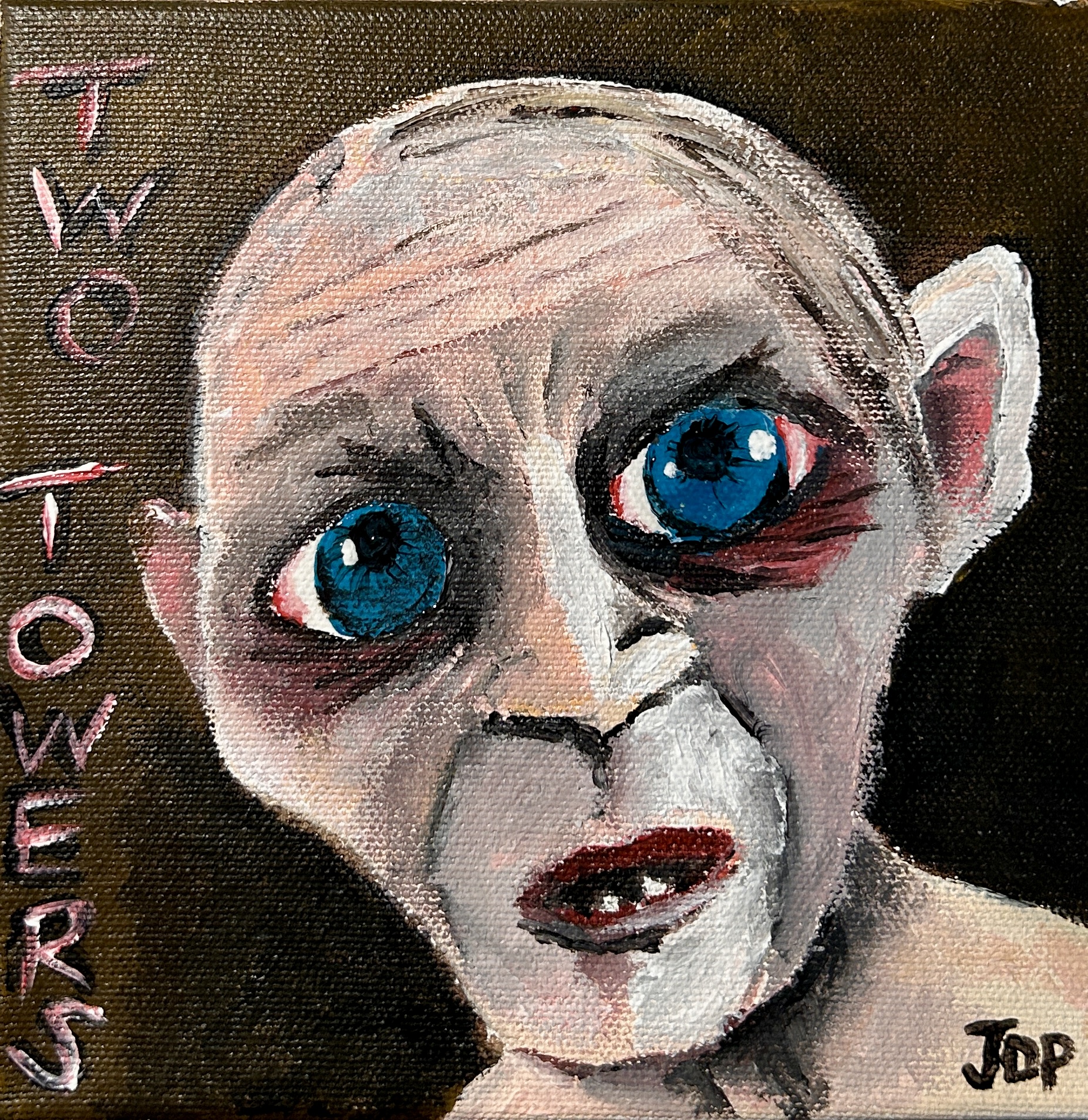
    Gollum by Julie Paterson

    Multicellularity, sticking more than one cell together to form more complex organisms occurs on page 709/916. Pippin and Gandalf have ridden to Gondor and are meeting with Lord Denethor​ (The Return of the King – The Siege of Gondor).

    “Before long he was walking with Gandalf once more down the long cold corridor to the door of the Tower Hall.”

    The Cambrian Explosion, a point in time where we see fossils suddenly appear for almost all modern groups happens on page 803/916. We have sped past the journeys with Gollum, the encounter with Faramir and the Oliphaunt, and Gollum’s betrayal of the hobbits to Shelob and arrive at Sam rescuing Frodo from orcs after he has been poisoned by the spider (The Return of the King – The Tower of Cirith Ungol)

    “At that rage blazed in Sam’s heart to a sudden fury.”

    Land is colonised by plants and animals on page 833/916.The siege of Gondor is in full swing and Denethor perishes in a bonfire meant for the wounded Faramir (The Return of the King – The Pyre of Denethor).

    “Gandalf in grief and horror turned his face away and closed the door.”

    Reptiles, particularly lineages leading to dinosaurs become dominant by page 847/916 (The Return of the King – The Houses of Healing). Aragorn, Gandalf, Pippin and the wounded Merry reunite after the Battle of the Pellenor Fields​ where the Mordor forces have been beaten back and the Witch King destroyed.

    “And get the pipe out of my pack, if it is unbroken.”

    The extinction of the dinosaurs and many other things occurs on page 893/916 where Frodo and Sam are lost in the mountain border of Mordor (The Return of the King –The Land of Shadow).

    “The tops of the Morgai were grassless, bare, jagged, barren as a slate.” ​

    The Primate lineage that becomes the Hominids, our ancestors, evolves​ on page 906/916. Frodo and Sam, starving and thirsty, approach Mount Doom through the surrounding wasteland (The Return of the King – Mount Doom).​

    “Then let me carry it a bit for you.”

    Finally, on page 916 we come to the last 5 million year. Frodo and Sam are slumped on the slope of an erupting Mount Doom after destroying the ring (The Return of the King –Mount Doom). All of human history​ fits into the last sentence

    “Here at the end of all things, Sam.”

    So is this effective? I guess one needs to know the story to get the full effect but even just looking at the page numbers will give you the right idea. Most of the interesting stuff happens in the last few pages. Almost nothing much happens in the first two thirds. Life, itself, arrives surprisingly early.

    I feel like it helps me with to work with the notion of lots of time.

    It’s only forever, not long at all

    sings David Bowie in the song Underground in the Movie Labyrinth. The more I think about it, the more I think that this is a very perceptive line.

    Still, I am out of time for now. I’m off to celebrate my granddaughter’s birthday.

     The author, Adrian Paterson, is a lecturer in the Department of Pest-management and Conservation at Te Whare Wānaka o Aoraki Lincoln University. He has experienced a lot of time.

  • The genetic mystery behind “clonal” plants

    The genetic mystery behind “clonal” plants

    Hey plant lovers! Let me share something incredible with you about the plant world. Some clever plants have discovered a super cool way to multiply without needing seeds or pollen from other plants. It is called apomixis. Think of it as nature’s way of letting plants create mini-me versions of themselves. These amazing plants can thrive and spread their families far and wide, even when life throws them some challenges.

    Want to meet one of these botanical wonders? Say hello to Pilosella, which includes the common hawkweed. These remarkable plants are not just special because of their unique family-growing style, they also teach us lessons about how plants adapt and stay strong when their world changes around them.

    Apomixis: Nature’s Reproductive Shortcut

    In Pilosella, scientists found that this cloning trick is actually controlled by three special gene regions, kind of like switches on a circuit board:
    Switch 1: LOA – avoids meiosis, the normal gene-splitting step,
    Switch 2: LOP – avoids fertilisation, so eggs grow into plants without needing pollen,
    Switch 3: AutE – lets the plant build the food-filled tissue (endosperm) that supports the developing seed.
    Together, these three “super switches” turn regular sexual reproduction into a smooth, pollen-free process.

    The LOP locus: the key to clonal reproduction

    Let’s zoom in on one of those switches: the LOSS OF PARTHENOGENESIS locus, or LOP. It’s the part of the genome that tells the plant, “Hey, go ahead and make a seed, even without any pollen.” That means the egg cell doesn’t need fertilisation to start developing into a full plant.

    Using some clever genetic detective work, Ross Bicknell (former Plant and Food scientist), Chris Winefield (Lincoln University), and five other researchers mapped this LOP region to a small section of the genome, 654 thousand base pairs long (which is small, considering plant genomes can be billions of bases in total length). They did this using a special technique involving polyhaploids — basically, plants that carry only a single set of chromosomes, which helps make genetic signals easier to read.

    The role of the PAR gene and jumping DNA

    One especially interesting gene in the LOP region is called PARTHENOGENESIS, or PAR for short. This gene is a key player in apomixis, and it shows up in other plants like dandelions, too.

    Dandelion flower (left) and a seed head (right). From learn.colincanhelp.com/know-your-weeds-dandelions/

    Here’s where it gets wild: scientists found that the active version of PAR (the one that triggers cloning) carries a little hitchhiker — a transposable element, or “jumping gene”, stuck in its promoter region (the bit that controls when the gene turns on). This jumping gene acts like a sneaky switch that flicks PAR into high gear, telling the plant: “Start cloning!”

    Even cooler? This transposable element-based activation seems to have happened independently in different plant groups — dandelions, hawkweeds, and their cousin Hieracium all show this trick, but with slightly different transposable elements in different spots. It’s like nature reinvented the same superpower in different ways, a phenomenon known as convergent evolution.

    So, are these plants just cloning machines?

    Not quite! For a while, scientists thought apomixis might be an evolutionary dead-end — after all, if you keep making copies of yourself, you might miss out on helpful mutations or adaptability and you steadily pick up flaws that you can’t get rid of. But Pilosella proves that’s not always the case. These plants can reproduce both ways: by cloning or by mixing genes with other plants. That means they can pass on their tried-and-true genetic blueprints or shuffle the deck when times get tough.

    In nature, this flexibility is a huge bonus. It lets them survive droughts, colonise poor soils, and hang in there when pollinators are scarce, and still adapt to new environments when needed. It’s the best of both worlds.

    Why this matters for the environment

    These clever plants are like nature’s survivalists. Their ability to reproduce without pollination means that they can spread quickly, especially in harsh places like dry grasslands or alpine meadows.

    But here’s the twist: sometimes they’re too good at it. In places like New Zealand, hawkweeds can become aggressive invaders, crowding out native plants. My own mother, for example, considers them total pests in her lawn!

    Scientists want to understand the genetic switches behind apomixis (like the LOP locus) to figure out how to manage or even control these fast-spreading plants, or perhaps one day harness apomixis for crop breeding.

    What this means for the future of plants and food

    Building on our exploration of the Pilosella plant and its unique LOP locus, let us dive into how plant genetics deepens our understanding of the natural world. As scientists examine these complex genetic blueprints, they uncovered valuable insights about:

    • How our green friends cleverly adapt to our changing climate
    • The super-smart ways that plants figure out how to survive and flourish in tough spots
    • Cool possibilities for helping crops grow better, even when the weather gets tricky

    But wait, there is more! This exciting research is not just about one plant, it is opening doors to better farming methods, helping protect our precious plant species, and finding clever ways to help plants weather the storms ahead.

    Let’s wrap this up

    Our exploration of Pilosella and its powerful LOP locus shows that even a so-called “weed” can teach us big lessons about evolution, resilience, and the future of farming.

    So next time you’re out for a walk and spot a humble hawkweed or dandelion, take a second look — you’re staring at a tiny miracle of plant reproduction, a living clue in one of nature’s greatest puzzles.

    This article was prepared by Bachelor of Science with Honours student Sienna Zeng as part of the ECOL608 Research Methods in Ecology course.


    References

  • 500 not out!

    Recently, we ticked past the 500th article posted to EcoLincNZ. In many ways it is just a number, but it is sufficiently round to make me think about what we have achieved.

    Jon Sullivan and I put the original site together in 2008. Blogging was the new thing and we thought that it might be a great way of getting information out about the cool research being done at Lincoln University by the ecologists (and ecology adjacent researchers). Our aim was to provide biology school teachers with examples of cool ecology done here in New Zealand, as well as to build a resource to show to prospective postgrads about what types of research they could do.

    Sixteen years later, after a several of re-designs and shifts of providers, a couple of big earthquakes, and life in general, we have quietly and steadily kept accumulating articles. I quickly realised that Jon was going to handle the technical side and I would have to write the bulk of the articles. Currently, I have done about 220.

    A world cloud of the first 500 articles in EcoLincNZ. ‘New’ ‘Zealand’ ‘species’, not surprisingly, are ahead of the rest!

    The first article was on 29th July 2008. I posted on the different meanings of Gondwanan. I still like this one. It showcases a paper and makes a good point. Later that day (and probably for the only time) I posted a second article about how fairy penguins and little penguins are genetically distinct.

    The following year Jon and I had the idea that we would incorporate this writing into our Research Methods course and have the each postgraduate student produce an article about research done at Lincoln and uploading it to EcoLincNZ. The first article was by Phil Cochrane on May 15th, 2009 about hatching failures in native bird populations that suffer from inbreeding. We now have 183 of these postgrad projects.

    I think that this has been a good learning experience (not only do the students write their blogs in a series of drafts but they also provide feedback on each others’ articles). It also means that we have a wider variety of topics for EcoLincNZ as many of the students are not ecologists and will pick papers of more interest to them.

    In addition to the usual articles I started a Sandwalk series in 2010 where I have a cartoon of Darwin pacing his favourite walk and a reason why he may have taken so long to publish ‘The Origin of Species’ (well actually why he would have taken so long if he lived today). I have put out one or two a year since.

    This is what 16 years of blogging does to you!

    Another common theme is my interest in all things Tolkien. In 2014 I decided to write an article on how Tolkien had made me an evolutionary biologist. I drew some analogies and examples from Tolkien’s work to explain some points. That was fun and so I have continued with these types of articles till today.

    Some newer topics have started to build nicely: agroecology (30), community conservation (39), plant pathology and wine (40), soil (19), fire ecology (14) and threatened species (43).

    There are many common themes that we have talked about in our articles. As this is a blog written by the former Department of Ecology and now Department of Pest-management and Conservation there should be no surprise that Biodiversity is a theme of 117 (23%) of the articles, Conservation is a theme of 97 (19%), and Wildlife Management has 82 (16%).

    In terms of taxa, plant ecology has done well (65 articles) compared to bird ecology (29) and invertebrate ecology (40). My own areas have been well catered for: behaviour (67), species distributions (44), monitoring (48) and biogeography (17).

    After so many articles do I have any that I particularly like? I did like the two that I wrote about the value of our insect collection, especially as it was at a time when it was under threat of being closed (On the value of collections: pinning down the answer; On the value of bespoke collections: regional natural history collections are important too!).

    I enjoyed writing my Tolkien-flavoured articles. I also had fun with the article about Ursula le Guin’s Earthsea (A weevil of Earthsea: Finding the true name for the fourth beetle) as names are so important in this work and Earthsea is a bit New Zealand-like. My favourite title was The beetle that joined the stones about a beetle group that moved from living under bark into living in crevices on high mountains. Or maybe it was ‘Kate Bush and the smelly stoats‘ where I combine my love of the songs of the great singer with some recent mammal research?

    Where to from here?

    We haven’t really done this for the internet traffic. With a few changes in provider it makes it difficult to look at popular articles over the 16 years. Certainly traffic was higher in the early teens than it is now but we still get a steady stream of visits every day and articles from all eras are still read.

    The five most read over the last year or so are ‘Sitting on the Fence: Are Predator-Proof Fences a Solution to New Zealand’s Biodiversity Challenges?‘ (Dafna Gilnad, 2017), ‘Kawakawa, the ‘holey’ herb of Aotearoa‘ (Wendy Fox, 2021), ‘Why wasps and bees hover over cabbage plants’ (Wesis Pus, 2015), ‘I see you: Sauron and the panda‘ (Adrian Paterson, 2023), ‘Measuring the burn‘ (Adrian Paterson, 2016).

    Blogging declined worldwide in the 2020s as podcasting became more popular, but there seems to have been a mild blogging resurgence in 2024. So I think that we will keep on doing what we are doing. We tried a few podcasts in 2017/18 and this could be something to look at a little more. The online world continues to change. With AI around the corner it is not obvious what the value of these short articles will be in 5 years, perhaps worthless, perhaps really valuable.

    I guess as long as I enjoy writing the articles and we think that there is value in postgraduates writing this way, we will continue on. I wasn’t expecting to be doing this 16 years on. 500 has a nice ring to it. 1000 sounds even better!

    Adrian Paterson is a lecturer at Lincoln University and the Head of the Department of Pest-management and Conservation. He has interests in molecular biodiversity, conservation animal behaviour and biogeography. He quite likes writing these short articles about cool ecological science and his experiences.

  • Detecting eDNA: everything, everywhere all at once

    Let’s say you want to know what animal species are present in a forest. You could walk along line transects and record the species visually observed. You could set up trail cameras to take pictures of passing animals for as long as there is enough space in the memory card and battery life in the cameras. You can use the acoustic survey method to study bats, birds, frogs, and even some monkey species, as they can be distinguished based on their sounds and calls.

    Depending on the size of your study area, making a list of the animal species present might take a several hours to several months because you will need to carry out various methods to identify them, which may also require species experts.

    These are well-established conventional methods for biodiversity monitoring, but is there no single method to find all the species in a given area at once? A one-size-fits-all t-shirt?

    There is a rapidly developing method that can identify a good portion of species in a given study area, including those living on the ground, in the ground, in the water, and even those flying in the air.

    Every organism contains genetic material called deoxyribonucleic acid (DNA), passed down from parents to children. All organisms from the same species have very similar DNA.

    An illustration of the double-helix of the DNA molecule. Original public domain image from Wikimedia Commons

    This technology takes advantage of the traces that organisms leave of their DNA in their environment, whether feathers, skin, scales, urine, or faeces. These traces, known as environmental DNA (eDNA), can be found in soil, water, and air.

    This shiny new method is called DNA metabarcoding. Simply put, it identifies organisms by matching their DNA with reference DNA from the gene database or library. It is like matching the barcode of products when you check out at the supermarket.

    The process begins with collecting water or soil, or even air, samples from the study area. These samples typically contain genetic material from diverse organisms, including bacteria, plants, and animals.

    Once samples are collected from the field, they are brought to the laboratory. DNA is separated from the samples, amplified, and sequenced to generate vast amounts of genetic data that can be compared with existing DNA databases and reference libraries such as GenBank for species identification.

    Environmental DNA – An emerging tool in conservation for monitoring past and present biodiversity – Scientific Figure on ResearchGate. Available from: https://www.researchgate.net/figure/The-overall-workflow-for-environmental-DNA-eDNA-studies-with-examples-of-organisms-that_fig1_269724781 License: CC BY-NC-ND 4.0

    DNA metabarcoding can detect a broad range of organisms at once, providing a snapshot of the species diversity within the study area. That way, you can avoid performing various sampling methods. How convenient is that!

    Of course, no method is perfect, even DNA metabarcoding. Since it is still developing, there are limitations. The public gene library has the DNA references of many species but this is still a small fraction of all the species on earth, so far. There can be contamination in the samples, which could disrupt the results. Errors can occur not only during sample collection in the field but also in the laboratory.

    Compared to DNA metabarcoding, conventional methods have stronger standardised techniques for sampling and for interpreting the datasets. Besides, in the context of biodiversity monitoring, conventional methods can provide detailed information, such as abundance, age, sex ratios, and individual animals’ special characteristics, such as colours and conditions, which DNA metabarcoding cannot tell us.

    Conventional methods are like pictures with tiny pixels portraying good resolution, but their taxonomic scope is limited, whereas those of DNA metabarcoding cover a broad range of species, but the resolution is coarse.

    Is there the best of both worlds?

    Yes! Robert Holdaway and colleagues, including Ian Dickie working at Lincoln University, suggested that combining DNA metabarcoding with conventional monitoring methods will benefit scientists in many ways.

    Using them together will enable scientists to test and improve the reliability and accuracy of our still-developing DNA metabarcoding method. Moreover, combining them will result in a higher chance of detecting species from the same lineage.

    Robert and colleagues provided three case studies in New Zealand that can benefit from the dynamic duo.

    First, the duo can be of advantage to the nationwide measurements of New Zealand’s biodiversity. They can provide greater taxonomic coverage and more thorough information on the relations among biodiversity, ecosystem functions, and services.

    Second, integrating DNA metabarcoding with Māori biodiversity monitoring approaches will bring more understanding to the Māori worldview of interconnections among living and non-living beings. Metabarcoding can enhance biodiversity inventories, identifying species important and relevant to Māori which are rare or hard to find using conventional methods.

    Third, combining DNA metabarcoding with traditional surveillance in detecting pest species at the early stage will secure native species and landscapes from harmful biosecurity threats, such as harmful pests and diseases.

    In addition, DNA results shared from various surveys using the dynamic duo will be added to the reference libraries making them more resourceful and convenient for future research. Having more reference DNA sequences of species in the reference libraries, like GenBank, will make biodiversity monitoring much easier by identifying species with just a few clicks.

    DNA metabarcoding is a rapidly developing and powerful tool for monitoring biodiversity. Integrating it into conventional methods will lead to a stronger method to get plausible results. Overall, as Robert and colleagues indicated, not only will they add value to New Zealand’s biodiversity and Māori culture, but they will also protect the native natural environment and species through early detection of pests.

    This article was prepared by Master of Science postgraduate student Zin Mar Hein as part of the ECOL608 Research Methods in Ecology course.

    Together, they will indeed make the best of both worlds for conservation.

  • Oh the horror! What should scare us at Halloween

    It’s Halloween today. Although ‘trick or treating’ has started to catch on over the last couple of decades, Halloween has never been that big a deal here in NZ. Perhaps it’s because it happens in spring when everything is greening up, new life abounds around us, and we are starting to appreciate the lengthening days and warmth. In the northern hemisphere it is the opposite and perhaps lends itself to the sinister, the thinning of the veil between worlds, the slide into the difficult time of the year.

    Halloween – a time for ghouls and ghosts.

    Most obviously, Halloween is a time for horror movies and themes. Scary images show up on our screens and theatres and aim to frighten us. I’ve often thought that horror does not capture Halloween that well. Halloween is more about fey magics, creatures of legend appearing to drive uncanny bargains, the sense of the other, and perhaps a sense of dread. Horror seems like a small part of this.

    To be fair, I am not a horror fan. I am certainly not a gore and blood person. I enjoyed the old Hammer Horror films, was scared by “The exorcist”, and scarred by “The fly” (the old black and white version – “Help me…”). But I have stayed clear of slasher films and probably haven’t seen a full-on horror for, well, for a long time.

    What are people horrified by at Halloween? Mostly it is ghouls, witches, zombies, vampires, English rugby referees, and ghosts. But it seems to me that there are plenty of other things to be horrified about.

    What’s down that path….? Opportunity or threat?

    Cate Macinnis-Ng and a host of authors, including Will Godsoe from Lincoln, have published a paper in the Journal of the Royal Society of New Zealand. In this they look at the potential threats and opportunities with the ongoing change in climate. The neat angle here is that they take perspectives from many different people and apply an ecological method, a horizon-scanning approach, to come up with ten for each.

    Most of the benefits revolve around the application of new technologies and the chance for major positive societal changes. The negatives are much more specific, more disease outbreaks, dealing with heat waves, increasing black swan events and so on. It is not difficult to read this and feel a real sense of alarm for the future.

    So, if you want some real dread this Halloween day, then this is an article to read. Perhaps under your bed covers with the torch. There are no bumps in the night, no jump cuts, no creepy faces in mirrors (although I guess NZ is a bit like a cabin in the woods).

    But there is plenty of dread and horror.

    Adrian Paterson is a lecturer at the Department of Pest-management and Conservation, Lincoln University.

  • The handle on the climate change pot

    I live at a student apartment here in Lincoln on campus and the handles of all of our pots are loose. Maybe you know the feeling. It is a problem, but it feels like a problem for the future.

    Recently, I talked to one of my roommates about it: “Let’s find a screwdriver and fix the pots”. But we have no screwdriver at our apartment, so nothing happened. One of these days, while picking up a pot, my pasta will end up on the floor, as the handle came off! We know this moment will come and it will then be a problem. But it probably will not be tomorrow and there are other more pressing matters at hand, like all of the assignments I have to complete over the next two weeks.

    The infamous pots and pans from our flat. No firm handles in sight. Photo: Jess Bardey

    Climate change is our global pot with a loose handle.

    During 2019, multiple councils in Canterbury, New Zealand, issued emergency declarations for climate change, basically saying that our response to climate change has to happen now. There was a global wave of these declarations in 2019, as it felt like a way for local governments to do something against the global problem of climate change. What a climate emergency declaration entails can vary widely, from a vague “climate change is an emergency in our region” to an outline of possible solutions. Looking back over the last three years, the Corona virus response showed us that governments are able to react quickly to a crisis. A reaction that was hoped for in response to the declarations as well.

    Every time we pick the climate change pot up, we can feel its handle rattling and it feels a bit more loose than the last time. We can see the slow loosening of the handle in the ever drier and warmer summers, the high fluctuation in temperature, and the higher frequency and strength of natural catastrophes. With disasters like droughts, floods or wild fires, climate change feels very real and like an emergency. The handle feels like it is falling off right this second and we feel like we should immediately do something about it, for example set it down, grab a screwdriver, so that it does not end in disaster. But we don’t, we pick the pot back up and go on with business as usual, forgetting about the incident until the next time it occurs.

    Climate protesters demand an emergency declaration, Washington DC, 2021
    Climate Emergency Banner – DC March” by Backbone Campaign, licensed under CC BY 2.0.

    Sylvia Nissen from Lincoln University looked into two of those declarations to understand their impact, or lack thereof, which were issued by Environment Canterbury and the Christchurch City Council. After the declarations were released they were seen as a sign of hope that might lead to some action. In fact nothing really changed even multiple months after the declaration, with one of the councils even supporting a decision that would lead to more carbon emissions. The declaration by Environment Canterbury was issued after their work was inhibited by activists chaining themselves to their building and stopping their water supply, and the Christchurch City Council felt they were under global pressure, following the release of many declarations around the world. The release of these statements was a fast and easy way to appease the public without having to put much work into it. I mean, looking at our rattling pot handles again, talking to my roommate did feel like we did something about the problem, even though we really didn’t.

    Calling climate change an emergency also led to a weird appearance in the declarations, namely that much of them were focused on defining how climate change is different from other emergencies. Canterbury is well acquainted with emergencies over the last 15 years, with earthquakes in Christchurch in 2010 and 2011, followed by fires, floods and droughts in the region. An emergency is defined as a problem that is surprising and unexpected and in need of an immediate solution. Even though the effects of climate change are getting more prevalent each day, we still feel like we can find the screwdriver to fix it tomorrow. However, none of the existing screwdrivers seem to fit, so maybe we need to find a new one, or a new toolbox. Climate change is an intricate, multilayered problem that needs work on many different fronts at the same time. Local authorities often feel as if they need the governments higher up to change something, because they do not have the authority to do so.

    The emergency declarations were used to get the government of New Zealand to release an emergency statement as well. Often in times of emergencies, the authority completely shifts to one entity to make the response efforts more efficient. This is especially concerning in New Zealand as non-emergency situations have often led to suppression and disregard of Māori rights, and a centralization of power might especially lead to excluding Māori advice from councils. In the declarations Māori advisors were often described as only “present”, not giving an indication as to whether their worries were taken into account.

    Looks like a good start to a toolbox. The yellow gives them quite the emergency color. By hehaden, licensed under CC BY-NC 2.0.

    The notion of just giving the solution over to the next higher authority can also be seen as quite concerning, as bottom-up approaches were seen to lead to more realistic and inclusive solutions. And though no local government will be able to find the whole solution, each can provide their own, unique screwdriver to help fill a toolbox that can fix all the different issues, to screw the handle of the climate change pot back on.

    And looking at all the effects climate change already has on our world, is it really still a problem for tomorrow?

    So now I am going to get up and find a screwdriver. Because the loose handles of our pots (including the climate change one) can very quickly become a problem of today.

    This article was prepared by postgraduate student Jess Bardey as part of the ECOL608 Research Methods in Ecology course.

  • And we’re back!

    As you may have noticed EcoLincNZ has been offline for the last three months. It seems that we were victims of a nasty hack that meant that we had to migrate and rebuild the site, over Christmas and the summer break.

    Jon Sullivan has been outstanding in getting virtually all of our material into the new site.

    It did make us ponder about whether we wanted to continue with our research blog, after all blogs are not as popular as they once were. However, we like this format and we have developed some good teaching/learning tasks around this kind of creative writing. And hopefully, dear reader, you obtain some value from what we do.

    So, EcoLincNZ is back and we look forward to providing more overviews of ecology-related research projects done by Lincoln University.