Category: taxonomy

  • More than teeth: mouth microbiomes of stoats and possums

    More than teeth: mouth microbiomes of stoats and possums

    Like most people, I hate going to the dentist. Every time I have a check-up, they poke and prod around my mouth, trying to find something wrong. Most of the time, they end up telling me the same thing: I don’t floss enough.

    Despite all those check-ups and the money that went into braces, I rarely find myself thinking about what actually goes on inside our mouths. They are the first point of contact for everything, from breaths of fresh air to the good (and bad) choices about what we eat. But our mouths have a lot more going on than we credit them with.

    Our mouths are home to over 700 different species of microbes – tiny microscopic organisms that can be anything from bacteria to fungi to viruses. While that might sound like a bad thing, these microbial communities contain both helpful and harmful organisms. Many beneficial microbes assist with digestion and help regulate harmful microbes, even in food!

    Our mouths are home to hundreds of different microorganisms. Image from Tjandrawinata et al., (2025) licensed under CC BY 4.0

    These diverse oral communities exist in almost all animals, and their roles go far beyond digestion. They can also influence immune responses and even host behaviour. In turn, oral microbiomes themselves are shaped by a host’s genetics, physiology, environment, and diet. As microbiomes co-evolve with their hosts, we can potentially understand genetic variation and evolutionary processes in host species by looking at these small passengers.

    Common Brushtail Possum (Trichosurus vulpecula) – JJ Harrison (CC-BY-SA-2.5)

    These interesting, yet poorly understood, communities were studied by a group of nine scientists, including researchers from Lincoln University. They wanted to understand the oral microbiomes of two invasive to New Zealand mammals: the stoat and the common brushtail possum. Stoats and possums are both notorious pests in Aotearoa. They disrupt our vulnerable ecosystems, killing native plants and animals. While extensive research has examined the species themselves, little attention has been given to their microbiomes, let alone their oral microbiomes.

    Stoat (Mustela erminea) – James Lindsey (CC BY-SA 3.0)

    Led by Arsalan Emami-Khoyi, the researchers aimed to characterise the diversity, content, and variation of oral microbiota in the animals. With ethics approval from the Lincoln University Animal Ethics Committee, they live-captured five stoats and five possums from Banks Peninsula. Unlike a typical trip to the dentist, the animals were sedated before researchers swabbed their mouths. The researchers then used a DNA technique called 16S rRNA metabarcoding to discover and record microbial communities. This complex technique identifies the abundance of different groups of microbes.

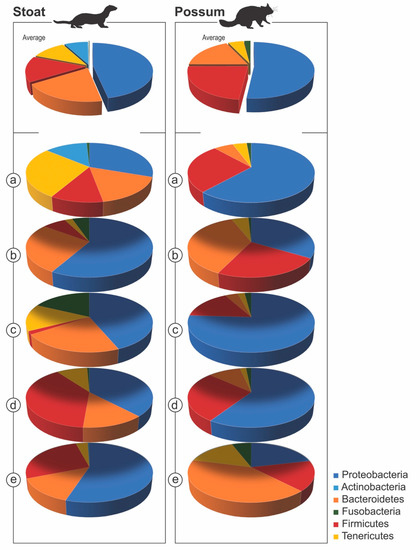
    All of the animals captured were healthy apart from gum inflammation – my dentist would be horrified by how little they brush their teeth. As published in the journal Diversity, the researchers identified 19 different major microbial groups (phyla), and 51 known species in the animals’ mouths. Despite this high diversity, a small number of microbes dominated each mouth fauna in both animals. These same groups are abundant across other mammal species, representing a ‘core’ set of microbes across mammals. Some of these core groups are Proteobacteria and Firmicutes.

    The researchers also found clear differences in microbial composition between stoats and possums. This suggested a link between diet and microbes, with omnivorous possums having plant-metabolising bacteria, such as Treponema sp., which were completely absent in the carnivorous stoat. At the same time, the high diversity in both species suggests that other factors, such as genetics, environment and physiology, also play an important role in shaping oral microbiomes.

    The variation of the five core oral bacteria in stoats and possums found in the study (CC BY 4.0).

    This high variation in the oral microbiome could help us understand evolutionary responses of introduced species to new environments. Because of their short lifespan and fast reproduction, microbial communities can change more rapidly than their host genetics. So focusing on them could teach us about how much these invasive species have adapted to New Zealand’s environment.

    Understanding the oral microbiomes of these invasive mammals could also have practical applications in pest control. Microbes can influence how animals process toxins and other chemicals, which may influence how well poisons work. In New Zealand, we often rely on poisons, such as 1080 and brodifacoum, to control our mammalian populations. Future research on this could help us improve the effectiveness of control tools.

    Work has already been done beyond this study. The lead author and colleagues have developed a device that collects DNA from possums in the field, allowing us to sample DNA without capturing the animal directly. Alongside collecting host DNA, this approach can also provide insights into possum health by analysing oral microbial DNA.

    The device developed by Arsalan Emami-Khoyi and colleagues for capturing DNA in the field (Arsalan Emami-Khoyi et al., 2021)(CC BY 4.0).

    Personally, I think this study could help us understand population connectivity. Comparing microbial samples from different locations could provide a new way to understand population connectivity and how invasive species spread.

    There is a wide range of potential applications from this research, and microbiomes will likely play an increasingly important role in future pest management.

    It turns out we can learn a lot from what’s happening inside an animal’s mouth. So maybe my dentist is right to look so closely after all.

    This article was prepared by Master of Bioprotection student  Sam Bonney as part of the ECOL608 Research Methods in Ecology course

    Emami-Khoyi, A., Benmazouz, I., Paterson, A. M., Ross, J. G., Murphy, E. C., Bothwell, J., Alizadeh, H., van Vuuren, B. J., & Teske, P. R. (2020). Oral Microbiome Metabarcoding in Two Invasive Small Mammals from New Zealand. Diversity, 12(7), 278. https://doi.org/10.3390/d12070278

  • Jumping to the top of the world: new salticid spider species in the Southern Alps

    Spiders.

    Your reaction to that word might determine whether or not you finish reading this post, but try to bear with me — at least for a little while. While I can accept that most people aren’t nearly as fond of spiders as I am, I think all but the truly arachnophobic (it’s okay; I understand that you can’t help it) can agree that the jumping spiders are among the “cutest” and most acceptable spider groups. These active little hunters can often be found in or around the house, and their big binocular eyes and expressive “face” make them a lot more relatable than your average creepy-crawly. Well, most of them!

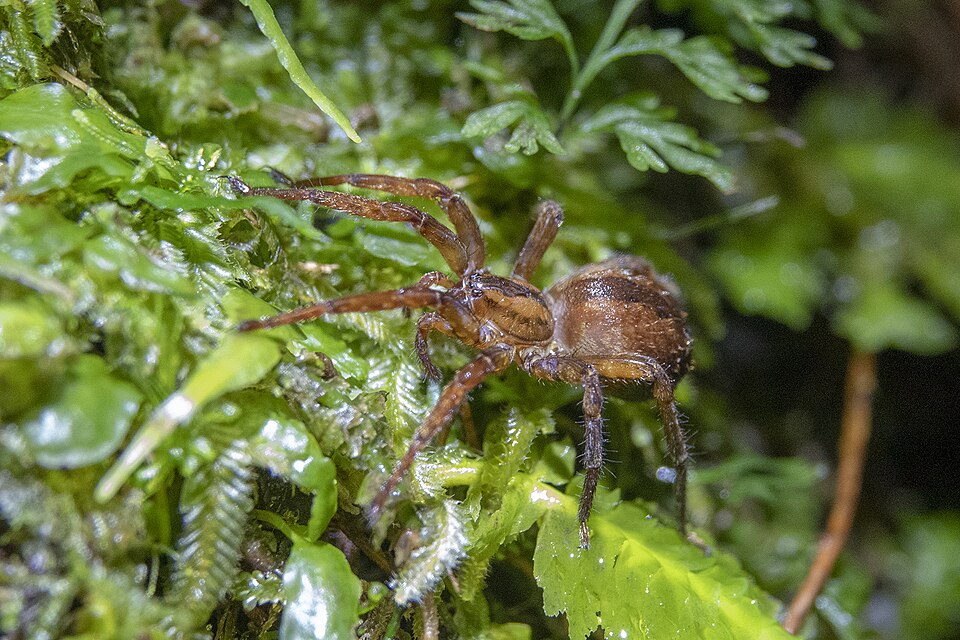
    A newly-described female Ourea petroides from the Ōtira River valley, Arthur’s Pass. © own work, 2022. CC-BY-NC.

    Jumping spiders, in the family Salticidae, are among the most well-researched spiders in the world, with over 6,500 species described. Meanwhile, the jumping spiders found in Aotearoa New Zealand – apart from the most commonly-encountered species – are very poorly known to science. There are thought to be around 200 species in NZ, with about 50 known well enough to be named. However, we can only reliably identify fewer than a dozen of them. Compare this with Australia, where hundreds of species are known already, and work to describe the rest is well under way.

    Not to be outdone by the Aussies, Lincoln University’s Robin Long, along with her supervisor Dr Cor Vink, decided to do something about that. For her Master’s project, Robin set out to catalogue and describe the jumping spiders found in some of NZ’s most remote and extreme environments: the rocky heights of the South Island’s alpine zone.

    Robin visited 21 different sites all over the Southern Alps, from Paparoa to Fiordland, collecting 170 jumping spider specimens (all by hand!) from up to 1,800 m above sea level — and logging some impressive hiking mileage in the process!

    Looking across the Ōtira River at a scree slope where Ourea petroides can be found, Arthur’s Pass. © own work, 2022. CC-BY-NC.

    Through DNA analysis and careful examination of microscopic features on each spider, Robin separated those 170 specimens into 12 new species, and determined that the group was so unlike others known to science that it represented a brand new genus (a group of closely-related species with a common ancestor). She named this genus Ourea because, like the ancient Greek mountain gods, many of the species were found to be associated with a specific mountain range.

    Many of NZ’s indigenous species are only found across quite small areas, often because of the (relatively) recent and rapid growth of our mountains — which even today continue to grow taller by around 7 mm per year. Formerly widespread species were split into separate populations by the tectonic uplift, and over the last few million years these now-isolated populations have diverged into new species. Robin’s jumping spiders, much like many other NZ alpine species, took advantage of the ample prey and new habitats created by the growth of these mountain ranges. Over time these spiders even developed cryptic colours and patterns that help to camouflage them against the particular rock types they live amongst.

    Magnificent moustache: a female(!) Ourea saffroclypeus from the Remarkables Range. © Robin Long, 2022. CC-BY-NC.

    Not content with merely describing a whole genus and a dozen new species, Robin also set about studying and describing the spiders’ behaviours when interacting with other members of the same species. Jumping spiders have exceptional eyesight, and are known for communicating with each other through visual displays that range from the bronze hopper’s simple leg-waving, all the way to the flamboyant, colourful dances (which often incorporate vibration as well) performed by the aptly-named peacock spiders.

    The four Ourea species that Robin observed in the lab each exhibited a unique set of behaviours when they met another spider, and these behaviours differed depending upon whether they met a member of the same or the opposite sex. Males postured fiercely at each other, squaring up in a face-to-face grappling contest with legs and fangs outstretched.

    When attempting to impress a female, males gestured with their legs and “zigzag-danced” their way closer, before attempting to reach out and gently stroke the female’s head. Perhaps unsurprisingly, this final move had quite mixed success! Females meeting each other were a bit more sensible, and usually made a few simple (though probably quite impolite) leg gestures at each other, before one or both turned away and went in the opposite direction.

    Despite the enormous amount of work that went into researching these spiders, Robin acknowledges that her almost 150-page thesis has only scratched the surface of the topic. Little is known of the spiders’ life histories or the individual species’ spatial distributions, and it’s “very likely” that there are additional species in the genus waiting to be discovered on other mountain ranges.

    Exquisite camouflage: Ourea petroides, Ōtira River valley, Arthur’s Pass. © own work, 2022. CC-BY-NC.

    Robin also suggests a similar study would likely uncover another distantly-related group of undescribed jumping spiders living quietly in the Southern Alps. This is a common problem with New Zealand’s invertebrate fauna: while we have a good general understanding of what’s around us, there are still huge gaps in our knowledge — and usually the studies that attempt to address this just end up revealing more unanswered questions!

    We have a rich history of brilliant people, like Robin, studying, documenting, and describing New Zealand’s unique invertebrate biodiversity, and there are still many new discoveries to be made in every corner of our little country. But, despite huge technological advances, research has dwindled in recent decades due to funding redirections and the restructuring of government services.

    Under the looming threats of climate change and habitat loss, we need to pay closer attention to the smallest and most enigmatic (if not always particularly cute) creatures that live alongside us, lest they disappear before we even have a chance to study them. Australia is well ahead of NZ in this regard, with funding and support for taxonomic studies provided through their world-leading ABRS scheme. I’m not much of a sports enjoyer, but beating the Aussies at this game is one trans-Tasman rivalry I could definitely get behind.

    This article was prepared by Bachelor of Science (Honours) student Dustin la Mont as part of the ECOL608 Research Methods in Ecology course.