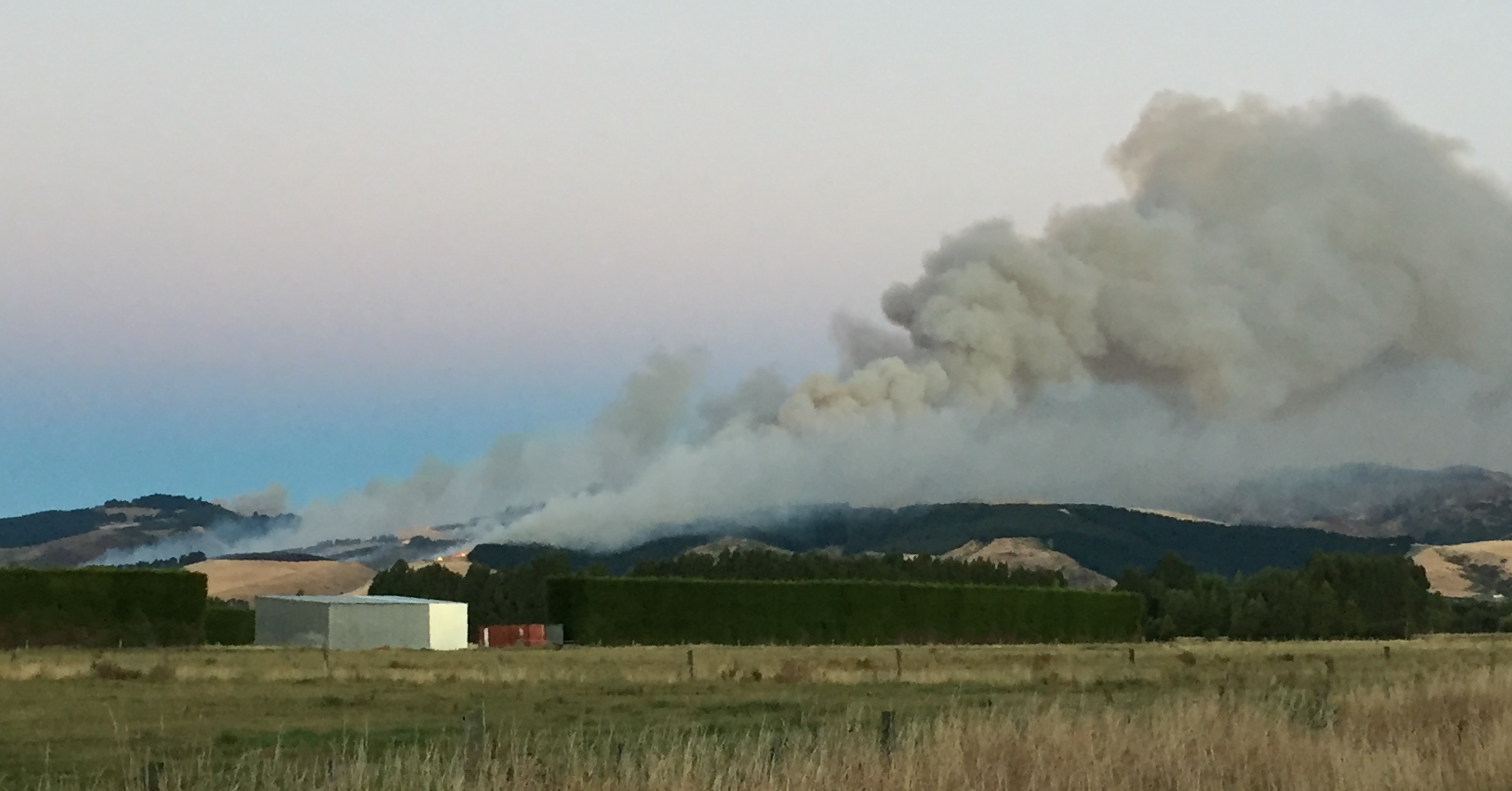
In mid-February 2017, at about ten at night, I walked out to the street outside my south-Christchurch home and took a photo of the hills to the south-east. A large vegetation fire was stretched across the hills, which were lit black and orange, with strips of flames and glowing smoke. The blaze was at least 4 km away, but the blackness flattened the scene, and the fire and smoke seemed above me almost, and growing. You could almost believe the hills themselves would burn down.

I took that photo on the fourth day of the 2017 Port Hills fire. It took more than 60 further days for the fire to be fully extinguished. A life was lost, 1600 ha of land was burned, and nine houses were destroyed. Like many people in Christchurch, I was left wondering, why did it burn so fiercely and for so long? Why did this ridge burn, but not that gully? Why did some trees recover, and send out new shoots, while others perished?
Along with floods, earthquakes, and other things, fires like the 2017 Port Hills fire are described as “natural disasters”, but how natural was this fire really? Prior to human settlement — which began around 800 years ago — fire in Aotearoa was rare. NZ was mostly covered in relatively moist, old growth forest. Because of this history, few New Zealand plants are fire-adapted. However, in Aotearoa and globally, wildfires are becoming more damaging and more frequent, threatening life, property, and ecosystems.
Understanding what plant species burn, how they burn, and why, is crucial to understanding and managing fire risk across the modern Aotearoa landscape. A recent paper sought to investigate these questions and was led by Azhar Alam, with Sarah V. Wyse, Hannah L. Buckley, George L. W. Perry, Xinglei Cui, Jon J. Sullivan, Dylan W. Schwilk, and Timothy J. Curran.
Most studies have assessed flammability (how easily they burn) of plant species by looking at leaf flammability in isolation. Azhar felt that there were limitations to this approach; that on its own leaf flammability didn’t fully capture how a fire really behaves when burning a plant in the real world.
The authors preferred to assess shoot flammability. “Shoot” here means the young branch and branchlets of a plant, and all the leaves that are attached. The authors felt that — compared to just leaves — shoot flammability would better describe how a plant ignites and burns, and, in particular, better captures canopy flammability.
This is important. Canopy flammability strongly influences how easily a fire moves from tree to tree or shrub to shrub. If we want to understand — and even predict! — how a fire might move through a stand of pines, gorse or kānuka, compared to a stand of old growth native forest.

Rather than just burning the shoots of a bunch of plants and recording the relative flammability of the species, the authors were interested in recording the effect of shoot architecture on flammability. “Architecture” here means how many branches and how tightly branched the twigs and leaves of a shoot are. For example, Kapuka has a few, large leaves with little branching, whereas korokio has many, small leaves and lots of thin, interlacing branchlets.
The authors collected six shoots each from 65 plant species that you commonly find in Aotearoa forests and gardens, including 35 indigenous species.
For each shoot, a number of leaf and shoot architecture traits were recorded. It was these traits that the authors predicted would show a strong relationship to flammability. The leaf traits recorded were:
size of the leaves (total area),
thickness of the leaves,
leaf surface for each gram of leaf mass,
dryness of the leaves.
The shoot architecture traits recorded were:
“branchiness” of the shoots (measured both as how many “main” branches each shoot has, and also how many branches the shoot has when you count all the branches the main branches have, all the branches those branches have, and all the branches those branches have and so on,
“twiggyness” of the shoots (measured by twig mass per given volume of shoot),
proportion of flammable mass (fuel) there is in a given volume of shoot,
The shoots were all burned on a “plant barbecue” and their flammability was recorded.
But what exactly is flammability? And how do you measure it? There are four key factors that determine flammability of plant shoots:
How quickly do shoots ignite? Ignitability.
How much heat do they release once alight? Combustibility.
How long do they burn for? Sustainability.
How much of each shoot is consumed by the fire? Consumability.
The results of these burning tests were clear. All shoot architecture traits and leaf traits were strongly related to shoot flammability.
Among the shoot architecture traits, greater “branchiness” was shown to increase a shoot’s ignitability, consumability, and maximum temperature, while a greater amount of flammable mass (fuel) for a given volume of shoot was shown to increase a shoot’s fire sustainability and consumability.

Of the leaf traits, leaf dryness was key. In fact, leaf dryness increased all aspects of flammability more than any shoot architecture or leaf trait. Leaf thickness decreased flammability across the board.
While leaf architecture traits were not as significant as leaf dryness in affecting shoot flammability, they were still significant. Demonstrating their importance is crucial for improving the management of fires and fire risk. Plant traits are already used in fire behaviour models to predict what fires will do.
Including shoot architecture traits in these models has the potential to improve their power and precision. Understanding what a fire is likely to do gives us the power to change what it will do by planting low-flammability tree species to create fire breaks, or buffering properties with lawn or pavement. This knowledge will save property, ecosystems, and even lives.
If you drove through Arthur’s Pass, in the South Island this summer gone (2024-25), you probably drove past the charred and blackened beech trees and snow tussocks near Castle Hill; evidence of a fire that burned through 1,000 hectares of scrub, grassland and forest last December. This is a scene we can expect to see more and more in Aotearoa in the coming decades. Improving our ability to anticipate and manage fires and fire behaviour will only grow in importance as we move further into our new climate future.
This article was prepared by Master of Science student Joe Potter-Butler as part of the ECOL608 Research Methods in Ecology course.




_assessing_its_environment_for_potential_natural_enemies.jpg)