It is widely known that some 66 million years ago an asteroid hit the Earth, contributing to mass destruction and extinctions, most popularly of the dinosaurs. But did you also know that a very common animal class, birds, are direct relatives to avian dinosaurs? They are literally the only dinosaur descendants. The American Museum of Natural History sheds a light on this, and also names some non-dinosaur animals that persisted through the asteroid impact.
While tough, thick-skinned crocodiles and alligators surviving may not come as a surprise; frogs, lizards, and some mammals living through the Chicxulub asteroid (with a diameter of 10 to 15 km) impacting with the Earth surely is impressive! If they hadn’t made it through who knows if we would be here today? Those survivors are the origin of our current biodiversity.
Sadly, this biodiversity is now threatened by one of its own. Many species are going extinct because of us humans. We overuse finite resources, pollute and destroy natural environments to build cities, malls and farms, import invasive species that out compete native ones, … The list goes on.
There is one really important factor to add here: climate change. By burning fossil fuels, such as coal, gas, and oil, we release gigantic amounts of CO2 into the atmosphere: 37.55 billion metric tons in 2023 alone. The CO2 and other greenhouse gases produced block the escape of heat from the Earth, and our atmosphere becomes warmer. Not only does it become warmer globally, but extreme weather events, such as floods, droughts and storms, become more common, and sea levels rise due to expanding oceans, as well as glacial and polar ice melting.
Climate change already has a major impact on our planet’s biodiversity. It affects 1,688 threatened or near-threatened species listed in the IUCN red list, a categorisation of the threat status of species, and has been ranked the 7th most important “biodiversity killer“.

Steps are being taken to slow climate change on an international scale, though they haven’t been too successful so far. Governments issue restrictions on emissions produced by industries, promote the use of public transport, and invest in renewable energy production. In 2015, 196 countries signed the Paris Agreement. This created an international plan of action to limit global warming to 1.5°C above the average global temperature in pre-industrial times.
Even though these measures are being taken, it is likely that climate change will continue to increase in importance for the biodiversity crisis. Measures to limit greenhouse gas emissions will have a delayed impact on the global climate. Thus, the effect of our current emissions will only become visible in 10-20 years‘ time, and in the coming decades, climate change will intensify as a result of past emissions.
As this is the case, we need to think about what it means for the Earth’s biodiversity. One of the most famous examples of the impacts of climate change on species are polar bears (Ursus maritimus). They only live in the Arctic, which is warming twice as fast as any other region of the world. There, polar bears live and hunt for seals on the ice shelves. Due to higher temperatures, the ice melts and the bears quite literally lose their home and their hunting territory, easily becoming undernourished and sick. To add insult to injury, Arctic warming makes the huge oil and gas fields under the ice more accessible, so that some countries and companies have started exploiting the Arctic. As Greta Thunberg would say, “How dare you?“.
Polar bears are just one example to illustrate how a species is affected by climate change. Of course, its impacts vary between ecosystems and species, and a polar bear has different challenges to an alpine plant or desert mammal.
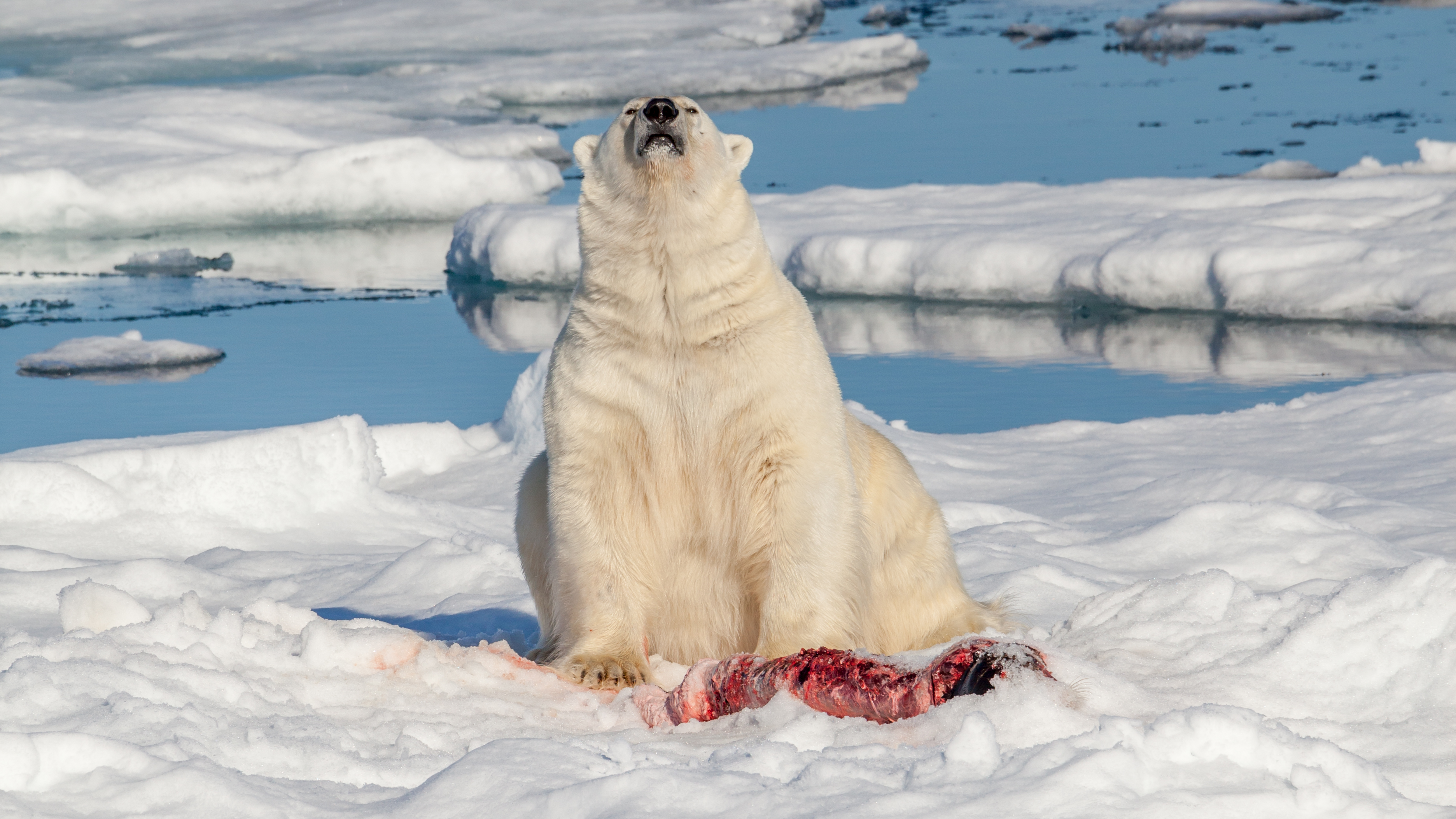
_assessing_its_environment_for_potential_natural_enemies.jpg)
It has become common for biologists to make predictions on how a species will react to climate change. Historically, only the current climatic conditions of a species’ home range were used to simulate how that range could shift with climate change. Those predictions are then used to inform conservation decisions, which is why it is important that they are as accurate as possible.
Unfortunately, those conservative models lack a lot of information. If we think back to the polar bears, losing its habitat and hunting range hugely impacts the species, but other associated factors also will influence how they fare in the future. For example, it is predicted that the higher energetic costs of hunting due to climate change will impact female reproduction, and reduce the number and size of healthy litters. Modelling a population with its current demography (its reproductive, survival, and mortality rates), can lead to unrealistic projections, because it doesn’t account for possible future changes to it.
A study by Urban and multiple colleagues, including Lincoln University’s William Godsoe, looked at ways to improve the accuracy of biodiversity predictions in the face of climate change. They found that including just six biological factors would drastically improve the accuracy of models. Data on the demography of the species, its interaction with other species, its evolution and responses to environmental changes can strongly affect modelling results. So can information on how good it is at dispersing (spreading) as well as its physiology (bodily functions). However, though it may sound easy to include those factors, we lack this data for most species. It is always a challenge trying to make predictions more accurate but lacking data to do so.
A few strategies can be used to make up for this lack of data. For example, one could focus on modelling the future of keystone species, those that have a more important impact on their environment than others do. Or, researchers could focus on species that are supposedly more sensitive to climate change than others, because if we protect those, others likely also would benefit.
Unfortunately, with our current knowledge, it is mostly a guessing game to know which species will survive the burden of climate change that we put on the Earth. Though progress has been made, and more integrative predictive models suggested, we still have many questions to answer. Which will be the modern equivalent of birds to the dinosaurs? Or of the crocodiles, reptiles and few mammals that survived the Chicxulub?
Though predictions always have uncertainty, trying to make the models better by including more information is really important to help us better protect our rich biodiversity!
This article was prepared by Master of International Nature Conservation student Leonie Kock as part of the ECOL608 Research Methods in Ecology course.
M. C. Urban et al. (2016) Improving the forecast for biodiversity under climate change. Science Vol. 353, Issue 6304, aad8466. DOI:10.1126/science.aad8466
Leave a Reply