Category: evolution

  • It’s only forever, not long at all

    It’s only forever, not long at all

    Time has very much been on my mind lately.

    To be exact, it is probably the comprehension of time that has been at the forefront.

    I just went to the 40th anniversary of the movie ‘Labyrinth’, a quirky movie by Jim Henson of muppets fame, written by Monty Python Terry Jones, and starring David Bowie as the Goblin King (and who also wrote the songs) and Jennifer Connolly in her first role. Essentially a teen babysitting her baby half-brother wishes the goblins would take him when he cries to much. They do and many dream-like twists and turns occur in the goblin labyrinth as Sarah finally outwits the Goblin King to get the baby back.

    I was 19 when I went to the cinemas to see this movie. It’s a little intimidating to think that 40 years have passed since that that fresh-faced Adrian was starting his honours year at Otago. In some ways it seems like yesterday, in others a lifetime has passed by. I mean I’ve done a PhD, got married, became a lecturer, raised three sons to independence, supervised 78 postgraduates to completion, travelled, read a lot of Tolkien, listened to a lot of Kate Bush, played a lot of games, coached a lot of cricket and so on.

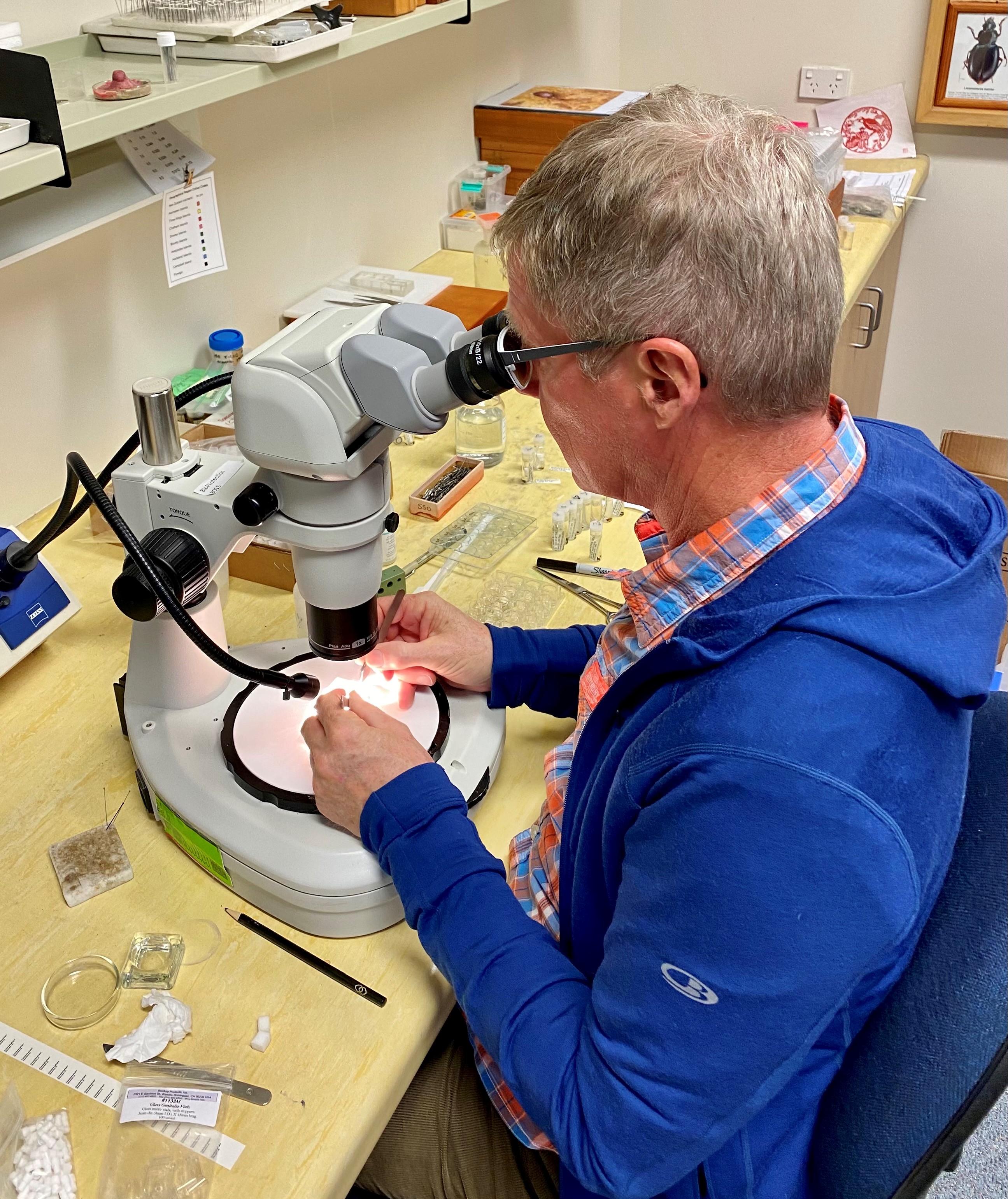
    Adrian in 1989 – starting his research career with behavioural work on native bees. Image by Adrian.

    (By the way the movie holds up well, the practical effects are still amazing, the songs catchy, Bowie’s pants are still alarmingly tight, although there are parts that have not aged well, especially the early computer effects – I’d like to think of that as a metaphor for something!)

    At a smaller scale, my granddaughter is about to turn one. (Note even the idea of being a grandfather makes me contemplate time a lot!) As an evolutionary biologist I have always said to my classes that, from an evolutionary fitness point of view, becoming a grandparent is the goal – you have reproduced and your children have reproduced. There’s not much more that you can do.

    I’ve also found that being a grandfather is a wonderful job in its own right! It feels like the most important thing that I could be doing. So yah for evolution!

    The last year has whizzed by and granddaughter has changed from an organic lump into a moving, noise-making, interactive Individual. Biology is amazing. But where did that year go?

    The perception of time is a funny old thing. With regards to my granddaughter the last year has sped by. On the other hand, I got a bad concussion last January (I zigged when I should have zagged) and the recovery from that, still ongoing, seems to have taken a decade. Same period of time but contrasting experiences!

    Adrian in 2026 with granddaughter. Image by Julie Paterson.

    Our poor human perception of passing time can really get in the way of understanding science, especially the sciences that take place over long periods, such as evolution, geology, astronomy. A particular issues is getting our minds to comprehend just how much time there has been.

    In my teaching I have used several analogies to try and get across the sheer scope of time. You want to take something familiar and use that as a metaphor. I’ve walked around the classroom where every step is 50 million years, I’ve used a rugby game where every minute is 25 million years. Usually, I am trying to emphasise that the dramatic stuff that we are most interested in happened recently and a looooooong time from the beginning.

    So here I go again trying to give a sense of the time available for the history of the Earth! This time let’s think about ‘The Lord of the Rings‘. Most people know the basic story: Bilbo gives Frodo a magic ring which turns out to be the source of the Big Bad of the world’s power that must be destroyed in the volcano where it was made. Shenanigans ensue.

    So, lets say we start with Chapter one and finish when the hobbits destroy the ring at Mount Doom (I know there is a prologue and there are several chapters after this but let’s stick with this basic journey of Shire to Mordor). In my copy of the ‘The Lord of the Rings‘ (LotR)this part of the story takes 916 pages. If the Earth forms with the first sentence of Chapter 1 “When Mr Bilbo Baggins of Bag End announced…” we are at 4.5 billion years ago.

    Each subsequent page is then the equivalent of 5 million years (still a period of time that is unimaginably long!).

    First evidence of life on Earth appears around page 54/916. In our read through of LotR this is in the The Fellowship of the Ring – Three is Company where Sam and Frodo meet Gildor and the elves within the Shire​ as they camp after leaving Bag End.

    Before long the elves came down the lane towards the valley” ​

    Prokaryote fossils (bacteria) appear in the fossil record​ around page 114/916 where Tom Bombadil rescues the hobbits from the clutches of a barrow wight. (The Fellowship of the Ring – Fog on the Barrow Downs)

    “At these words there was a cry and part of the inner end of the chamber fell in with a crash.”

    We finally see complex cells (eukaryotes) – the kind that would lead to you, me and the trees over half way through on page 503/916. Gandalf and Aragorn are talking to a defeated Saruman in the wreck of Isengard (​The Two Towers – The Voice of Saruman).

    “They came now to the foot of Orthanc.”

    Note that we have missed the hobbits fleeing the Nazgul and the Shire, Rivendell, the Mines of Moria, Lothlorien, Boromir’s death, the breaking of the Fellowship, Gollum, Ents, Rohan and Helms Deep!

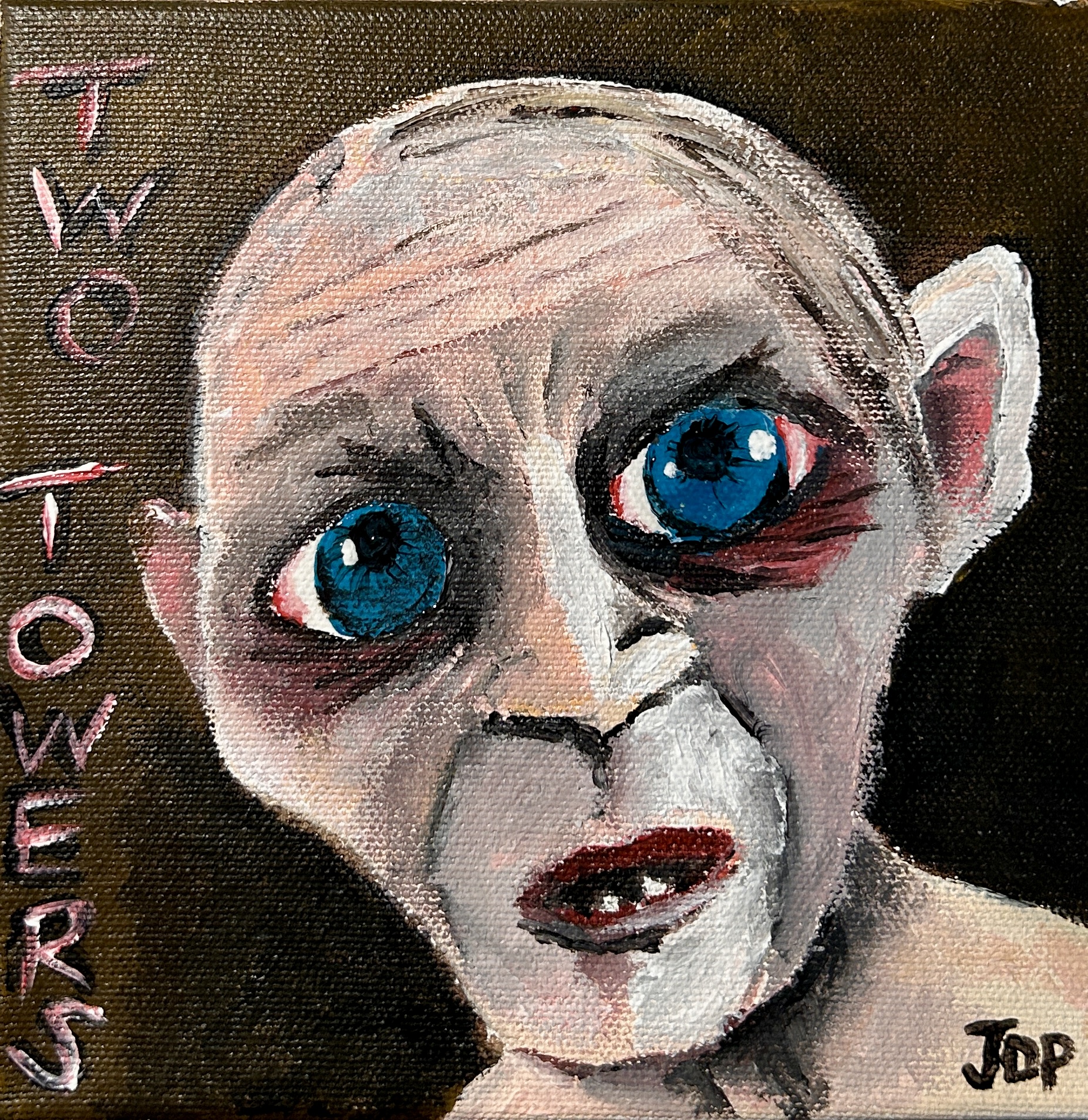
    Gollum by Julie Paterson

    Multicellularity, sticking more than one cell together to form more complex organisms occurs on page 709/916. Pippin and Gandalf have ridden to Gondor and are meeting with Lord Denethor​ (The Return of the King – The Siege of Gondor).

    “Before long he was walking with Gandalf once more down the long cold corridor to the door of the Tower Hall.”

    The Cambrian Explosion, a point in time where we see fossils suddenly appear for almost all modern groups happens on page 803/916. We have sped past the journeys with Gollum, the encounter with Faramir and the Oliphaunt, and Gollum’s betrayal of the hobbits to Shelob and arrive at Sam rescuing Frodo from orcs after he has been poisoned by the spider (The Return of the King – The Tower of Cirith Ungol)

    “At that rage blazed in Sam’s heart to a sudden fury.”

    Land is colonised by plants and animals on page 833/916.The siege of Gondor is in full swing and Denethor perishes in a bonfire meant for the wounded Faramir (The Return of the King – The Pyre of Denethor).

    “Gandalf in grief and horror turned his face away and closed the door.”

    Reptiles, particularly lineages leading to dinosaurs become dominant by page 847/916 (The Return of the King – The Houses of Healing). Aragorn, Gandalf, Pippin and the wounded Merry reunite after the Battle of the Pellenor Fields​ where the Mordor forces have been beaten back and the Witch King destroyed.

    “And get the pipe out of my pack, if it is unbroken.”

    The extinction of the dinosaurs and many other things occurs on page 893/916 where Frodo and Sam are lost in the mountain border of Mordor (The Return of the King –The Land of Shadow).

    “The tops of the Morgai were grassless, bare, jagged, barren as a slate.” ​

    The Primate lineage that becomes the Hominids, our ancestors, evolves​ on page 906/916. Frodo and Sam, starving and thirsty, approach Mount Doom through the surrounding wasteland (The Return of the King – Mount Doom).​

    “Then let me carry it a bit for you.”

    Finally, on page 916 we come to the last 5 million year. Frodo and Sam are slumped on the slope of an erupting Mount Doom after destroying the ring (The Return of the King –Mount Doom). All of human history​ fits into the last sentence

    “Here at the end of all things, Sam.”

    So is this effective? I guess one needs to know the story to get the full effect but even just looking at the page numbers will give you the right idea. Most of the interesting stuff happens in the last few pages. Almost nothing much happens in the first two thirds. Life, itself, arrives surprisingly early.

    I feel like it helps me with to work with the notion of lots of time.

    It’s only forever, not long at all

    sings David Bowie in the song Underground in the Movie Labyrinth. The more I think about it, the more I think that this is a very perceptive line.

    Still, I am out of time for now. I’m off to celebrate my granddaughter’s birthday.

     The author, Adrian Paterson, is a lecturer in the Department of Pest-management and Conservation at Te Whare Wānaka o Aoraki Lincoln University. He has experienced a lot of time.

  • The munchy mountain mystery of the lost bark beetle!

    The munchy mountain mystery of the lost bark beetle!

    Have you ever bitten into a slice of bread, only to find out that it’s gone mouldy? Yuck! But what causes mould, and how does it spread? This was a mystery solved by scientists in the 1800s.

    Fungal branches. CC BY-SA 4.0 Rafał Szczerski

    Mould in bread is caused by a fungus (fungi for multiple). Fungi are made of many tiny branches that grow into a huge maze. These branches reach out to find food from the environment around them; the branches spread from a central point to search for food at the edges. As resources run low, the middle of the fungus dies, creating an expanding ring of live branches. There are many types of fungi out there, and mould is one type that we try to avoid when we store our fruit, vegetables, and bread. When scientists discovered fungi, they solved one mystery, but there are new questions to be answered.

    One mystery involves a type of insect that loves to eat fungi: beetles! Specifically, beetles in the group called Brontini. These little guys eat fungi when they are larvae (baby beetles before they’ve become adults). Usually, the these larvae eat fungi under the bark of trees, but recently a special Brontini beetle was found. This beetle, called Protodendrophagus antipodes by scientists, lives up in the mountains of New Zealand, above the treeline in the alpine zone. Protodendrophagus antipodes is a long name, so we’ll call them Anti.

    Anti (Protodendrophagus antipodes) larva. Photo credit: John Marris.

    Anti are special for more than one reason. First, they live way up in the cold alpine area, which is a harsh environment to live in. The freezing temperatures and dry environment even stop trees from growing there! Second, every other species of Brontini beetle feeds on fungi under tree bark. Confusingly, the area where Anti lives doesn’t have these fungi. Since it’s too high up the mountain for trees to grow, there’s no fungi under tree bark for the beetles to munch on. And so, one group of enthusiastic scientists decided to figure out what these little guys eat. Let’s meet our investigators!

    Our team is made up of three skilled diet detectives: John Marris (“The Mastermind”) – the strategic leader who knows the ins and outs of beetles; David Hawke (“The Brains”) – a science whiz with a flair for chemistry; and David Glenny (“The Sidekick”) – your friendly neighbourhood plant expert. Together, the team solved the mini mystery in the mountains: where is the food for Anti?

    Lichen on rock. CC BY 4.0 Caleb Catto

    In 2018, the team went into the Southern Alps on an exciting trip to examine the scene and gather more evidence. They found two very important clues. First, there were lots of lichens in the areas where the beetles live. Second, sometimes the beetles lived where there wasn’t anything else to eat. I bet you can guess what our prime menu suspect is!

    You’ve probably seen lichens around, though you may not have known what they were. Lichens grow on trees and rocks, but they’re not just one species; lichens are an example of a “symbiotic relationship”. This is when two organisms work together to boost each other’s chance of survival. In this case, the organisms work so closely together that the lichen itself is actually made up of both species! The body of the lichen is a strong skeleton built from fungus. Inside that skeleton live algae, plant-like organisms that can use the sun to make food. In this way, the fungus keeps the algae safe, and the algae feed the fungus. Win win! Cha-ching!

    Spores from a fungus. CC BY 4.0 Aurora Storlazzi

    Since lichens are made up of fungi, this seemed like a pretty good place for our detectives to start. Every good private eye needs evidence to make their case. Thankfully, our clever detectives saw a way to test their theory: the stomach contents of the beetles! They collected some Anti as “evidence” and looked at the food in their stomachs. Inside they found spores that came from a lichen fungus.

    “What is a spore?” you may ask. Remember that maze of branches that make up a fungus? Well, sometimes the branches can’t find enough food for the fungus to eat. If that happens, the fungus has a new strategy to survive: spores! These are little circular pieces of fungus that can spread to new areas and find the fungus a better home.

    CC BY 4.0 Luis Prado

    But their work wasn’t done yet: the detectives found more than just lichen spores in their beetle stomachs. They also found a whole bunch of mystery food which they couldn’t identify. The scientists needed to confirm that lichens really are the only food eaten by Anti. So, the scientists put their thinking hats on and decided to find a new way to solve this puzzle. They chose to use an approach called the “stable isotope test”.

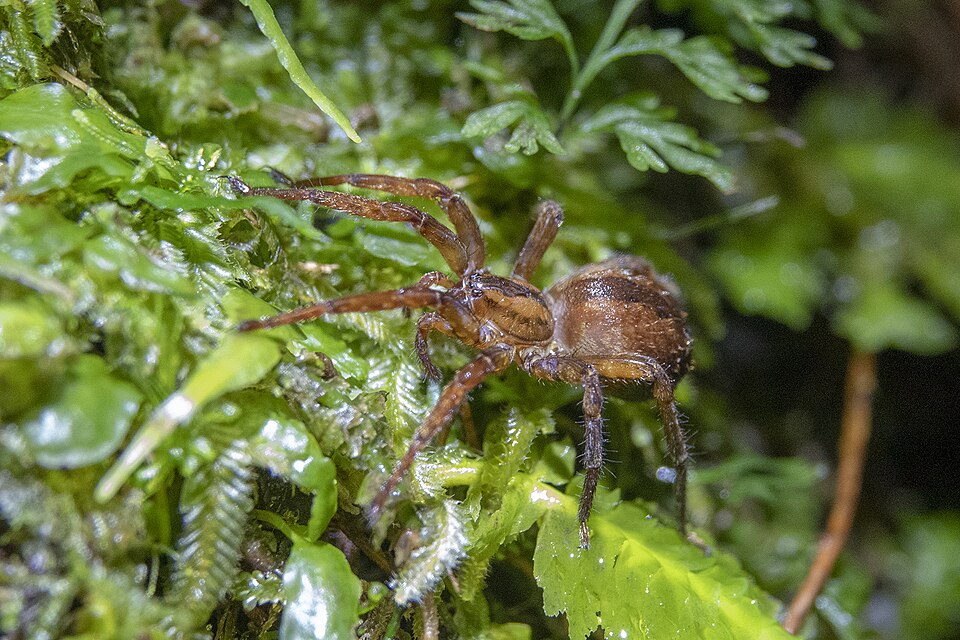
    An isotope is a special form of elements, such as nitrogen and carbon, and organisms at the bottom of the food chain absorb them from the environment. If an animal eats something, then the isotopes of the animal should be pretty similar to its food.To solve this mystery, the scientists tested the isotopes of Anti and all of the potential foods in the area. A good detective looks at all the possible solutions, so they tested the soil, the mosses, the lichens, the tiny mountain plants, and even a type of spider.

    At last, the detective work was done. Their test showed just what we’re all thinking: the Anti beetle really does eat lichen. The link was so clear that David Hawke called it a “textbook example” of the test in action. The scientists were very excited because lichen-eating is pretty rare for beetles.

    After all their investigation, the detectives could finally declare: “case closed!” Now we have a new mystery: how do these beetles survive in the extreme cold of the alpine zone?

    This article was prepared by Master of Science student Heidi Allan as part of the ECOL608 Research Methods in Ecology course.

  • The genetic mystery behind “clonal” plants

    The genetic mystery behind “clonal” plants

    Hey plant lovers! Let me share something incredible with you about the plant world. Some clever plants have discovered a super cool way to multiply without needing seeds or pollen from other plants. It is called apomixis. Think of it as nature’s way of letting plants create mini-me versions of themselves. These amazing plants can thrive and spread their families far and wide, even when life throws them some challenges.

    Want to meet one of these botanical wonders? Say hello to Pilosella, which includes the common hawkweed. These remarkable plants are not just special because of their unique family-growing style, they also teach us lessons about how plants adapt and stay strong when their world changes around them.

    Apomixis: Nature’s Reproductive Shortcut

    In Pilosella, scientists found that this cloning trick is actually controlled by three special gene regions, kind of like switches on a circuit board:
    Switch 1: LOA – avoids meiosis, the normal gene-splitting step,
    Switch 2: LOP – avoids fertilisation, so eggs grow into plants without needing pollen,
    Switch 3: AutE – lets the plant build the food-filled tissue (endosperm) that supports the developing seed.
    Together, these three “super switches” turn regular sexual reproduction into a smooth, pollen-free process.

    The LOP locus: the key to clonal reproduction

    Let’s zoom in on one of those switches: the LOSS OF PARTHENOGENESIS locus, or LOP. It’s the part of the genome that tells the plant, “Hey, go ahead and make a seed, even without any pollen.” That means the egg cell doesn’t need fertilisation to start developing into a full plant.

    Using some clever genetic detective work, Ross Bicknell (former Plant and Food scientist), Chris Winefield (Lincoln University), and five other researchers mapped this LOP region to a small section of the genome, 654 thousand base pairs long (which is small, considering plant genomes can be billions of bases in total length). They did this using a special technique involving polyhaploids — basically, plants that carry only a single set of chromosomes, which helps make genetic signals easier to read.

    The role of the PAR gene and jumping DNA

    One especially interesting gene in the LOP region is called PARTHENOGENESIS, or PAR for short. This gene is a key player in apomixis, and it shows up in other plants like dandelions, too.

    Dandelion flower (left) and a seed head (right). From learn.colincanhelp.com/know-your-weeds-dandelions/

    Here’s where it gets wild: scientists found that the active version of PAR (the one that triggers cloning) carries a little hitchhiker — a transposable element, or “jumping gene”, stuck in its promoter region (the bit that controls when the gene turns on). This jumping gene acts like a sneaky switch that flicks PAR into high gear, telling the plant: “Start cloning!”

    Even cooler? This transposable element-based activation seems to have happened independently in different plant groups — dandelions, hawkweeds, and their cousin Hieracium all show this trick, but with slightly different transposable elements in different spots. It’s like nature reinvented the same superpower in different ways, a phenomenon known as convergent evolution.

    So, are these plants just cloning machines?

    Not quite! For a while, scientists thought apomixis might be an evolutionary dead-end — after all, if you keep making copies of yourself, you might miss out on helpful mutations or adaptability and you steadily pick up flaws that you can’t get rid of. But Pilosella proves that’s not always the case. These plants can reproduce both ways: by cloning or by mixing genes with other plants. That means they can pass on their tried-and-true genetic blueprints or shuffle the deck when times get tough.

    In nature, this flexibility is a huge bonus. It lets them survive droughts, colonise poor soils, and hang in there when pollinators are scarce, and still adapt to new environments when needed. It’s the best of both worlds.

    Why this matters for the environment

    These clever plants are like nature’s survivalists. Their ability to reproduce without pollination means that they can spread quickly, especially in harsh places like dry grasslands or alpine meadows.

    But here’s the twist: sometimes they’re too good at it. In places like New Zealand, hawkweeds can become aggressive invaders, crowding out native plants. My own mother, for example, considers them total pests in her lawn!

    Scientists want to understand the genetic switches behind apomixis (like the LOP locus) to figure out how to manage or even control these fast-spreading plants, or perhaps one day harness apomixis for crop breeding.

    What this means for the future of plants and food

    Building on our exploration of the Pilosella plant and its unique LOP locus, let us dive into how plant genetics deepens our understanding of the natural world. As scientists examine these complex genetic blueprints, they uncovered valuable insights about:

    • How our green friends cleverly adapt to our changing climate
    • The super-smart ways that plants figure out how to survive and flourish in tough spots
    • Cool possibilities for helping crops grow better, even when the weather gets tricky

    But wait, there is more! This exciting research is not just about one plant, it is opening doors to better farming methods, helping protect our precious plant species, and finding clever ways to help plants weather the storms ahead.

    Let’s wrap this up

    Our exploration of Pilosella and its powerful LOP locus shows that even a so-called “weed” can teach us big lessons about evolution, resilience, and the future of farming.

    So next time you’re out for a walk and spot a humble hawkweed or dandelion, take a second look — you’re staring at a tiny miracle of plant reproduction, a living clue in one of nature’s greatest puzzles.

    This article was prepared by Bachelor of Science with Honours student Sienna Zeng as part of the ECOL608 Research Methods in Ecology course.


    References

  • Invasive predators may alter the personalities of New Zealand’s native birds

    • A recent study published in the New Zealand Journal of Zoology suggests that introduced invasive mammalian predators are changing the personalities of native birds.
    • Researchers compared two populations of kakaruai/South Island robins in similar forest habitats, one from the predator free island of Motuara and one from the main island, where introduced predators are present.
    • In the experiment, robins from the main island were more shy and less bold when they could pick up presented food items close to the researchers.
    • This suggests that a selection pressure from introduced predators favours individuals that are less bold and more cautious, potentially shifting personality traits of individuals in populations under predation pressure in the long term.
    Petroica australis. (C) Copyright Maximilian Hanschmann - all rights reserved.
    Petroica australis in the Hawdon Valley (Arthur’s Pass). (C) Copyright Maximilian Hanschmann – all rights reserved.

    New Zealand’s robins are well known for their curiosity driven behaviour, but they are at risk and the populations are declining.

    The small birds only weigh 35g and can survive up to 17 years – given that they are safe from invasive predators.

    While still occurring on the main islands and doing better than many other species endemic to New Zealand, that evolved in the absence of any mammalian predators, the robins struggle to survive since several predatory mammal species have been introduced to New Zealand by humans.

    During their evolutionary history in New Zealand, the birds never needed to coexist with these predators and as such act in a naive way towards them, making them an easy prey for ship rats, possums, stoats, weasels and feral cats.

    Introduced predators are a big problem for robins, even if populations survived until now, they are struggling where predators are present, a fate they share with almost all remaining native bird species. Predators will prey on eggs, nestlings, fledglings and adult females in the nest, leading to skewed sex ratios, where there are many more males than females in the population. The risk of nest predation is seven times higher where mammalian predators are present, and the life expectancy of adult birds is reduced by roughly 75% compared with areas free of predatory mammals.

    Petroica australis on the West Coast of South Island. (C) Copyright Maximilian Hanschmann – all rights reserved.

    In a recent study published in the New Zealand Journal of Zoology, researchers looked at different populations of the kakaruai/South Island robin (Petroica australis) to assess the impact of mammalian predators on their behaviour.

    Individuals in two different populations, living in a similar native (kanuka Kunzea ericoides dominated) forest habitat but with a different exposure to introduced mammalian predators, were studied. One population lives on the predator free island sanctuary of Motuara and originates from a population that was never under the influence of mammalian predators, except for rats. The other population lives in two connected patches on mainland New Zealand, close to Kaikoura and is exposed to mammalian predators present at the site, including feral cats, stoats, ferrets, weasels, rats, mice and possums.

    The aim was to assess the boldness of the robins or the willingness to take risks, which can vary among individuals within a species and can be influenced by environmental factors.

    A robin in Nina Valley. Image from Adrian Paterson

    To assess the propensity to take risks (known as the ‘shyness-boldness’ continuum) of the birds, mealworms were presented as food items at different distances to the researchers (proximity as a risk). It was then noted how long a bird took to pick the first item up (approach time) and how long a bird took to pick up all the food items (handling time). The quicker the bird approached and the more time it spent close to humans, the bolder it was considered.

    The results showed that robins not under influence of predators had a significantly bolder personality. They were much more likely to quickly come as close as 30cm to the researchers and spent more time handling the food as robins that live on the mainland, under the predation pressure of various introduced mammals.

    These findings suggest an evolutionary selection pressure against bold individuals in the robin populations that are exposed to introduced predators. The predation risk has the potential to select for certain personality traits that correlate with reduced predation risk, favouring shyer birds.

    The findings highlight the big impact of introduced predators, influencing the behaviour and possibly evolutionary outcomes. Individuals that are more cautious around predators are less likely to get killed and have a greater chance to have more offspring, promoting their personality traits in the next generations. These effects are likely not limited to robins, but likely also apply to other struggling native bird species that survived until now.

    The researchers also point out the importance of considering behaviour in conservation actions, as shy individuals should be chosen for reintroduction or supplementation programs in areas where predators are present, to increase the chance of survival.

    Robin and trail camera in Nina Valley. Image from Adrian Paterson.

    What you can do:

    • Spread the word! Talk with other people about biodiversity issues and how to solve them.
    • Value the unique native ecosystem of New Zealand and its vulnerable species.
    • Promote no-go areas where birds breed and in core areas of vulnerable ecosystems.
    • Lobby for better regulations and environmental standards.
    • Use your vote in elections to support the effort to safe New Zealand’s unique, but highly endangered biodiversity.
    • Control predators on your property. Help others controlling predators.
    • Plant native plants from your region. Remove non-native plants, even if they are “pretty”.
    • Participate in citizen science (e.g. iNaturalist) and help to detect various species.
    • Be a responsible cat owner: cats should be microchipped, registered and unable to reproduce uncontrolled. Consider walking your cat on a leash or ensure it can’t leave your property. New Zealand’s native species are exceptionally vulnerable to predation! Feral populations are not only a huge issue for non-adapted, vulnerable species, but also an animal welfare problem for the feral cats.
    • Be a responsible dog owner: dogs should be microchipped, registered and unable to reproduce uncontrolled. Walking your dog on a leash reduces the negative impact on wildlife. Dogs are among the gravest threats for adult kiwi, as they can kill a kiwi by just giving it a playful push (kiwis don’t have a sternum and are incredibly vulnerable). Ensure the dog can’t leave your presence.

    This article was prepared by Master of International Nature Conservation student Maximilian Hanschmann as part of the ECOL608 Research Methods in Ecology course.

    Read the full study here:
    White, R., Rossignaud, L., & Briskie, J. V. (2023). The bold bird gets the worm? Behavioural differences of South Island robins (Petroica australis) in relation to differing predation risk. New Zealand Journal of Zoology, 51(2), 334–349. https://doi.org/10.1080/03014223.2023.2255165

  • Climate change and biodiversity: predicting impacts of the sixth mass extinction

    It is widely known that some 66 million years ago an asteroid hit the Earth, contributing to mass destruction and extinctions, most popularly of the dinosaurs. But did you also know that a very common animal class, birds, are direct relatives to avian dinosaurs? They are literally the only dinosaur descendants. The American Museum of Natural History sheds a light on this, and also names some non-dinosaur animals that persisted through the asteroid impact.

    While tough, thick-skinned crocodiles and alligators surviving may not come as a surprise; frogs, lizards, and some mammals living through the Chicxulub asteroid (with a diameter of 10 to 15 km) impacting with the Earth surely is impressive! If they hadn’t made it through who knows if we would be here today? Those survivors are the origin of our current biodiversity.

    Sadly, this biodiversity is now threatened by one of its own. Many species are going extinct because of us humans. We overuse finite resources, pollute and destroy natural environments to build cities, malls and farms, import invasive species that out compete native ones, … The list goes on.

    There is one really important factor to add here: climate change. By burning fossil fuels, such as coal, gas, and oil, we release gigantic amounts of CO2 into the atmosphere: 37.55 billion metric tons in 2023 alone. The CO2 and other greenhouse gases produced block the escape of heat from the Earth, and our atmosphere becomes warmer. Not only does it become warmer globally, but extreme weather events, such as floods, droughts and storms, become more common, and sea levels rise due to expanding oceans, as well as glacial and polar ice melting.

    Climate change already has a major impact on our planet’s biodiversity. It affects 1,688 threatened or near-threatened species listed in the IUCN red list, a categorisation of the threat status of species, and has been ranked the 7th most important “biodiversity killer“.

    Concepts central to climate change causes and consequences. CC BY-SA, author: typographyimages (pixabay.com)

    Steps are being taken to slow climate change on an international scale, though they haven’t been too successful so far. Governments issue restrictions on emissions produced by industries, promote the use of public transport, and invest in renewable energy production. In 2015, 196 countries signed the Paris Agreement. This created an international plan of action to limit global warming to 1.5°C above the average global temperature in pre-industrial times.

    Even though these measures are being taken, it is likely that climate change will continue to increase in importance for the biodiversity crisis. Measures to limit greenhouse gas emissions will have a delayed impact on the global climate. Thus, the effect of our current emissions will only become visible in 10-20 years‘ time, and in the coming decades, climate change will intensify as a result of past emissions.

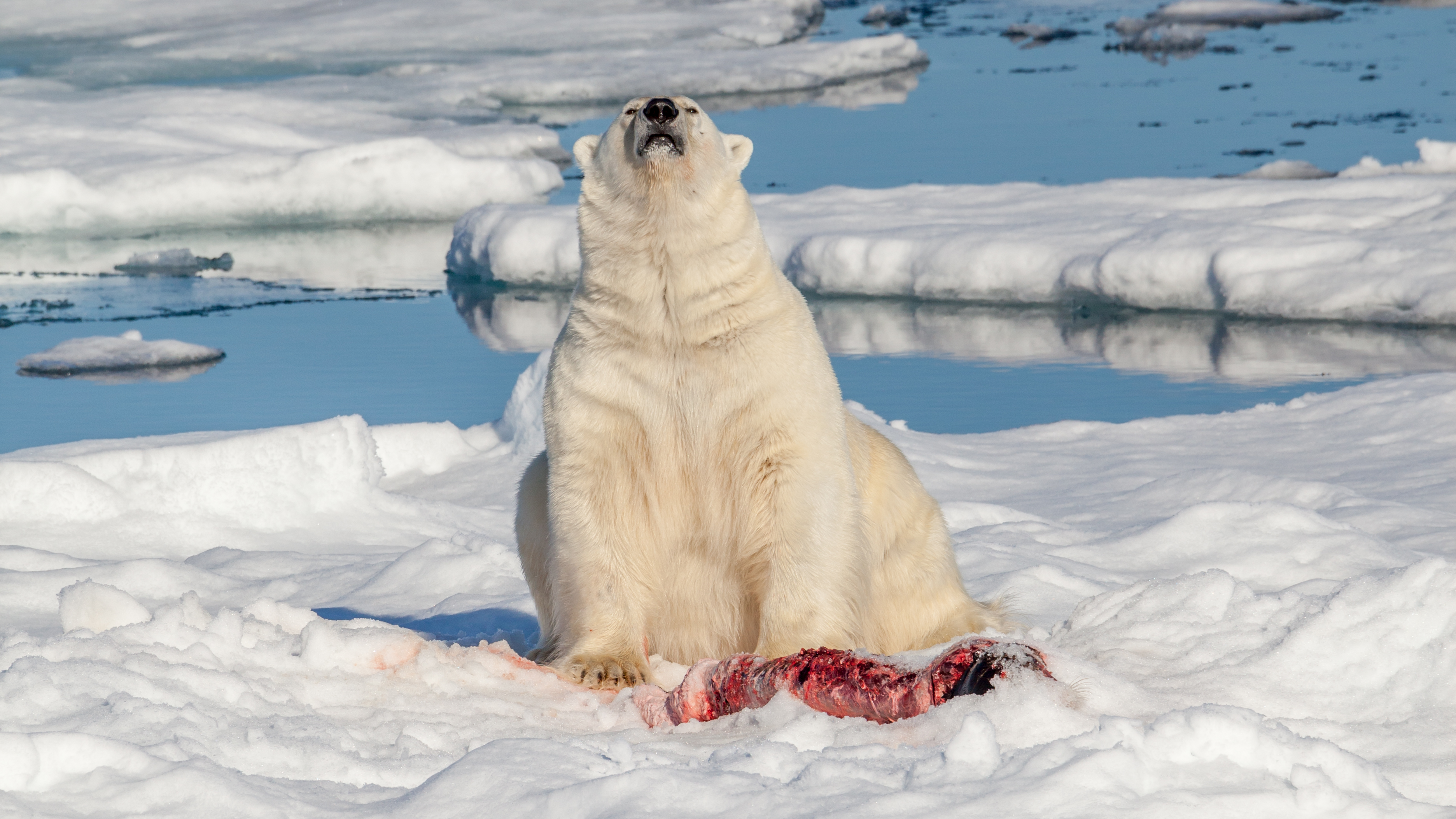
    As this is the case, we need to think about what it means for the Earth’s biodiversity. One of the most famous examples of the impacts of climate change on species are polar bears (Ursus maritimus). They only live in the Arctic, which is warming twice as fast as any other region of the world. There, polar bears live and hunt for seals on the ice shelves. Due to higher temperatures, the ice melts and the bears quite literally lose their home and their hunting territory, easily becoming undernourished and sick. To add insult to injury, Arctic warming makes the huge oil and gas fields under the ice more accessible, so that some countries and companies have started exploiting the Arctic. As Greta Thunberg would say, “How dare you?“.

    Polar bears are just one example to illustrate how a species is affected by climate change. Of course, its impacts vary between ecosystems and species, and a polar bear has different challenges to an alpine plant or desert mammal.

    Polar Bear. Creative Commons, author: Andrea Weith.
    Polar Bear eating a seal. CC BY-SA, author: Andrea Weith.

    It has become common for biologists to make predictions on how a species will react to climate change. Historically, only the current climatic conditions of a species’ home range were used to simulate how that range could shift with climate change. Those predictions are then used to inform conservation decisions, which is why it is important that they are as accurate as possible.

    Unfortunately, those conservative models lack a lot of information. If we think back to the polar bears, losing its habitat and hunting range hugely impacts the species, but other associated factors also will influence how they fare in the future. For example, it is predicted that the higher energetic costs of hunting due to climate change will impact female reproduction, and reduce the number and size of healthy litters. Modelling a population with its current demography (its reproductive, survival, and mortality rates), can lead to unrealistic projections, because it doesn’t account for possible future changes to it.

    A study by Urban and multiple colleagues, including Lincoln University’s William Godsoe, looked at ways to improve the accuracy of biodiversity predictions in the face of climate change. They found that including just six biological factors would drastically improve the accuracy of models. Data on the demography of the species, its interaction with other species, its evolution and responses to environmental changes can strongly affect modelling results. So can information on how good it is at dispersing (spreading) as well as its physiology (bodily functions). However, though it may sound easy to include those factors, we lack this data for most species. It is always a challenge trying to make predictions more accurate but lacking data to do so.

    A few strategies can be used to make up for this lack of data. For example, one could focus on modelling the future of keystone species, those that have a more important impact on their environment than others do. Or, researchers could focus on species that are supposedly more sensitive to climate change than others, because if we protect those, others likely also would benefit.

    Unfortunately, with our current knowledge, it is mostly a guessing game to know which species will survive the burden of climate change that we put on the Earth. Though progress has been made, and more integrative predictive models suggested, we still have many questions to answer. Which will be the modern equivalent of birds to the dinosaurs? Or of the crocodiles, reptiles and few mammals that survived the Chicxulub?

    Though predictions always have uncertainty, trying to make the models better by including more information is really important to help us better protect our rich biodiversity!

    This article was prepared by Master of International Nature Conservation student Leonie Kock as part of the ECOL608 Research Methods in Ecology course.

    M. C. Urban et al. (2016) Improving the forecast for biodiversity under climate change. Science Vol. 353, Issue 6304, aad8466. DOI:10.1126/science.aad8466

  • Thistle do me: a fussy biocontrol beetle

    My mother makes a great liver and bacon. Like many cooks who have spent decades on a sheep farm she is also a dab hand with a great mutton roast, scones, and sponge cakes. She can also preserve fruit at a moments notice. The highest compliment I every received for my own infrequent cooking attempts was from my son when I made some excellent gravy – “Well, he is Nanny’s son” he explained. Family feasts around birthdays and Christmas are common at my mother’s house.

    Edith’s fish pie

    One curious dish that makes an appearance amongst the roast veggies and mint sauce is a dish of fish pie. It’s not a typical part of most peoples’ ‘event dining’ but it is a regular for us in amongst the more high flying hams and legs of lamb. Mum’s humble fish pie is tasty, with lots of eggs and white sauce, and the right amount of rice and corn. More impressively, my sons, my nieces and nephews also love it.

    When someone needs a perk up, they’ve been unwell, or they are passing through on their way to a cold, old student flat, a bowl of Nanny’s fish pie will arrive. When there are lots of different options on a laden table, there is always room on your plate for the fish pie.

    Family gathering, three brothers, empty fish pie dish in centre!

    I can understand how I like it, I’ve been eating it all of my life. I guess it is the same for the grandchildren. It’s a constant and comforting food. I’m sure that every family probably has a similar dish.

    How ingrained are food preferences? Do we build them up over a lifetime of experience or do we arrive with inherited preferences? Perhaps a bit of both? It can make a difference.

    Thistles, from the Cardueae tribe, have been introduced into New Zealand, mostly by mistake as passengers with more useful seeds. Like many other species, thistles have done well here and have established in large numbers and with wide distributions. One of the worst is the Californian thistle (Cirsium arvense), close relative of a nearly as successful invader, and a little more photogenic, Scotch thistle (Cirsium vulgare).

    There have been many attempts to control the spread of these thistles with varying, but generally unsuccessful, outcomes. Ideally, it is great to have a solution that can work without too much effort on our part. A successful biocontrol agent can fit that prescription.

    The green thistle beetle (Cassida rubiginosa) forages and lays eggs for their larvae to grow on species from the Cardueae tribe. This creates problems for health and survival of these plants. Excellent, a solution to our prickly problem!

    Cirsium

    Not so fast. Cardueae is a large group (over 2400 species with many natives in New Zealand). The last thing that we need is a beetle that chomps up lots of the species that we are trying to protect. We also don’t want a beetle that gets distracted by eating other species when it should be eating the target. We’ve been there and done that (see the mustelids brought into NZ to eat the rabbits! Oops). We need to know that this beetle is a little more fussy in its likes.

    A Lincoln-based group, including Jon Sullivan from Pest-management and Conservation, have tested the preferences of the green thistle beetle. They have published in Pest Management Science. They selected 16 different plant species from the Cardueae tribe. Beetles were given the chance to eat each species either with no choice (plonk the beetles on a plant and see what they do) or choice (allow them to select between any pair that is presented to them).

    Crucially, the evolutionary relationships were known between the different plant species. Ideally we want the beetles to only eat thistle species of interest and not just anything vaguely similar (just those that are closely related).

    Green thistle beetle samples in Lincoln University Entomology Research Museum.

    When given no choice the beetles tended to make the best of what was offered. When you are really hungry then that marmalade is edible even if you don’t like it! Give the beetle a choice, however, and they go for the species that is most closely related to the Cirsium species. In fact this was such a strong preference that the researchers were able to conclude that the green thistle beetle is very unlikely to become a problem for anything other than the thistles that we want to control.

    The green thistle beetles are born with preferences for the type of plant that they want to eat and to lay their larvae in. These preferences allow them to adapt and specialise more fully to these plant species. New Zealand does not have any native Cirsium, or other closely related species. So the beetle can go forth and munch to their hearts’ content.

    So, was I born with a hankering for mum’s fish pie? Well it is an old family recipe, so the preference for it probably has passed down through our lineage, probably as something that we re-learn every generation. Now if I get some grandchildren, I will have to make sure that they are exposed to fish pie at an early age!

    Adrian Paterson is a lecturer in Pest-Management and Conservation at Lincoln University. He has a lot of preferences that he would like to explain!

  • The big, bold, redbacks of Buckland

    No, Mr Baggins has gone away. Went this morning, and my Sam went with him: anyway, all his stuff went. Yes, sold out and gone, I teller. Why? Why’s none of my business, or yours. Where to? That ain’t no secret. He’s moved to Bucklebury or some such place, way done yonder. Yes it is – a tidy way. I’ve never been so far myself; they’re queer folks in Buckland. No, I can’t give no message. Good night to you!” JRR Tolkien – The Fellowship of the Ring

    One of the greatest illustrations of Tolkien’s work, IMHO, The Gaffer and the Black Rider by Stephen Hickman.

    I’ve always liked this passage where old Gaffer Gamgee is talking, unbeknown, to a nazghul. It is an important story point but delivered in the type of conversation that you could hear all over the world. ‘Those people that live 20 – 30 km away are just so different and weird!‘ Are the people of Buckland really so different to the good, honest folk of the Shire? If so, how did this happen by simply crossing a river?

    There is a question around invasive species whether the individuals that arrive in a new area are just a random selection of the individuals (and their traits) that live in their home area or whether they represent a group of individuals with consistent and particular traits that make them more likely to have successfully invaded the new area.

    For example, all humans in Aotearoa/New Zealand have arrived from outside these shores over the last 1000 years. Were the people that made their way here more bold and explorative than the rest who stayed behind? Or were they no different than their neighbours who stayed at home? Maybe they just simply had the opportunity to go?

    These ideas are important in thinking about why invasive species are successful at establishing or not. If any old random subset of the population can turn up then they are less often going to successful at establishing (they may not be fit-for-purpose!) compared to if they arrive with skills that allow them to survive better in a new environment (or even to survive the journey).

    Being large might help give invasive individuals an advantage over native species. Likewise, producing more offspring, growing faster, being bold, exploring more, dispersing sooner, having a broader diet, could all help with invading and establishing.

    What about our Bucklanders?

    Long ago Gorhendad Oldbuck, head of the Oldbuck family, one of the oldest in the Marish or indeed in the Shire [has had high evolutionary fitness over many generations], had crossed the river [successfully able to disperse relative to other hobbits and to explore more], which was the original boundary of the land eastwards. He built (and excavated) Brandy Hall, changed his name to Brandybuck, and settled down to become master of what was virtually a small independent country. His family grew and grew [high fecundity in offspring production], and after his days, continued to grow, until Brandy Hall occupied the whole of the low hill, and had three large front-doors, many side-doors, and about a hundred windows. The Brandybucks and their numerous dependants then began to burrow, and later to build, all round about … The people in the Marish were friendly with the Bucklanders … But most of the folk of the old Shire regarded the Bucklanders as peculiar, half foreigners as it were [suggests a slightly different distribution of traits compared to the parent population].Though, as a matter of fact, they were not very different from the other hobbits of the Four Farthings. Except in one point: they were fond of boats, and some of them could swim [bold and innovative behaviours].” JRR Tolkien- The Fellowship of the Ring

    Captive redback with web. Image by Adrian Paterson.

    We are also told elsewhere that the Brandybucks and Tooks (another bold lineage of hobbits) are generally taller than average Shire hobbits. Tolkien, as I have said in many other places (taxonomy of orcs and hobbits, evolutionary biology ideas, burrow architecture, mammal pest management, fire and ecosystems), was rather accurate when it came to integrating biology into his writing. Did he get it right here?

    To test this invasion idea you need a species that is well-studied in it’s native range as well as in its colonising range. You also need to be able to measure all of those traits. Spiders fit the bill nicely. They’re small and have short generations, are easy to fit into small experimental set ups, and some are venomous and, therefore, well studied. Enter the redback spider (Latrodectus hasselti), invasive in Japan and New Zealand and well studied in its Australian homeland.

    Cor Vink, New Zealand’s leading arachnologist, joined a group based in Toronto, Canada headed by Monica Mowery, to look at individuals from these three areas. They measured the size of individuals (bigger is usually better in interactions with competitors), their egg sac production (producing more young may give you more opportunities for at least some surviving), and length of generation times in captive populations (shorter allows for faster replacement, longer allows for larger more long-lived individuals).

    A redback – amazing photo from the talented Bryce McQuillan

    They measured the behaviour of the redbacks, such as frequency of cannibalism (you never know when a snack might come in handy!). Also, individual spiders were placed in a new environment and the speeds at which they started spinning webs (exploration) or moving after being exposed to a puff of wind (boldness) were measured. Spiders were also placed into a warm arena with a small simulated breeze to see whether they would balloon (effectively float away in the wind) or rappel (climb using their web silk) away from the start point (dispersal).

    The outcomes from this work were published in Biological Invasions. Redbacks from the invasive populations showed more dispersal behaviour than the home populations. They also tended to be larger in size, more cannibalistic, and produced more offspring. Interestingly, the redbacks in Japan and New Zealand did not seem to be more bold or explorative than in Aussie. Overall though, the invasive populations looked and acted differently to the source population.

    It appears that populations that successfully disperse and establish in new areas might do so because they are settled by individuals with useful traits that differ a little from the source population. This may help us to figure out which species potentially pose the most invasive threats.

    What about those strange Bucklanders? The Gaffer was mostly right. They are a bit different. Bucklanders are a population that managed to successfully disperse to an isolated area. Bucklanders are larger and more fecund. Tolkien does not record whether the Bucklanders tended to be more cannibalistic than hobbits in the Shire, but that would be a prediction!

    We can certainly sympathise with the Gaffer’s concerns about his Sam going to live among them.