Cirsium arvense is commonly known as the Canada thistle in USA and Californian thistle in Canada. No one wants to take responsibility for these prickly things. They actually come from Europe where they are called creeping thistles.
This thistle is a small weedy plant that can be a potential nightmare for New Zealand farmers. According to the NZ Ministry for Primary Industries, (2021), it cost the country $722 million in lost revenue in the year 2020 alone, up from $31 million in 2009.
Photo by Make It Old (Flickr User)
Given the disruptive nature of this weed, Wendy Kentjens, a budding weed ecologist with the passion for gardening, along with her supervisors, Seona Casonato and Clive Kaiser, decided to learn more about controlling the Californian thistle population on New Zealand pastures.

To understand why Californian thistles are so weedy, Wendy decided to study the interesting microscopic world of the endophytes living inside, and how they may help or hinder the plant.
Sounds straight forward! Well, it was far from that.
Here is a summary of the challenges Wendy faced while carrying out research on Californian thistles.
‘Ah the prickly little devils…’ – Working with the thistles meant cuts and scratches all through the research.
‘Miss Unpopular, conducting pot trials at the nursery.’ – Turns out, planting weeds that no one likes is a fast way to make some frenemies.
‘The sheep ate my data!’ – Wendy found that the sheep initially didn’t eat thistles on pastures, but when they got infected with a rust fungus (Puccinia punctiformis), it made it very tasty for the sheep. She talks more about using rust fungas as a biocontrol agent in her paper “Californian thistle (Cirsium arvense):endophytes and Puccinia punctiformis” (Kentjens et al., 2024).
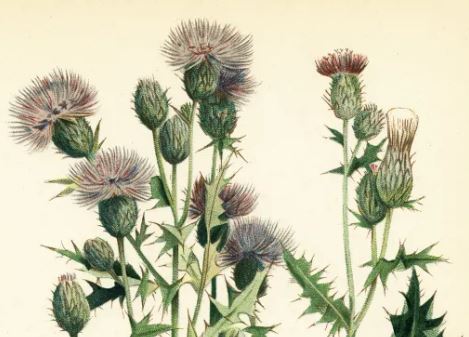
‘Hard to photograph the entire plant.’ – It can be really hard to see all the features of a plant from a single photo; Wendy’s mum made her a pencil drawing of the weed for her thesis.
Figure drawn by Marion van Cruchten
How do you find the microscopic endophytes within the thistle?
To find all the endophytes present in these thistles, the bottom, the middle, and the top leaf of the plant were all cut into small 5 mm2 pieces and placed in a petri dish over a growing medium. Then, spore by spore, each different looking fungus was isolated into new growing dishes and incubated.
Voila! Now Wendy had pure cultures of all the fungi she had found and was all ready for the next step.
DNA from these pure fungal cultures was collected and identified.

What did they find inside?
A total of 88 genera of fungi were cultured from the plant tissue, of which 65 were not previously associated with Californian Thistles.
The diversity found was a significant increase in our understanding of this infamous weed and what lives within its structure that makes it supposedly invincible.
Fungal biocontrol can be an effective tool against these weeds. However, Endophytes can alter outcomes of a host–pathogen interaction. A recent study published by Manaaki Whenua (Landcare Research), found that 60% of all rust fungus released as biocontrol had a medium effect on the weed host or a variable effect. Around 15% of all rusts released as biocontrols have failed to become established at all.
There could be a number of reasons for the variable or unsucessful results. In the case of the invasive Japanese knotweed (Fallopia japonica), two of the endophytes accociated with the weed (Alternaria sp. and Phoma sp.) hindered the establishment of fungal biocontrol by suppressing the production of rust pustules (raised masses of coloured spores that rupture epidermal leaf tissue). (Den Breeyen et al., 2022).
Understanding these organisms living within the thistle will help future studies on the effective use of fungal biocontrol in fighting these “lovely” weeds. Looking at the endophytes and how they are helping these weed propogate so sucessfully will help us get one step ahead of it and hopefully find biocontrol agents that can circumnavigate these endophyte-host relationships.
Note that the figure drawn by Marion van Cruchten is currently under review by the European Journal of Plant Pathology titled ENDOPHYTIC DIVERSITY AND COMMUNITY COMPOSITION OF CIRSIUM ARVENSE TISSUES OVER A GROWING SEASON. Authors Wendy Kentjens, Seona Casonato, and Clive Kaiser
This article was prepared by Master of Science student Dee Patel as part of the ECOL608 Research Methods in Ecology course.
References:
Den Breeyen, A., Lange, C., & Fowler, S. V. (2022). Plant pathogens as introduced weed biological control agents: Could antagonistic fungi be important factors determining agent success or failure? In Frontiers in Fungal Biology (Vol. 3). Frontiers Media S.A. https://doi.org/10.3389/ffunb.2022.959753
Kentjens, W., Casonato, S., & Kaiser, C. (2024). Californian thistle (Cirsium arvense): endophytes and Puccinia punctiformis. In Pest Management Science (Vol. 80, Issue 1, pp. 115–121). John Wiley and Sons Ltd. https://doi.org/10.1002/ps.7387
Kentjens, W., Casonato, S., & Kaiser, C. (2024). Endophytic genera in californian thistle (Cirsium arvense (L.) Scop.). Australasian Plant Pathology, 53(2), 199–210. https://doi.org/10.1007/s13313-024-00972-w
Ministry for Primary Industries. (2021). Economic costs of pests to New Zealand (Nimmo-Bell & Associates, Ed.; Paper No: 2021/29). Ministry for Primary Industries. https://www.mpi.govt.nz/dmsdocument/48496-Economic-costs-of-pests-to-New-Zealand-Technical-report
– figure drawn by Marion van Cruchten is currently under review by the European Journal of Plant Pathology titled ENDOPHYTIC DIVERSITY AND COMMUNITY COMPOSITION OF CIRSIUM ARVENSE TISSUES OVER A GROWING SEASON. Authors Wendy Kentjens, Seona Casonato, and Clive Kaiser