Category: conservation

  • Under Cover of Darkness: Moon Brightness and Mammalian Predator Activity

    Under Cover of Darkness: Moon Brightness and Mammalian Predator Activity

    Written by Kate McDowell

    Last June, I found myself several hours into what would end up being a sixteen-hour run, in the middle of the night, on the coldest weekend of the year. As the ground visibly started to freeze in front of me, I realised that my head torch was struggling in the negative temperatures. Its battery couldn’t cope with the cold exposure. But you know what, I had a trick up my sleeve; it was a full moon.

    I was guided by the incredible illumination of the moon on a clear winter night, and by how few animals I saw apart from the sheep and cattle of Lake Taylor station. As I left the station and entered Lake Sumner Forest Park, my headtorch flickered in the biting sub-zero temps of mid-winter New Zealand near the Southern Alps. I had barely heard a sound since nightfall, apart from my own crunching footfalls on freshly frozen tussock.

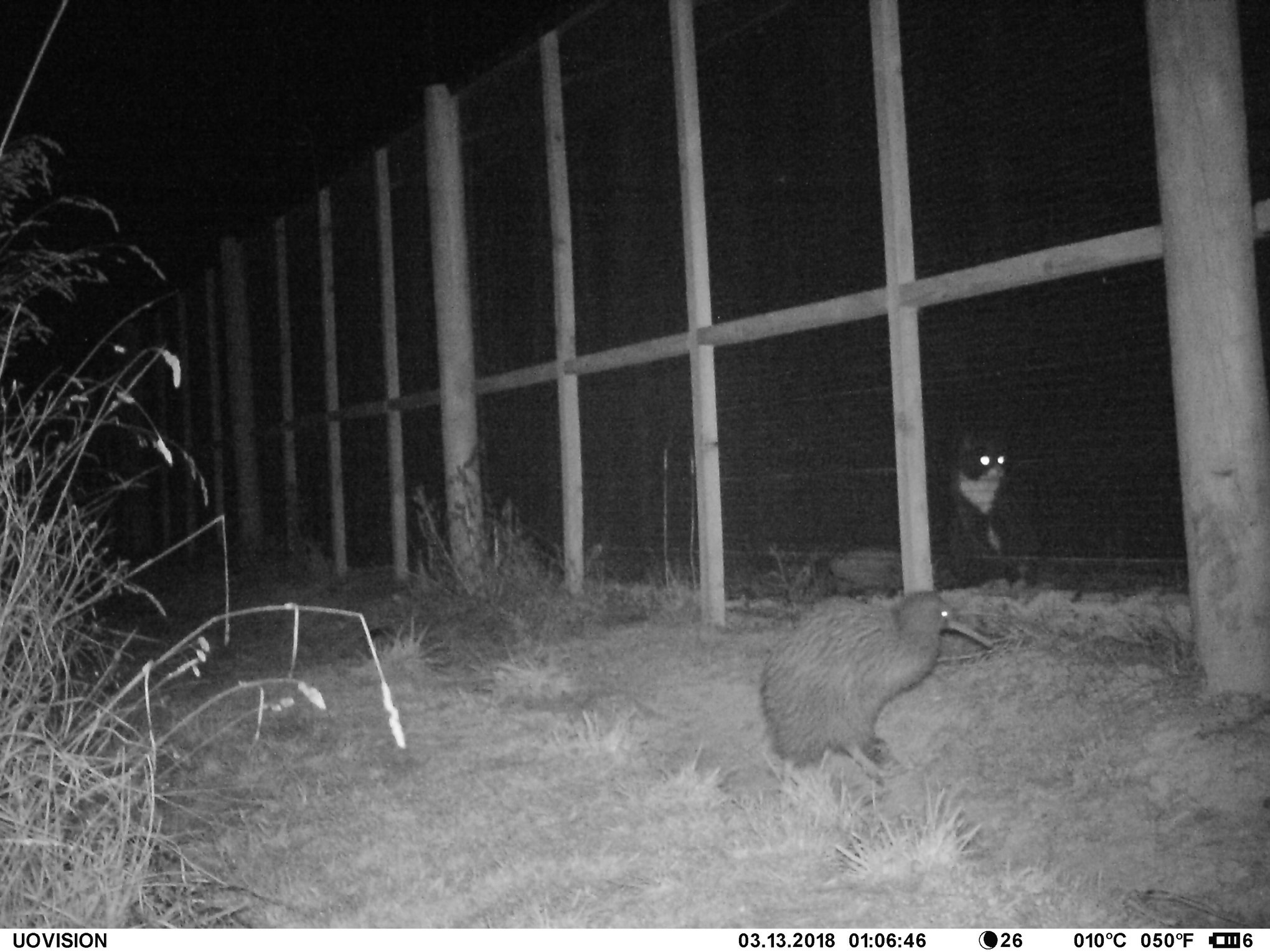
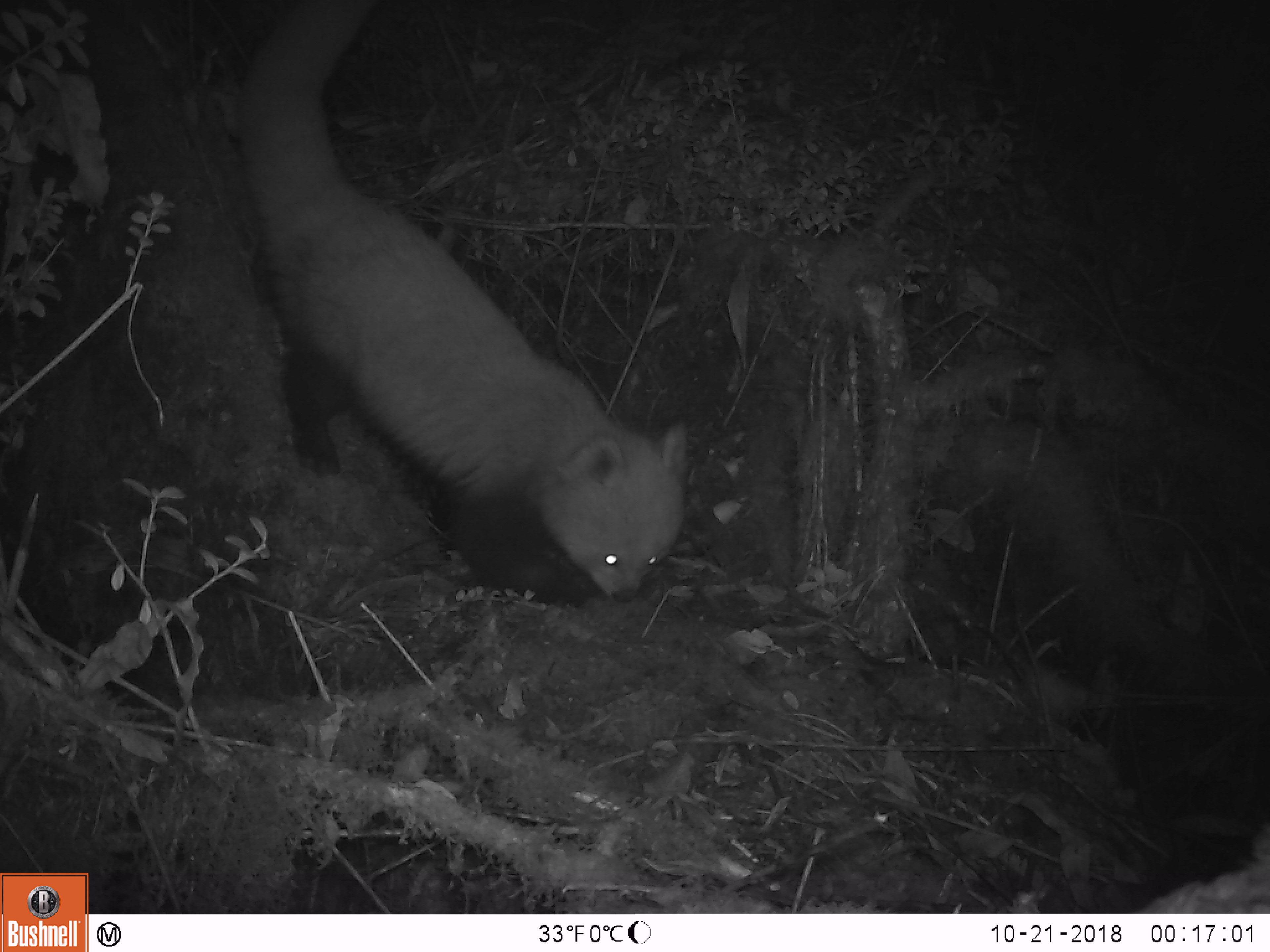
    There were no pest animals dancing in the moonlight that chilly midwinter run, and I found myself wondering if our mammalian pests changed their activity based on how bright that big ball of cheese in the sky was. In 2016, Shannon Gilmore did a neat study on the effects of moon phase and illumination on activity of five introduced NZ mammals (cats, rats, mustelids, possums, hedgehogs) for her thesis at Lincoln University. 

    A trail runner foolishly runs 16 hours over an alpine pass, whilst being watched by introduced predators who may or may not be contemplating consuming the body of said runner. [Source: Chat GPT AI, Kate McDowell]

    I seemed to be one of the few introduced mammals blatantly puffing my way up the North Branch Hurunui riverbed. I have this strong memory of looking down and watching myself be followed by my own moon shadow. It made me question – how many eyes were following me in the dark canopy of the nearby beech forest?

    Gilmore found that increased vegetation cover and rain were contributing factors to pest detection. Sites with dense canopies had higher detection rates, potentially because they provide better shelter and reduced exposure from threats like light. While rainfall was not a statistically significant factor, pest activity generally decreased with rainfall. Gilmore suggested this may be because it is cold or the rain might be disrupting the animal’s sense of smell.

    So maybe my paranoia about forest animals staring me down wasn’t so crazy after all. It was certainly interesting to think back on the run and how many introduced predators there could have been in the nearby beech forests. The conservation implications for understanding where predators are and why they might change their activities also gave me some things to mull over the next day.

    Detecting these introduced predators is essential for informing control efforts; we need to know where predators are and how many of them are in a given area. Environmental conditions may be obscuring the predator’s true activity levels. Gilmore added to previous studies of moon phase effects on mammals by accounting for interaction effects of weather and vegetation. Whether these effects were caused by the lower light levels or by something else not explored in this study is yet to be answered.

    Many studies have looked at the role of moon phase and animal activity, but in 2016 few studies had investigated the additional factor of the moon’s brightness. Gilmore was the first to measure hourly light levels through the night and looked at how it affected the activity level of the nocturnal pest species. A highly sensitive light meter (Sky Quality Meter, or SQM) to measure illumination levels between moon phases in the Blue Mountains (Otago), Banks Peninsula (Canterbury) and Hawkes Bay.

    Gilmore found that while moon phase could not explain pest activity, moon illumination did. As the dark side of the moon grew larger, pests seemed to thrive under cover of darkness and became far more active. When the moon hits a mammal’s eyes, Gilmore theorised that they may be spurred to hide. Most introduced mammals in NZ are prey in their native countries and it is hard to say whether a single century of living without their native predators has changed their behaviour.

    SQM successfully managed to detect differences in illumination between moon phases and under different canopy cover levels. Canopy cover was found to have a larger impact on illumination than moon phase. SQM findings on Banks Peninsula suggested that on darker nights a pest is more likely to be active.

    Building on earlier research, Farnworth, Innes and Waas (2016) released a paper looking at the effect of light on mouse foraging behaviour. This study agreed with Gilmore’s results, finding that mice displayed strong preferences for foraging in unlit areas. Farnworth et al. further built on Gilmore’s conclusions by contemplating that artificial light could provide protection from predators in ecologically sensitive areas – for instance, in areas where predator proof fences have been breached by a tree limb dropping on it.

    Predator proof fence study by ZIP scientists showing a rat trying to escape. [Source: ZIP (Zero Invasive Predators Ltd), used with permission]

    The innovative organisation Zero Invasive Predators (ZIP) completed an interesting follow up study in 2018, focusing on whether or not light could deter rats from entering an area. They found that although light did not limit rats passing through, they were less likely to linger in lit zones. Their conclusion: illumination could be used in a layered deterrent system, where light is used to slow down pests.

    Conservation in NZ is generally hamstrung by lack of funding. Efficiency is key to making the most of the meagre dollars on offer, so studies like Gilmore’s can help optimise monitoring and control operations. So when that bad moon comes a-rising, you can bet that pest control and monitoring will be less effective, and it would be more useful to focus efforts during darker nights.

    I definitely felt exposed running through a riverbed under a full moon, so I can appreciate how light can serve as a useful predator deterrent. It’s another tool we should add to the belt as we work toward a predator-free country.

    We’ve reached the end of our illuminating lunar article, but the real question now is how many song references did you pick up on? 😉

    This article was prepared by Master of Science student Kate Morrison as part of the ECOL608 Research Methods in Ecology course.

    Paper: Gilmore, S. (2016). The influence of illumination and moon phase on activity levels of nocturnal mammalian pests in New Zealand (Master’s thesis, Lincoln University).

  • Detecting red panda, dancing with Kate Bush

    Detecting red panda, dancing with Kate Bush

    I’ve been a fan of Kate Bush since she released ‘Wuthering Heights’ when I was 10 years old. She famously does not tour or give shows and so I have never had the chance to see her live. A couple of weeks ago a tribute act ‘An evening without Kate Bush’ came through Christchurch. Great! I booked tickets and dragged Julie along.

    My wife is a long suffering SOKF (spouse of Kate fan), but she was happy to indulge me. Little did she know what was in store. It was a great show. Sarah-Louise Young danced and sang very well and was quite funny. Kate Bush always walks a fine line between quirky and bonkers. The Piano audience had a good time.

    The show was quite interactive. At one point Sarah-Louise asked what our favourite Kate song was. I stuck up my hand and she came over. In addition to the song (Get out of my house), she was interested in whether Julie was a fan (not particularly) and how long we had been married (30 years).

    As she turned to go, Julie added “Oh and Adrian proposed to me in a Kate Bush way.” Well that was that. Julie was then explaining The Dreaming album cover, the ring, the kiss and so on. Much hilarity ensued.

    The show continued on. We got to ‘Don’t give up‘, the song sung by Peter Gabriel with Kate. Sarah-Louise wanted a couple to come onstage and of course that was us. We had to slow dance for the song (much as happens in the video). That’s 6.5 minutes, or an eternity on the stage.

    So, there we were, literally, in the spot light, in front of 325 people. I didn’t find it too bad. I focused in the dancing and not tripping over. Julie was very uncomfortable and most definitely not herself. We reflected later that I am more used to ‘performing’ as a lecturer in front of crowds. Julie is a teacher but only has much smaller groups to perform to.

    I think that we did OK. It turned out that there were a couple of people in the audience who new us and messaged that we did some good dancing (probably they were just happy that they hadn’t been picked to do it).

    As we quietly swayed and turned on stage I did reflect on how the knowledge of being observed really does affect the behaviour of individuals. This links through to my research where I am often making observations of individual birds and mammals.

    A gaggle of red panda! Image from Sonam Tashi Lama

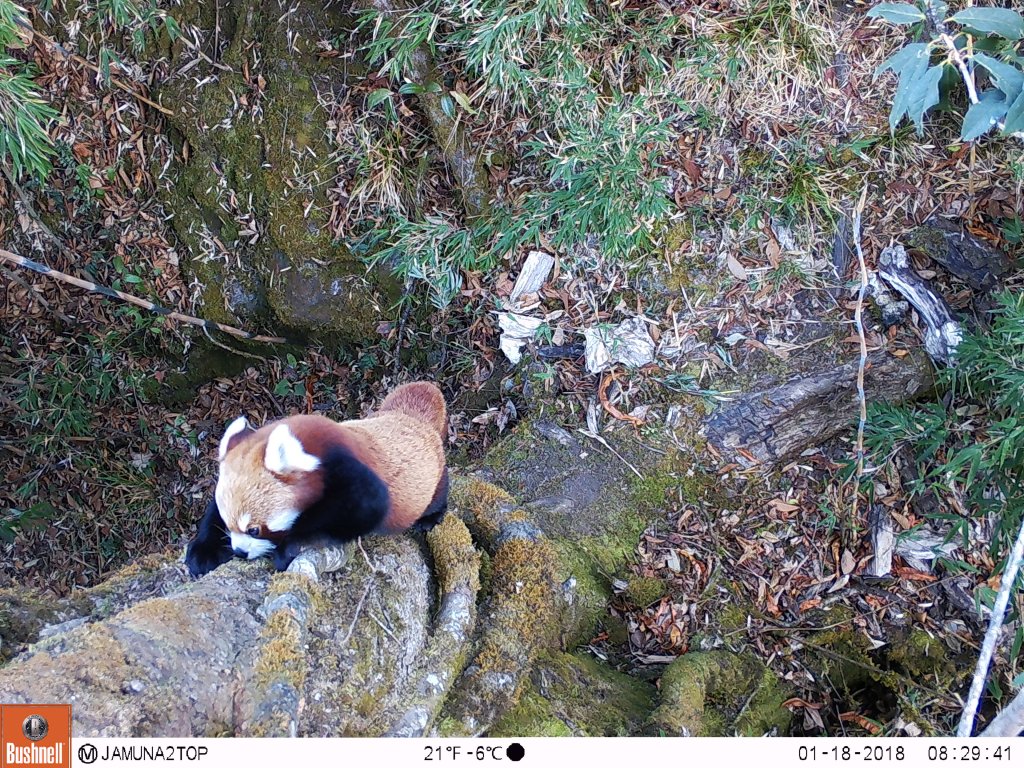
    Recently, we have been using trail cameras to get a better understanding of red panda, and other mammals, in their habitat of eastern Nepal. In these areas red panda are relatively cryptic and declining. Grids of cameras offer a way of observing red panda over long periods of time without humans needing to be nearby.

    Cameras can tell us about the distribution of species over daily and seasonal cycles (Collecting mammals: camera traps in eastern Nepal). We also observed that panda do notice the cameras and that this can lead to subtle changes in their behaviour (I see you: Sauron and the panda).

    In this work with Sonam Tashi Lama (Red Panda Network), and published in the Wildlife Society Bulletin, we set up 19 sites in the alpine forests of eastern Nepal. At each site we had two cameras, one set up in a typical manner at ground level and the other in the tree canopy 5 m above. The cameras collected data over several months.

    We found that red panda were active over the whole day (gotta eat a lot of bamboo and other vegetation!) but activity peaked around dawn and again at midday.

    Arboreal cameras took four times as many photos as ground cameras. These were mostly of leaves blowing in the wind but they were eight times more effective at capturing red panda images. These behaviours included action activities (e.g. tree climbing), clear images of faces, and motion‐lite activities, like sleeping and grooming.

    Image from Sonam Tashi Lama

    So, now we know that cameras can affect the behaviour of red panda being observed and that the placement of the cameras can affect how successful our observations are. Is this a problem? Perhaps, but it is better to know there is a problem when we conduct future research. Also, the information that we are gathering, even if there is some biases, is still way better than not knowing anything.

    We will take the net gain in what we now know about red panda and that can help us with managing them and their habitat.

    It was nice to be reminded about how it feels to be observed. Whether it is 300 Kate Bush fans or a trail camera, there is a physical reaction to knowing that something is out there and perhaps it is watching you. It’s something to keep in mind when designing these studies.

    Oh and don’t put your hand up when you are in the audience of these kinds of interactive shows!

    Adrian Paterson is in the Department of Pest-management and Conservation at Lincoln University. Now that he thinks about it, he has spent a lot of his research prying into the private lives of animals.

  • How to help lizards in your back yard/paddock

    How to help lizards in your back yard/paddock

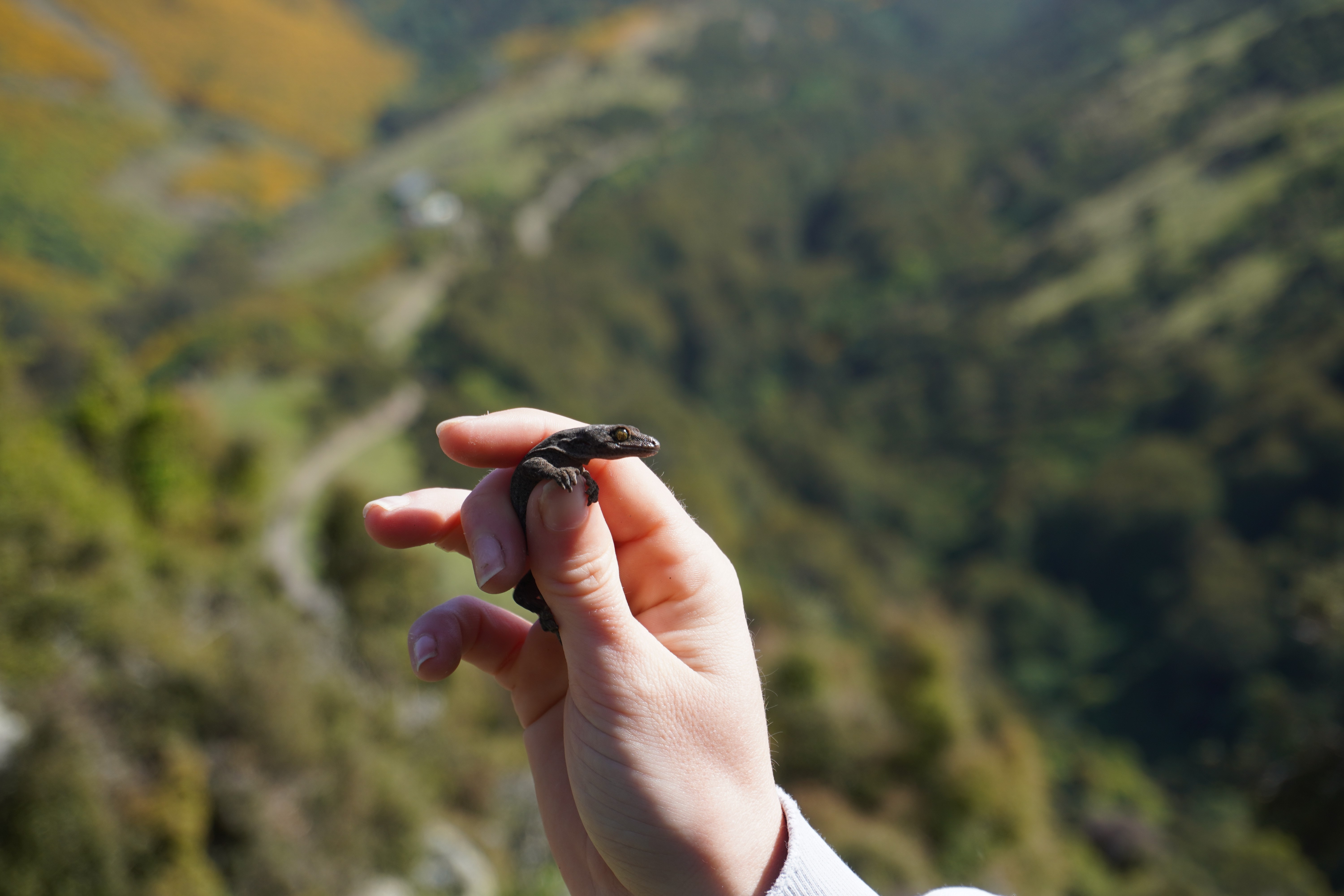
    Has your cat ever brought in a nice present only for you to find it’s a lizard? Have you seen a lizard scutling away on a nice sunny summer’s day while walking around the garden? Well, you may have lizards residing in your back yard!

    In New Zealand we have over 125 different lizard species, 76 are skinks and 48 are geckos, all but one one skink species is native. Of these 126 species, 49 (~36%) are Threatened and a further 67 (~50%) are At Risk (Hitchmough et al., 2021). Therefore 86% of our lizard species are threatened by various factors, such as predation, urbanisation, habitat fragmentation, and agricultural intensification.

    We all need to play our part to ensure that lizards do not continue to decline.

    There are simple tools we can use that can help the lizards in our back yard. Skinks love to hide under rocks and in small gaps when startled. Geckos love to live in tight crevices, like spaces in wood, stone and even in various human-made structures (e.g. power boxes and garages).

    We can create structures called Artificial Retreats (ARs) that mimic these natural retreats that lizards love so much. Artificial Retreats are a tool that we can easily implement that can support vulnerable lizards.

    Currently, artificial retreats have been designed for scientific monitoring and are commonly constructed from roof-cladding Onduline sheets, which isn’t an easily accessible or cheap material. My thesis investigated two other alternative designs that are constructed in a manner that is easily accessible to landowners and public members keen to do their part in lizard conservation.

    One AR type was constructed from a stack of three bricks (Figure 1) that have a 10 mm wooden dowel stuck between each layer so that the lizards can easily move between them.

    The second was constructed from two plywood sheets (Figure 2), bolted together, with the 10mm dowel in between the sheets.

    The third was the common Onduline design (Figure 3). I tested these ARs across Canterbury farms located at Cleardale Station in the Rakaia Gorge, as well as Flea Bay and Goughs Bay on Banks Peninsula.

    I captured 26 lizards to test in the three AR designs and there was no preference among the three. However, the geckos at Cleardale Station preferred some designs more than the Flea Bay lizards. At Flea Bay, the lizards were more commonly found in the brick (46%  of all geckos) whereas at Cleardale they didn’t use the brick ARs. At Cleardale Station, a equal number (17%) were found in both Onduline and wooden ARs. At Flea Bay, 17% lizards were captured and only 4% of lizards were found in the Onduline design at Flea Bay.

    Depending on the location of the property and the species of lizards present, there will be differences in which AR they prefer. Having an option of several different AR designs is preferable. 

    During the field trials I found that the ARs did not withstand heavy stock (cattle)interactions and were frequently interfered with. However, I did not have any problems with ARs placed in sheep paddocks.

    Landholders can implement any or all three of the designs into their property and all have a chance of lizard occupation. A variety of designs means that landholders can choose which AR design to use based on what available materials they have.

    Having a choice of AR designs make it accessible to whomever wants to conserve lizard species on their properties without having to spend large amounts of money or spending valuable time having to source the materials to construct the AR.

    Key design components and considerations when planning and building lizard ARs.

    • The ARs need to have at least one gap that has a 10mm gap.
    • Placed in an area where lizards or their poo have been seen.
    • Recommended not to be placed in a paddock in cattle.

    Acknowledgements: A massive thank you to the financial support for this project from The Brian Mason Trust and the North Canterbury Forest and Bird Trust.

    Reference

    Hitchmough, R., Barr, B., Knox, C., Lettink, M., Monks, J., Patterson, G., Reardon, J., van Winkel, D., Rolfe, J., & Michel, P. (2021). Conservation status of New Zealand reptiles, 2021.  

    Written by Sam Fitzgerald, a MSc student in the Department of Pest-management and Conservation at Lincoln University.

  • Collecting mammals: camera traps in eastern Nepal

    Collecting mammals: camera traps in eastern Nepal

    Collecting things seems to have deep roots in the human brain. There are few things more satisfying than finding something unexpected that you really need for your collection. The shock (woah!), the excitement (at last!), the surprise (how did this get here?), the urgency (I better grab this before someone else does), even though anyone standing close to you probably won’t care about this!

    My youngest son had a few years of thrifting where he would scour second-hand stores for ‘cool clothes’ that he could buy and then sell on for a reasonable profit to people who wanted that retro look but didn’t want to spend time searching. Edgar trained me up to spot certain brands, labels, styles and so on. For about five or six years I spent a lot of time browsing ‘dead peoples’ clothes’ as my middle son Arthur called them. I still remember a great trip with Edgar as I took him to a university semester in Dunedin. We struck gold in Waimate (a little off the beaten track) and found 30+ items!

    A small selection of Tanith Lee.Active from the 1970s till the 2010s – prolific and great for collecting! The Winter Players and Companions on the Road are two of my favourite (short) books ever. Image from Adrian.

    What do I collect? I guess there is a distinction between hobbies and collecting? I have a lot of small plastic figures that I love painting but I am not searching for some elusive or rare halfling commando. I buy a lot of boardgames and there are some older games that I might keep an eye out for, but I would count these as hobbies not collecting.

    Books, I have a lot of books…. Some of that is hobby – reading the latest books by Tad Williams or Lindsey Davis, for example. But I definitely collect some authors (Tanith Lee, Robert Howard) and spend time in second hand book shops with a list…. I still remember the day that I found the original D&D colouring book in absolutely mint, uncoloured condition! So rare! So elusive! All mine! (Sadly it has somehow gone missing from my collection in recent years!).

    Collected on camera – a red panda. Image by Sonam Lama

    As a zoologist interested in natural history, you are also dealing with collecting. Typically you want to collect the types of species found in an area. This tells us a lot about species diversity and richness, conservation, ecological interactions, evolutionary adaptations and so much more! This collection could be physical (like the hundreds of thousands of insect specimens found in our LU Entomology Research Museum) or it could be observational, where spotting an individual from a species can be logged (like with iNaturalist). But it certainly scratches the collecting itch.

    Observations can be direct (e.g. I saw that animal) or indirect (e.g. I found a footprint of that animal). Either way these are data that tell us that a species is found in the area. We are increasingly relying on indirect methods to collect observations – in fact much of our wildlife research here in Pest-management and Conservation is around developing better ways to monitor our mammal pests.

    Sonam Lama was a Master of International Nature Conservation student at Lincoln University. He had spent a lot of time working for the Red Panda Network back in Nepal. As part of his research, with Adrian Paterson and James Ross, he was interested in being better able to monitor red panda in the wild (but that will be another story!). Sonam was also keen to find what other species share the red panda habitat in far eastern Nepal. Were there many predators? Were there many competitors?

    Sonam in the forest of eastern Nepal. Image by Sonam Lama

    Sonam worked within the high altitude (between 2-4000 m abs) forests of Ilam, Panchthar and Taplejung, which provide a corridor between the rest of Nepal and India. Over this large area Sonam identified sites where he could put his 60 cameras. Typically the cameras were attached to the base of a tree. Observations from these camera traps were made through winter and spring. Results have now been published in the European Journal of Wildlife Research.

    So what did Sonam collect? Over 3000 camera trap days about 90000 images were recorded. Two thirds were false triggers (vegetation moving in the wind, sudden changes in temperature with sunrise and sunset) – such is the bane of the camera approach. About 11000 were of local people moving through the forest. Amongst all of this were over 5000 images of mammals, including 23 different species, and 3600 images of birds, including 37 species.

    Seventeen of these mammals were medium to large and could be identified. Red panda were observed. The commonly seen species were a deer – northern red muntjac, wild boar and leopard cats. The rarest were other cats: marbled cat (first record in Nepal), Asiatic golden cat and common leopard. The spotted lingsang was also collected for the first time, as was the first melanic (black) leopard.

    Collecting images and video also allows us to look at behaviour. We can get a sense of when species are active. We can see which species move around in groups. Wild boar foraged for tubers in front of the camera, red panda marked their territory, two porcupines mated! Red panda and macaques were active during the day, red foxes and porcupines were nocturnal.

    Collected on camera, a melanic form of leopard. A first for the region. Image by Sonam Lama.

    All of these collected images and videos provide little snapshots of natural history for these species, many of which are difficult to find any other way. Our understanding of potential threats for red panda has also increased. They definitely share their habitat with several potential predator species (and we found a few that were not even known from Nepal). Perhaps more importantly we were able to show that people are common in these habitats and that they are often accompanied by dogs. Good to know from a conservation point of view!

    Collecting images of different species using trail cameras is an increasingly common tool around the globe. It is becoming an essential tool for monitoring species. It doesn’t hurt that there is that thrill of the collector when you find an image of something surprising in amongst all of those misfires.

    This article was written by Adrian Paterson (Pest-management and Conservation at Lincoln University). Yes he is a collector ( I guess you could argue that he collects EcoLincNZ articles!).

  • Pesty plastics: Removing a problem from wildlife management

    Pesty plastics: Removing a problem from wildlife management

    We often put up with bad situations because they stop something worse happening. This can be as big as having nuclear weapons to stop major wars occurring. Paying taxes is a burden but it keeps a society healthy and connected. Not eating so much chocolate seems wrong but will give you better long-term health.

    And then we have plastic. Plastic must rank as one of the most successful of human inventions. It can be used in myriads of applications, keeps foods hygienic for longer, and allows more people to have the luxuries of the modern world. Plastic also causes incredible waste and we are still learning about the ongoing and long-lasting impacts that occur from the breakdown of plastics into smaller and smaller molecules.

    One of the biggest shifts in day to day life over the last decade or so is the movement away from plastic where possible. Many countries have banned (or are banning) single use plastics. I would doubt that there is anyone unaware of plastics as an issue for our sustainable future.

    Plastic figures from Cthulhu: Death May Die! A great game with great plastic figures (but some guilt comes with it!). Image from Adrian Paterson.

    One of my hobbies is in collecting and playing board games. Historically there has been a lot of plastic in games. Lately, there has been a real effort by gaming companies to make as much as possible from cardboard and wood and to remove stuff like shrink-wrap. (Although I do love me some great detailed plastic miniatures some of the time. I try to add use by painting them. Unfortunately, there is still nothing quite as good for sculpting as plastic. Hopefully that will change (see this approach using mostly wood shavings as a building matrix called re-wood).)

    As we have mentioned many times on EcoLincNZ, we do a lot of research on vertebrate pest management, especially in monitoring and detecting mammals, like stoats, deer, possums, hedgehogs (even elephants and leopards). Controlling these pests is vital for conserving New Zealand’s endemic biodiversity. We are very good at doing this and improving all of the time. Unfortunately, we use a lot of plastic.

    Our tracking tunnels, chew cards and wax tags all have significant plastic components. Some of these are single use, some can be used a few times, but there are always some that get left in the environment. Also, many of the places that we are interested in monitoring are, by definition, in areas that have low human impacts and very little exposure to plastic. And here we are bringing the plastic there.

    Tracking tunnels are made of plastic. Typically they can be used multiple times but many are left in the monitoring areas. Image from Adrian Paterson.

    Now, you could argue that a few negatives of using a relatively small amount of plastic is far outweighed by the good that using these devices does. And you would be correct. But what if we could have our cake and eat it too?

    Katie Pitt is a PhD student at Lincoln University. She and her supervisors, James Ross and Adrian Paterson, have just published a paper in New Zealand Journal of Zoology where they question the use of plastic in wildlife management and ask whether we can do better.

    Katie looked at how much plastic is munched up by species, like rats and mice, when they interact with chew cards placed in various habitats. These bits of plastic remain in the rats and then the environment even if the cards are retrieved. The plastic fragments are also much reduced in size by the nibbling and can move around much easier, through wind, rain and rodent stomachs. The removed chew card will also end up in landfills.

    Katie found that chew cards in Canterbury and Taranaki typically left 15% of their volume behind in the environment as nibbled bits. Given the scale of monitoring throughout New Zealand this can quickly add up to a lot of plastic in areas that typically have no plastics.

    A well nibbled chew-card. All that missing plastic is now on the forest floor or in the faeces of rodents. Image from Katie Pitt.

    There may be an alternative. Katie tested some new chew cards made from wood pulp, and so fully biodegradable. Of course we don’t want to use a product that is inferior to what we already use, especially for something as important as protecting our biodiversity. Katie tested the use of wood pulp chew cards alongside plastic models. She consistently found that they performed just as well in a range of conditions (including with a lot of rain!). Katie also found that prices per chew card were similar with scope for the wood pulp cards to eventually become cheaper.

    Is this a problem that people want to solve? Katie asked individuals from 30 organisations that work in pest monitoring and found that 97% were keen to move away from single-use plastics, as long as there was no major reduction in functionality and cost.

    So we have a problem, people want to solve this problem, we have an alternative, and this alternative seems to work as well as what we already have. Eat that cake and have it as well!

    There is still a bit of work to do to scale this up to the levels that we need if this is to replace the status quo. Katie is also looking at how we would replace tracking tunnels. But the future is looking bright. And plastic-free.

    Adrian Paterson is a lecturer in the Department of Pest-management and Conservation at Lincoln University. As a Twin Peaks fan from way back, he really wanted to use “She’s dead, wrapped in plastic” in this article.

  • PAPP: A humane toxin for feral cats in New Zealand?

    Can a cute-looking animal turn into a fierce demon? Yes, when cat moves from a snoring heap on your couch to hunting birds and reptile species. Cats have been silent killers in New Zealand for decades. It is estimated that 100 million of birds are killed by cats every year in New Zealand. As the sun sets, here comes the giant, big-eyed bully— FERAL CATS.

    At night, birds and other native species seek shelter in their homes, shutting their doors, but feral cats can break the lock and drag them out of their houses, feasting on them. That sounds demonic!

    Justice may be on the horizon. A charming, dashing, handsome saviour of the birds is coming. Ladies and gentlemen, of the bird world, and reptiles as well, let me introduce to you your saviour. Para-aminopropiophenone! That’s a big name for a saviour; let’s shorten this to PAPP (say it like ”pap”).

    PAPP being developed as a new, humane poison for feral cats by Connovation NZ Ltd. Importantly, mammals are more susceptible to PAPP than birds are. PAPP kills feral cats more humanely than previous toxins, as it acts faster and is less aversive.

    Two fierce demons hunting a poor little bird (Image by- Gilbert Mercier, Flickr user)

    News of the introduction of a new toxin on the market is spreading like wildfire in the wildlife world. “But we should never celebrate too early,” an old Kea is saying, and Old Ben Kokako adds “We must be cautious“.

    To measure PAPP’s effectiveness, a two-phase trial was conducted by researchers Murphy, Shapiro, Hix, MacMorran, and Eason. The first trial was undertaken at two sites in North Canterbury. The second trial was undertaken on the central plateau in the North Island. Cats were trapped in Havahart live capture traps and were radio-collared to monitor their activities. Submarine bait stations, which are designed to target cats only, were stationed in the field. Three infrared monitoring cameras were also placed to monitor cats’ activities in the field area.

    And the hunt begins… (Image by- Pinke, Flickr user)

    The cats were first pre-fed so that they got used to the bait. Toxic baiting was then carried out by placing meat baits (minced beef and minced rabbit) containing 80 mg of PAPP at bait stations. The birds were eagerly waiting for the results of the trials. “Patience is a virtue” is an old saying in the reptile family.

    Five out of eight radio-collared cats and six other cats were poisoned found dead at the site. That was a huge success for the team, as the trial results showed the efficiency of PAPP. Another result from the North Island was just as promising. 13 cats out of sixteen radio-collared were found dead, and there were three more without the radio collar. So, a total of 27 cats from both islands were found dead. The remaining radio-collared cats appear to have left the area before the poison-baiting trial started.

    The result was great news for the bird and reptile world. Some of the birds were still suspicious about PAPP’s effectiveness. The matter was solved when the researchers showed the results of an earlier cage trial in which 18 out of 20 cats died and suggested that PAPP is an effective new tool for feral cat control in the field. During this trial, the cats who partly ate the bait also died, which shows PAPP’s overall effectiveness.

    Another question raised by an old Canterbury gecko was "what about the susceptibility of birds and reptiles to PAPP?". As in Australia, studies suggested that bandicoots (small marsupial mammals) and varanid lizards were highly susceptible to PAPP. It was a matter of great concern for both researchers and the native animal world. But it was also resolved as there was no evidence that some non-target species were also eating PAPP in the NZ trials, as the submarine bait stations used in the trials helped ensure targeted delivery.
    cute but alert… (Image by- patrickkanavagh, Flickr user)

    The researchers concluded their findings by addressing the non-target delivery of PAPP by developing efficient delivery systems, like bait stations, tunnel systems, or specific bait presentations that exploit the cats’ foraging behaviour. They also found that PAPP is the most humane way to kill feral cats among all the toxins found on the market as cats died within one to two hours. It acts fast and is less aversive.

    It was a sigh of relief for birds and reptiles because they had found a saviour. PAPP is a great solution to eradicating feral cats more efficiently. It is a true silent killer and a good alternative to sodium monofluoroacetate 1080 (another toxin used for poisoning). 1080 also affects non-target species, when delivered aerially, whereas no such effects were seen in the case of PAPP when delivered through submarine bait station for targeted delivery. So, PAPP isn’t just a funny name, it’s a glimmer of hope for New Zealand’s wildlife, and a demon-slayer!

    This article was prepared by postgraduate student Sikander Nagal as part of the ECOL 608 Research Methods in Ecology course in his Postgraduate Diploma in Applied Science degree.

    Original Article- Control and eradication of feral cats: field trials of a new toxin

    Share this:

  • Sonic science to eradicate the hedgehog

    Helpful gardeners or destructive beasts? Hedgehogs could be the last thing standing in the way of restoring native wildlife.

    Most New Zealanders are aware of the current predator problem, with possums, rats and stoats taking the cake for the biggest pains, but what about cute little hedgehogs? Are they really as innocent as they look or are they discretely unravelling the very fabric of our treasured native wilderness? Some scientists went on a hedgehog hunt to find out.

    Now imagine the magnificent Ōtamahua: an 80 hectare island smack in the middle of the flooded volcanic crater of Lyttleton Harbour, completely uninhabited by people, but instead populated by some weird mini chickens with fancy hairdos. Back in the day, European explorers hadn’t decimated local wildlife populations yet, and the island was teeming with now extinct koreke New Zealand quails, inspiring them to call this place Quail Island.

    Quail Island is a recreation reserve run by the Department of Conservation (DOC) and is being restored to a natural landscape after being formerly farmed. In this programme, the Quail Island Trust and DOC teamed up with a plan to eradicate all exotic pest mammals from the island. Scientists were ready to restore the island to its original splendour by bringing back native insects, lizards and birds, but one thing could be standing in the way of this; the island is dominated by European hedgehogs, and they’re not going down without a fight.

    Photo by Flickr user nutmeg66 CC BY-NC-ND 2.0

    So what’s the deal with hedgehogs? Everyone seems on board with killing every invasive pest mammal out there like it’s a glorified action movie. Oddly, people tend to feel very differently about these freaky little spike balls. Unlike other mammals that were introduced in New Zealand, people love them. This is because they can be seen helping around the garden, happily munching on slugs and snails, which are considered pests. But it’s difficult to understand exactly how these slug-munchers are impacting native wildlife, all we know is that we have gravely underestimated them.

    What else is on the dinner menu for these hedgehogs? Aside from the snails and slugs in your garden, they enjoy eating native beetles of all sizes, with a side of millipedes, and then moth larvae and earthworms for dessert. Some have even developed a taste for weta. Hedgehogs also snack on lizards and the eggs and chicks of ground-nesting birds. The hedgehogs are hungry and this is a bad situation for these vulnerable species.

    In the distant future, the year 2000, researchers from Lincoln University decided to go to war with the hedgehogs. They did so using their most powerful weapon of all: science and the pursuit of knowledge. They tested their techniques on local hedgehogs before heading into battle on Ōtamahua Quail island. The scientists discovered that they could entice the hedgehogs with a feast of their favourite foods. They tested baits like “kitekat chunky fish cat food” and quail eggs.

    (It is worth noting that while the original quail island quails went extinct, they were replaced by introduced California quails, which is convenient because the island didn’t have to renamed.)

    Once the scientists got to Quail Island and came face to face with these adorable monsters, they realized that unlike other invasive mammals, hedgehogs were pretty chilled out. They didn’t mind being caught and released again, which meant that it would be possible to remove them from the island without bloodshed. At this point, the animal rights activists may be cheering and the conservationists may be booing. Not killing them means putting them somewhere else. Instead of removing the problem, we are just relocating it.

    Photo of Ōtamahua Quail Island by Jon Sullivan CC BY-NC 2.0

    So the Lincoln researchers got to work running around the island, setting up 53 hedgehog traps. Since there was actually no such thing as a hedgehog trap at this point, they used their smart brains and decided to use traps for other pests which were known to catch hedgehogs by accident. The systematic trials led the scientists to the conclusion that one of the most effective baits for catching hedgehogs was something called “Chunks of Tasti Dinner Dog Roll”. You just can’t make this stuff up. Cat food and peanut butter were similarly popular among hedgehog audiences but surprisingly, quail eggs were not!

    Here’s the bad news: hedgehogs had made themselves at home across every kind of habitat on the island. Also, the number of hedgehogs being caught each night didn’t decrease over the course of the 11-day study, leading the scientists to conclude that there were far more hedgehogs on the island than they had previously thought.

    The baited traps were placed across all habitat types on the islands, but had much less success around pine and macrocarpa forests. The traps had the most success in catching hedgehogs in grassy and scrubby areas. Could this be the hedgehog headquarters?

    This research provided some important insights into the possibilities of eradicating hedgehogs. They figured out which food is preferred and which types of cages work best. They found that the hedgehogs didn’t hang out in pine and macrocarpa forests as much because there weren’t as many insect snacks for them in there.

    Quail Island in the centre. Image from Adrian Paterson.

    This study found that live trapping hedgehogs is possible but it is inefficient. The project took 75 hours of work and only managed to remove 24 hedgehogs, that’s 3 hours per hedgehog! The scientists suggested switching to lethal traps because these Houdinis are clever masterminds and they could be escaping from the live traps.

    Are there other options? Some have suggested recruiting the help of our best friends, dogs. On another island, dogs were used to find and kill possums. Hedgehogs are smelly and hunting dogs can find them easily without even being trained. The only caveat is that dogs do have to be trained to ignore other species, especially native birds like the precious little white-flippered penguin, another resident of Quail Island.

    On the mainland of Aotearoa New Zealand, hedgehogs were found in densities of 5 hedgehogs per 1 hectare of land (which is the size of 2 rugby fields). This is probably not the case on Quail Island because it is so dry, but nonetheless it will take a lot of effort to remove these destructive little creatures.

    This is one case study for the eradication of hedgehogs. While the current focus is on eradicating other predator species, may this serve as a warning that we can’t forget about the humble hedgehog when we talk about predator control.

    This article was prepared by Master of International Nature Conservation student Lindsay Wood as part of the ECOL608 Research Methods in Ecology course.

    Research Article Source: Kavermann, M., Bowie, Michael H., Paterson, Adrian M. (2003) The eradication of mammalian predators from Quail Island, Banks Peninsula, Canterbury, New Zealand. Lincoln University Wildlife Management Report series. https://hdl.handle.net/10182/683

  • Invasive predators may alter the personalities of New Zealand’s native birds

    • A recent study published in the New Zealand Journal of Zoology suggests that introduced invasive mammalian predators are changing the personalities of native birds.
    • Researchers compared two populations of kakaruai/South Island robins in similar forest habitats, one from the predator free island of Motuara and one from the main island, where introduced predators are present.
    • In the experiment, robins from the main island were more shy and less bold when they could pick up presented food items close to the researchers.
    • This suggests that a selection pressure from introduced predators favours individuals that are less bold and more cautious, potentially shifting personality traits of individuals in populations under predation pressure in the long term.
    Petroica australis. (C) Copyright Maximilian Hanschmann - all rights reserved.
    Petroica australis in the Hawdon Valley (Arthur’s Pass). (C) Copyright Maximilian Hanschmann – all rights reserved.

    New Zealand’s robins are well known for their curiosity driven behaviour, but they are at risk and the populations are declining.

    The small birds only weigh 35g and can survive up to 17 years – given that they are safe from invasive predators.

    While still occurring on the main islands and doing better than many other species endemic to New Zealand, that evolved in the absence of any mammalian predators, the robins struggle to survive since several predatory mammal species have been introduced to New Zealand by humans.

    During their evolutionary history in New Zealand, the birds never needed to coexist with these predators and as such act in a naive way towards them, making them an easy prey for ship rats, possums, stoats, weasels and feral cats.

    Introduced predators are a big problem for robins, even if populations survived until now, they are struggling where predators are present, a fate they share with almost all remaining native bird species. Predators will prey on eggs, nestlings, fledglings and adult females in the nest, leading to skewed sex ratios, where there are many more males than females in the population. The risk of nest predation is seven times higher where mammalian predators are present, and the life expectancy of adult birds is reduced by roughly 75% compared with areas free of predatory mammals.

    Petroica australis on the West Coast of South Island. (C) Copyright Maximilian Hanschmann – all rights reserved.

    In a recent study published in the New Zealand Journal of Zoology, researchers looked at different populations of the kakaruai/South Island robin (Petroica australis) to assess the impact of mammalian predators on their behaviour.

    Individuals in two different populations, living in a similar native (kanuka Kunzea ericoides dominated) forest habitat but with a different exposure to introduced mammalian predators, were studied. One population lives on the predator free island sanctuary of Motuara and originates from a population that was never under the influence of mammalian predators, except for rats. The other population lives in two connected patches on mainland New Zealand, close to Kaikoura and is exposed to mammalian predators present at the site, including feral cats, stoats, ferrets, weasels, rats, mice and possums.

    The aim was to assess the boldness of the robins or the willingness to take risks, which can vary among individuals within a species and can be influenced by environmental factors.

    A robin in Nina Valley. Image from Adrian Paterson

    To assess the propensity to take risks (known as the ‘shyness-boldness’ continuum) of the birds, mealworms were presented as food items at different distances to the researchers (proximity as a risk). It was then noted how long a bird took to pick the first item up (approach time) and how long a bird took to pick up all the food items (handling time). The quicker the bird approached and the more time it spent close to humans, the bolder it was considered.

    The results showed that robins not under influence of predators had a significantly bolder personality. They were much more likely to quickly come as close as 30cm to the researchers and spent more time handling the food as robins that live on the mainland, under the predation pressure of various introduced mammals.

    These findings suggest an evolutionary selection pressure against bold individuals in the robin populations that are exposed to introduced predators. The predation risk has the potential to select for certain personality traits that correlate with reduced predation risk, favouring shyer birds.

    The findings highlight the big impact of introduced predators, influencing the behaviour and possibly evolutionary outcomes. Individuals that are more cautious around predators are less likely to get killed and have a greater chance to have more offspring, promoting their personality traits in the next generations. These effects are likely not limited to robins, but likely also apply to other struggling native bird species that survived until now.

    The researchers also point out the importance of considering behaviour in conservation actions, as shy individuals should be chosen for reintroduction or supplementation programs in areas where predators are present, to increase the chance of survival.

    Robin and trail camera in Nina Valley. Image from Adrian Paterson.

    What you can do:

    • Spread the word! Talk with other people about biodiversity issues and how to solve them.
    • Value the unique native ecosystem of New Zealand and its vulnerable species.
    • Promote no-go areas where birds breed and in core areas of vulnerable ecosystems.
    • Lobby for better regulations and environmental standards.
    • Use your vote in elections to support the effort to safe New Zealand’s unique, but highly endangered biodiversity.
    • Control predators on your property. Help others controlling predators.
    • Plant native plants from your region. Remove non-native plants, even if they are “pretty”.
    • Participate in citizen science (e.g. iNaturalist) and help to detect various species.
    • Be a responsible cat owner: cats should be microchipped, registered and unable to reproduce uncontrolled. Consider walking your cat on a leash or ensure it can’t leave your property. New Zealand’s native species are exceptionally vulnerable to predation! Feral populations are not only a huge issue for non-adapted, vulnerable species, but also an animal welfare problem for the feral cats.
    • Be a responsible dog owner: dogs should be microchipped, registered and unable to reproduce uncontrolled. Walking your dog on a leash reduces the negative impact on wildlife. Dogs are among the gravest threats for adult kiwi, as they can kill a kiwi by just giving it a playful push (kiwis don’t have a sternum and are incredibly vulnerable). Ensure the dog can’t leave your presence.

    This article was prepared by Master of International Nature Conservation student Maximilian Hanschmann as part of the ECOL608 Research Methods in Ecology course.

    Read the full study here:
    White, R., Rossignaud, L., & Briskie, J. V. (2023). The bold bird gets the worm? Behavioural differences of South Island robins (Petroica australis) in relation to differing predation risk. New Zealand Journal of Zoology, 51(2), 334–349. https://doi.org/10.1080/03014223.2023.2255165

  • Finding a needle in a haystack: locating the short-tailed bat

    Most of us have been in the position where we’ve struggled to find something, be it your car keys, phone, or favourite pair of sunglasses. No matter how hard or long you search it just seems to elude you. One minute it’s there and the next it’s gone. You know it’s there, but where!! It’s an extremely frustrating feeling.

    This feeling is all too familiar to those scientists trying to monitor one of New Zealand’s bat species, the lesser short-tailed bat. These scientists would probably argue that finding small bats in a large forest has a few more challenges than searching for your car keys at home.

    Lesser short-tailed bat, Photo credit: CC-BY-4.0 Department of Conservation (NZ), via Wikimedia Commons

    To make monitoring the lesser short-tailed bat a bit easier it would be useful to know which parts of the forest they prefer to visit. Jessica Scrimgeour, Laura Molles, and Joseph Was looked into which forest structure lesser short-tailed bats are most likely to be found in. The scientists pondered over whether these elusive bats are in the forest they’re monitoring but they just can’t find them, or are they not in the forest at all.

    Most lesser short-tailed bat monitoring in New Zealand has occurred at ground level. However, scientists were aware that these bats can and do fly in all levels of the forest, from way down low to way up high. Bats may be hard to find when you are repeatedly looking in the same spot in the forest.

    Hard beech forest (Fuscospora truncata) in Ecclesfield Reserve, Upper Hutt, New Zealand, Photo credit: Rudolph89, Public domain, via Wikimedia Commons

    Back in 2013 Scrimgeour (Department of Conservation), Molles (Lincoln University), and Was (University of Waikato) used automatic bat monitors (ABMs) in the North Island to investigate this. ABMs are sound activated recorders that collect bat echolocation calls. ABMs can be set at different heights in beech and podocarp forests. Generally speaking podocarp forests are made up of trees of varying heights with a thick understorey. Beech forests on the other hand are made up of different beech tree species of a similar height, with a more open understorey.

    Lesser short-tailed bats prefer to fly through forests that have minimal clutter, or are the most open. ‘Clutter’ refers to, among other things, the amount of branches, leaves, and tree trunks that hinder the bats flight and echolocation.

    Echolocation is the bats way of navigating. It works by bats sending out sound waves that hit surrounding objects and then bounce back to the bat allowing the bat to orientate itself. In a cluttered forest the objects are very close together, which means that the bats are still sending out sound waves at the same time sound waves are bouncing back. Returning sound waves become challenging to interpret and can interfere with tasks such as orientating and finding food.

    Initially the group thought that a more cluttered forest would attract more bats, as clutter might mean an increase in biodiversity, with better quality food available. Even if the cluttered forest had the most food, which for bats is insects, they preferred to take the path of least resistance. Navigating through dense forest is just hard yakka, requiring too much energy. No surprises there, who doesn’t take the path of least resistance?

    Podocarp forest west of MacKay hut on the Heaphy Track, South Island, New Zealand, Photo credit: Pierre Lavaura, Public domain, via Wikimedia Commons

    Lesser short-tailed bats are very committed to taking the path of least resistance and even change the height they fly at depending on the type of forest they’re in. In the beech forest, bats spent the most time flying in the bottom tier of the forest, as this part was the least cluttered. In podocarp forest, bats spent most of their time flying in the least cluttered middle tier of the forest.

    As New Zealander’s we like to think that we are different to the Aussies across the ditch, but our bat species don’t quite think the same. The trans-Tasman bats are actually very similar to each other. Other research on bats in Tasmania found that bat flying activity is greater when the forest is more open. So I suppose you could say that the Tasmanian bats are a bit lazy like our bats, or they behave optimally!

    The results from this 2013 study have also been backed up in subsequent research in New Zealand. This research found that in urban and rural settings long-tailed bat activity was also effected by vertical airspace and horizontal microhabitats.

    For those on the lookout for bats this study has helped with deciding where to place monitoring devices for more robust monitoring programmes. Finding that needle in the haystack has just a little bit easier.

    Lesser short-tailed bat, Photo credit: CC-BY-4.0 Department of Conservation (NZ), via Wikimedia Commons

    What’s been happening with monitoring programmes for bats since 2013? Well, it turns out quite a lot. Acoustic monitors are now used instead of ABM’s. These monitors are basically microphones that record bat echolocation calls as they fly past the monitors. More research has gone into where bat activity is likely to be the highest to further help in the placement of acoustic monitors.

    This new knowledge has definitely paid off with the exciting recent discovery of a population of the lesser short-tailed bats in the lower North Island. It was thought that the lesser short-tailed bat was extinct from the Pākuratahi forest, Upper Hutt, because bats had not been detected there for a very long time. It just goes to show that just because you haven’t detected something doesn’t mean it’s not there. Sometimes you just need to look a bit harder or, at least, a bit smarter.

    Scrimgeour, J. Molles, L., & Waas, J. R. (2013). Vertical variation in flight activity of the lesser short-tailed bat in podocarp and beech forest, Central North Island, New Zealand. https://researchcommons.waikato.ac.nz/server/api/core/bitstreams/fe6c95f0-a86d-408b-a6b4-cbc112a24865/content

    This article was prepared by Postgraduate Diploma in Applied Science student Anna Gardiner as part of the ECOL608 Research Methods in Ecology course.

  • Wilderness and the New Zealand mind

    “Wilderness was the basic ingredient of American culture. From the raw materials of the physical wilderness, Americans built a civilization. With the idea of wilderness they sought to give their civilization identity and meaning.” – Roderick Nash, Wilderness and the American Mind

    Since the advent of the wilderness preservation movement in nineteenth-century America, protecting wild places has meant more than simply protecting pristine ecosystems. Despite the priceless value our world’s rapidly diminishing untouched landscapes hold for biodiversity conservation, wilderness preservation has first and foremost been a cultural mission.

    Doubtful Sound, Fiordland National Park – Rod Waddington, licensed under CC BY-SA 2.0

    Roderick Nash described wilderness not as a type of ecosystem but as a “state of mind.” Investigating this mindset reveals much about our reasons for protecting nature and what nature means to our society. The people of New Zealand decided very early on that its natural landscapes were worth protecting, especially its most wild and remote places. Wilderness areas are now considered a “defining characteristic” of New Zealand, with many citizens feeling a sense of “pride” and “identity” with these wild areas.

    Wild nature, as opposed to pastoral or modified landscapes, provides many people a source of connection to the natural world that transcends typical nature amenity values. People who visit wilderness areas report experiences of the sublime, of incredible beauty, of solitude and personal growth, of the unrivalled rewards of physical challenge and overcoming risk, and of a connection with nature that is no less than spiritual. But while wild places are by definition areas with as little human modification as possible, their preservation and meaning in society are entirely human.

    University of Lincoln researcher Kerry Wray wrote their doctoral thesis on the meaning behind New Zealander’s relationship with wilderness. Kerry identified how differences in wilderness valuation say much about the country’s human-nature relationship and its internal conflicts. Wray’s thesis covers how reasons for conserving nature can come from our desire for a life of meaning and connection and how this desire can direct the course of an entire nation.

    Nations, as well as individuals, look to their landscapes for identity. Where we come from often says much about who we are. New Zealand became one of the first countries in the world to establish national parks, starting in 1892. The government enacted legislation that officially recognised national parks as “areas of New Zealand that contain scenery of such distinctive quality, ecological systems or natural features so beautiful, unique, or scientifically important that their preservation is in the national interest.” They saw them as so valuable and essential to the essence of the country’s identity that they should also be preserved in “perpetuity.”

    Statue of Sir Edmund Hillary in Mount Cook/Aoraki National Park – Geof Wilson, licensed under CC BY-NC-ND 2.0

    As the country set out to preserve its landscapes it did so in a way that reflected the collective personality of the nation’s citizens. The colonial inhabitants of this land saw themselves as pioneers and explorers. As the country transitioned from colony to statehood, it looked for ways to distinguish itself. It looked towards its unpeopled valleys, deep fjords, and soaring peaks.

    Vast swathes of wild New Zealand were and remain unlike any environment in Europe and the people that explored them saw themselves as likewise distinct. The country aimed to preserve areas for backcountry tramping and hunting, celebrating their cultural love of adventure, self-sufficiency, and exploration. And so, with a provision in the 1952 National Parks Act for remote places, the country became one of the earliest adopters of the wilderness preservation movement in the world, setting aside immense areas with policies more strict than any other country.

    There are now 6 designated wilderness areas in the country, with many more remote areas that are effectively managed as wilderness. Wilderness in New Zealand is now, mainly under the 1985 Wilderness Policy, legally considered a place undisturbed by humanity, free from infrastructure including the most basic of modifications, such as huts, bridges, signs, and even tracks.

    Wilderness preservation polices have now spread around the world, with leading international conservation organizations emphasising their immense ecological and cultural value, such as the European Commission’s issue of wilderness management guidelines, definitions, and calls for further preservation. The International Union for Conservation of Nature has created a global classification and management guidelines system for wilderness areas. There are also non-profits with storied conservation legacies, such as the Wild Foundation and Wilderness International. It was largely due to the inspired efforts of the Federated Mountain Clubs‘ love of remote back-country experiences that New Zealand wilderness now ranks among the most wild and protected in the world.

    The wilderness area of Fiordland National Park, now a World Heritage Area, is the largest and most representative of the country’s wild nature. It was here in 1773 that Captain Cook moored when plotting New Zealand on the world map. It was here in Fiordland that advancements in species conservation were made as early as the nineteenth century with the protection of entire off-shore islands and the conservation efforts of some of the world’s rarest birds, such as the kākāpō and takahē.

    In Fiordland, the ethos of wilderness preservation has led to the protection of the largest expanse of native forest in the country. For trampers, it is the most remote one can get on the mainland. However, it is also home to three of the nation’s Great Walks and a national park attracting nearly 1 million visitors a year.

    The Darran Mountains, Fiordland National Park – Dan Nelson, licensed under CC BY-NC-ND 2.0

    “Fiordland National Park represents a legacy of every New Zealander, for every park visitor; a cherished corner of the world where mountains and valleys compete with each other for room, where scale is almost beyond comprehension, rainfall is measured in metres, and scenery encompasses the broadest width of emotions. It is a place of solitude, of retreat, of quiet rejuvenation… Welcome to Fiordland, land of the last retreat” – Department of Lands & Survey 1986

    The increasing demand for access to wilderness areas and their peripheries is not only putting pressure on these fragile ecosystems but on users’ values as well. For one person, the Fiordland wilderness means the Milford Highway and they may bemoan the lack of tracks that enter into deeper sections of the park. While for others, wilderness is not reached until hiking several days away from the Park into untracked valleys and may picket propositions to improve trails and build huts. How the Crown decides to manage these conflicting user expectations can direct the course of nature conservation in New Zealand as a whole, a country with more ecotourists and backcountry users every year.

    Which values will be prioritised? What interpretation of wilderness will be used in future? And, is the idea of wilderness always appropriate? Can it be harmful?

    Sign in Kauri National Park – Eli Duke, licensed under CC BY-SA 2.0

    With over a third of the country set aside for conservation and with one of the most extensive and strictly defined wilderness preservation systems in the world, New Zealand is a model case study in the phenomenon of wilderness preservation. But it is a phenomenon that is only beginning to come to terms with its colonial heritage.

    That word, wilderness, as well as its connotation, do not translate well out its Germanic language roots. Many people and cultures around the world have differing conceptions and values of wild places. And the Europeans who pioneered the idea paid little attention to human-nature relationships already present in these allegedly pristine or “Edenic” places.

    Indigenous peoples were the first to suffer from modern conservation strategies. Not only were they displaced from their lands but their heritage and legacy were ignored or erased. For example, nearly all wilderness areas in the United States were inhabited by native peoples before being designated. The European-American cultural idea of civilization vs wild nature imposed itself atop hundreds of years of indigenous peoples’ heritage with these ‘wild’ places. Wilderness preservation has led to the degradation of global indigenous heritage and even overt oppression.

    Countries around the world are now reassessing their relationship with nature conservation, including New Zealand. The future of Fiordland National Park, with its 800-900 year history of Māori inhabitation, has complex and competing human-nature relationships to be considered. Certain conservation lands throughout the country are now being reclaimed by iwi. Concessions are being made to allow customary use of natural resources across Crown Land. Wilderness areas are now being criticised for concealing indigenous heritage and restricting rights.

    The wilderness landscape of New Zealand played a large role in the creation of a national identity and a conservation agenda post-independence. Now again the idea of wilderness will play a role in how the country decides to manage its conservation lands and for whom.

    Nature conservation in New Zealand means more than saving the endangered birds. It has to do with culture, the quest for identity and beauty, and now, also, justice. There are many definitions of wilderness but all of them speak of a place somehow both lacking in humanity and a place to be sought, a wasteland and a wellspring of emotion, somewhere unmarked by human hands yet telling of our passions.

    The road into Aoraki Mount Cook National Park – /\ltus, licensed under CC BY-NC-ND 2.0

    Kerry’s work is a landmark piece in the academic discussion of New Zealand wilderness management. The many intangible values of wilderness and its environmental justice issues make it a complex idea to study or even casually talk about. Yet, Kerry’s endeavor describes why wilderness values are so important and demonstrates that it is possible to study them and produce substantive ideas for addressing its many complex problems.

    William Cronon’s famous critique of wilderness preservation called wilderness a “monument to the nation’s past.” The mounting challenges to conservation lands press our eyes forward. How we decide to value our world’s diminishing wilderness speaks to how we will value nature all together and what the future landscape of this country will look like.

    This article was prepared by Master of International Nature Conservation student Henry Luedtke as part of the ECOL608 Research Methods in Ecology course.