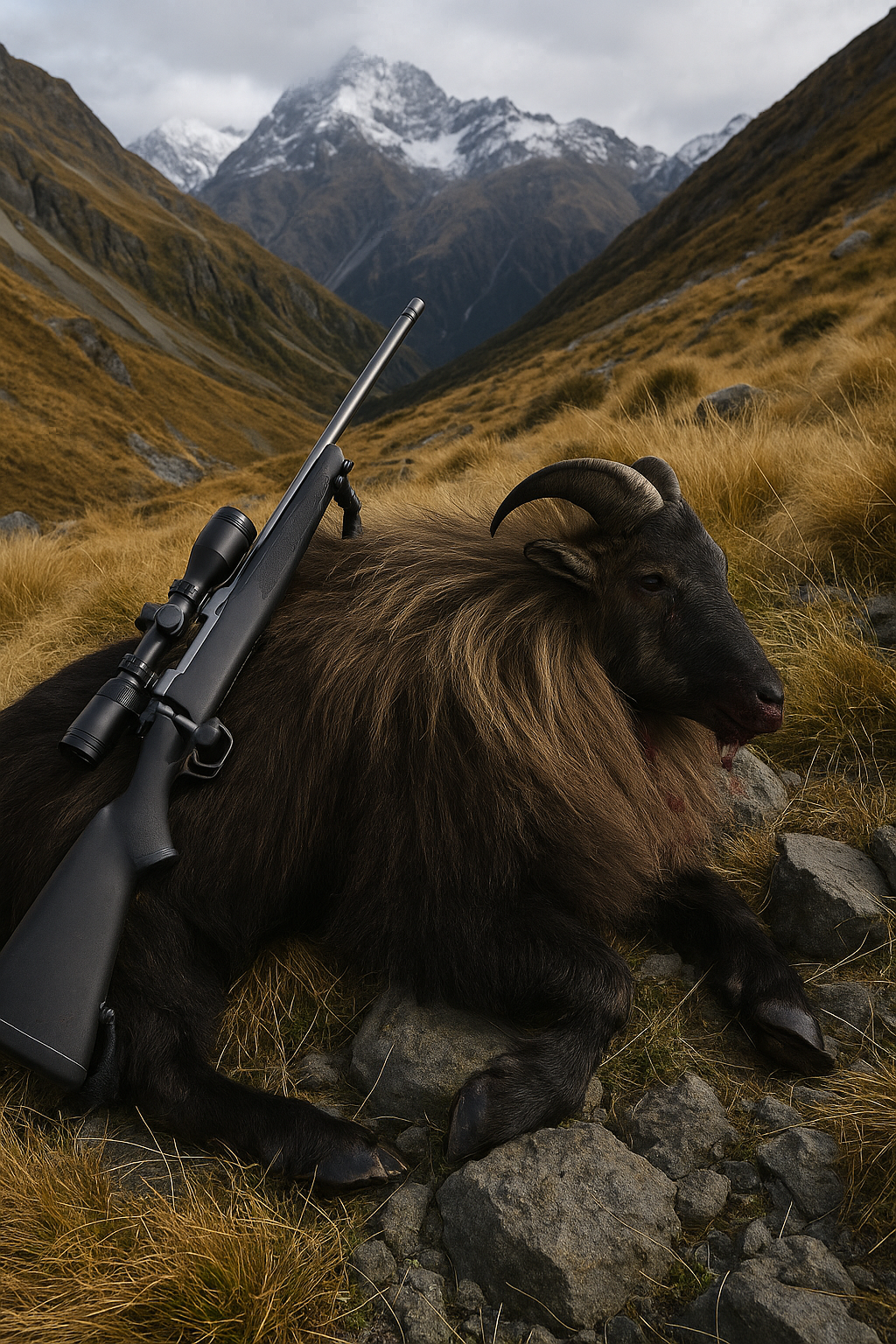
How would you feel if an animal deeply respected and protected in your homeland was treated as a trophy animal and hunted in another country for being invasive? I was heartbroken to discover the fate of Himalayan tahrs when I first arrived here in New Zealand.

Being from a native Sherpa community in the Khumbu region (popularly known to the world as The Everest region), I grew up roaming around the high alpine environment of the Himalayas. The region lies in the Sagarmatha National Park and Buffer Zone (SNPBZ) and is home to majestic mountains including the highest peak in the world, Khangri Chhomolungma (Mt. Everest in English), as well as stunning rugged terrains, glaciers, lakes and diverse flora and fauna.

The Khumbu region is habitat to many endangered wild animals including snow leopards, musk deer and red pandas. Due to its rugged environment and mountain slopes, the region is also a suitable native habitat of the Himalayan tahr (Hamitragus jemlahicus). We call them “Ri Rau” in Sherpa language meaning “Wild Goat”.

I was around 6-7 years old when I first saw a herd of the Himalayan tahrs grazing on the hills near my hometown Lukla while walking with my father. I remember watching and admiring them for hours hiding behind a rock. I was immediately mesmerized by their presence. The male stood out with their glossy thick brown coat of straight hair as if they came straight out of a salon, with strong dark horns surrounded by the females and their young ones. I was especially stunned by their ability to move confidently and swiftly across the rocky slopes. That moment still relives fresh in my memory. Since then, whenever I saw them, I always paused for a moment to admire their elegance and capturing the moments for memories.
The Himalayan tahr is currently listed as Near threatened on the IUCN Red list. In their native habitat they are mostly predated by common leopards and snow leopards. Due to anthropogenic activities such as habitat loss and illegal poaching, their population have been declining, and they are now protected in their native Himalayan environments.
When I first arrived in New Zealand, I discovered that the Himalayan tahrs are considered as invasive species, and they are hunted for recreational purpose in the country. I was really surprised by this as they are protected in the region that I come from. After doing some digging, I found out that the Himalayan tahrs were introduced in New Zealand in the early days of European settlements for sport, gifted by Duke of Bedford to help with recreational hunting option for emigrating Englishmen and released near the Hermitage at Mt Cook in 1909. As New Zealand doesn’t have any natural predators of Himalayan Tahrs, their population escalated rapidly reaching a population size of tens of thousands over the Southern Alps.

Photo: Image generated by ChatGPT (DALL-e) by OpenAI
The Department of Conservation of New Zealand (DOC) has been working on Himalayan Tahr population control since 1993 under the Himalayan Tahr Control Plan (DOC, 1993: HTCP) which allows limited population of around 10,000 tahrs within the seven defined management units. However, the tahr population has grown beyond the limitation of management plan in recent years, making it difficult to control them. The HTCP also includes a defined feral range to contain their population and permits farming or holding in game estates for commercial hunting only within the designated range.
A report from Lincoln University, conducted in 2020 by Geoff Kerr, Garry Ottmann and Fraser Cunningham studied the potential for containing tahrs in game estates outside their feral range to reduce demand on the wild tahr resource as recommended by the Game Animal Council (GAC, 2014). Three GPS tracked male tahrs were released in the High Peak Game Estate on 19th December 2018 to monitor their behavior and movement pattern inside the enclosure over a twelve-month period. While one tahr died of unknown causes, the remaining two were kept there until 24th December 2019. The study was done on the hypothesis that tahr containment within a game estate outside of their feral range would be successful.
The trial was successful showing that Himalayan thar can be effectively contained in game estates outside their feral range. GPS data showed minimal fence interaction, and the tahrs quickly adapted to their new territory. Most boundary activity occurred during the breeding season. The study also suggested potential for larger scale commercial operations due to their herding behaviour.
Despite extensive research and ongoing control efforts, Himalayan tahr continues to threaten New Zealand’s native biodiversity by heavily grazing on tussocks, alpine herbs, and shrubs, plants that have no evolutionary history of mammalian herbivory, thereby disrupting the natural ecological balance.
This problem also raises a serious question of human intervention with nature. More than wondering how to manage tahr populations, I find myself asking: What are they even doing here in the first place? Himalayan tahr has become invasive in New Zealand because people introduced them here without realizing its future consequences and it has backfired us, leaving us to manage the aftermath of our own decisions.
Witnessing the realities of a Himalayan tahr changing from a revered mountain dweller in my homeland to trophy hunted invasive species in New Zealand, has been an emotional and eye-opening experience for me. Looking at the conservation dilemma of tahrs between two different countries has challenged my perception and shown how the value of wildlife depends on the context. The Himalayan tahr’s journey, much like my own, has crossed oceans and adapted well into the new environment but the only difference is that the tahrs didn’t choose to come here. The Himalayan tahr’s story is a very powerful reminder of how human actions can disrupt the natural ecosystem. As someone who grew up admiring their beauty in the Himalayas, I hope their fate improves in the future.
The author, Ngima Chhiri Sherpa, is a postgraduate student in the Master of Applied Science (Environmental Management) at Te Whare Wānaka o Aoraki Lincoln University. This article was written as an assessment for ECOL 608 Research Methods in Ecology.
Paper Reference: Kerr, G. N. ., Ottmann, Garry., & Cunningham, Fraser. (2020). Himalayan tahr on game estates outside the tahr feral range. Centre for Land, Environment & People, Lincoln University. https://digitalnz.org/records/44715317
Leave a Reply