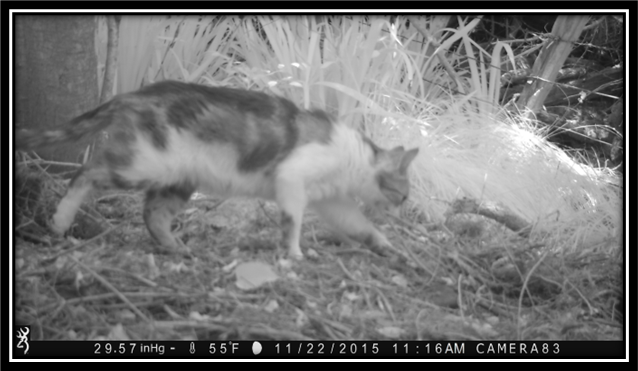
You are probably well aware of the feral cat issues here in Aotearoa New Zealand and the detrimental impact that cats are causing in our unique whenua (land). However, if you are new here, let me get you up to speed. The popularity of these adorable companions –1,134,000 companion cats and 196,000 strays, to be accurate – has come with a tremendous cost to native wildlife in Aotearoa New Zealand.
With over a decade of experience in the veterinary industry, I’ve witnessed animal welfare concerns from both perspectives. I’ve seen the devastating impact cats can have on native wildlife, as well as the suffering of unwell, neglected feral cats. This dual perspective made becoming a cat owner myself all the more meaningful, thanks to a foster failure named Professor (pictured below), who quickly stole my heart. After adopting him, it was an easy decision to create a comfortable indoor life for him. Knowing the toll that cats can take on wildlife populations and thinking about his health and safety, it was an obvious decision for me to keep him as an indoor cat. But unfortunately, 196,000 cats in Aotearoa New Zealand do not have the cushy indoor lifestyle that Professor has become accustomed to.
Learn about what the experts have to say on cat management here: https://predatorfreenz.org/stories/animal-welfare-agencies-views-on-cat-management/

Now what does the science say about monitoring cats that don’t have a cushy indoor lifestyle? In 2019 a team of scientists at Lincoln University carried out a study to better understand just that. They deployed a camera detection system across two pastoral sites in the Hawke’s Bay region. One system was placed systematically (on a grid) and the other strategically (placement where the researchers believed cat activity would be the highest). Their goal was to compare which camera trap placements would be the most effective method for monitoring feral cat populations. While feral cats are notoriously difficult to detect due to their low densities and cryptic behaviours, these researchers did get some interesting results!
During a telephone interview, with primary author Dr. Margaret Nichols (Maggie), Maggie cheerfully shared how she began to question the use of her time after processing countless images of hedgehogs enjoying the smell and feel of the ferret pheromones used to lure in the cats. Then things took a surreal turn when she found herself pondering reality itself—prompted by turkeys performing what looked suspiciously like synchronised dances.
But, dear reader, that wasn’t the only captivating creature caught on camera. No! The top-featured animal was… you guessed it… a sheep! Yes, you read that correctly. A single sheep nearly drove Maggie to madness after it camped out in front of one of her cameras for four entire days, triggering over 500,000 images. Poor Maggie! I’d be pulling the wool from my jumper too if I had to process that many sheep shots. Surprisingly, cats turned out to be the least detected animals of all—truly showcasing their cryptic behaviour and highlighting just how important this research was to carry out.
Against all odds Maggie and her colleagues persevered – through the thousands of sheep, hedgehogs and dancing turkey’s images to reveal a striking discovery. Camera traps placed at the forest margins detected more cats compared to those in mixed scrub or open farmland. Specifically, at forest margin an average of 3 cats were detected per night at Site 1 (Toronui Station made up of a mixture of open farmland and native forest) and 1.7 cats at Site 2 (Cape to City ecological restoration area). This compelling pattern suggests that strategic placement of cameras in these areas is likely to maximise cat detection. Hats off to Maggie and the team, what a cool discovery.

Well, there you have it reader – strategic camera placement at forest margins in the Hawke’s Bay area is the most effective way to monitor feral cats, but this is just the beginning of cat monitoring research in Aotearoa New Zealand. If you are like me and feeling inspired by Maggie and her colleagues’ findings, you might also be wondering where to even start tackling the feral cat population in your local area.
While science and data are fascinating, the telephone interview with Maggie wisely reminded me that the best part of her research experience were the organisations and the people involved along the way, particularly the Hawke’s Bay Regional Council , Predator Free South Westland, and Lincoln University. She reported that working with various stakeholders made the project not only successful but also deeply rewarding. She also noted that all research projects take more time than you think and to never underestimate the possibility of processing 500,000 sheep photos when doing camera monitoring!

What a great reminder that in life it’s not just about success or how long things take; it’s about the experiences and friendships you make along the way. Thank you, Maggie, for sharing that wisdom.
This article was prepared by Postgraduate Diploma in Applied Science student Chloe McMenamin as part of the ECOL608 Research Methods in Ecology course.
Now reader it is over to you, want to learn more about how you can help? Check out the The National Cat Management Strategy Group, or if you want to learn more about feral cats here in Aotearoa New Zealand check out what the Department of Conservation has to say.
Image refernce:
Garvey, P,M. (nd). FigS3: Hedgehog self-anointing after contact with the pheromone/kairomone vial [Supplemental material]. ResearchGate. https://www.researchgate.net/publication/311713979_FigS3_Hedgehog_self-anointing_after_contact_with_the_pheromone_kairomone_vial
Leave a Reply