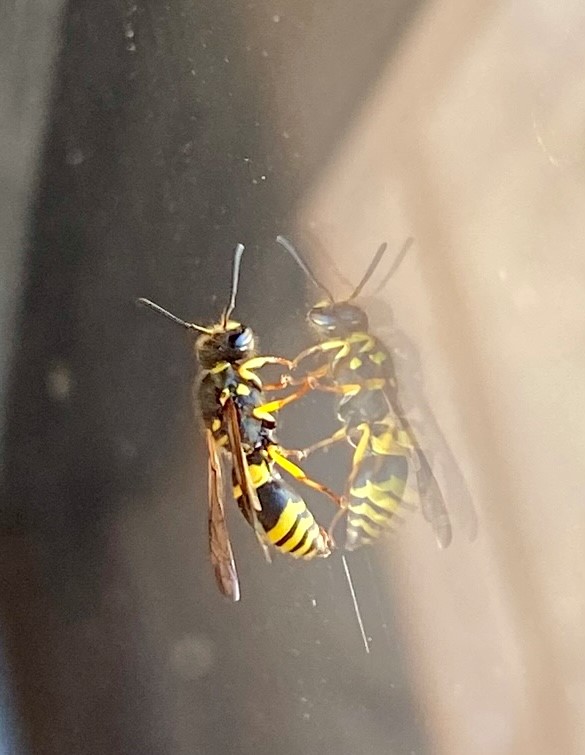
Home is where the heart is! And for social wasps, such as Vespula, home is everything.
Social wasps work together well in a group. Each wasp has a role, and together they act almost like a single living organism. While weather, food, and other environmental conditions, such as human disturbance, can affect how wasps behave, researchers wanted to know something different: can entire wasp colonies have their own personalities?
This question was explored by a team led by J.M. Jandt, from the University of Otago, and Mateus Detoni, then a PhD student at Otago and now a lecturer at Lincoln University. Their study was published in the scientific journal Insectes Sociaux.
Why study these wasps?
Vespula wasps are well known for defending their nests aggressively when they feel threatened. However, we still know relatively little about why some colonies seem more aggressive than others. The researchers wanted to find out whether different colonies consistently behaved differently, just as people can have different personalities. Importantly, wasps are recognised as pests and have major ecological and economic impacts in New Zealand. Understanding aggression will help us to manage wasps better.
What did the researchers do?
The study was carried out in three different locations in New Zealand’s South Island, observing three main behaviours. They recorded how wasps actively foraged for food, how aggressive the colony was when not disturbed, and how aggressive the nest became when disturbed. These assessments were measured over three periods: one day, one week, and over a month. Mateus and colleagues also recorded other information, such as nest size, weather when the colony was breeding, and temperature around the nest.

What did they discover?
Some colonies were consistently more aggressive than others, no matter when they were tested or how the tests were carried out. In other words, colonies appeared to have their own behavioural “personalities”
Some colonies were naturally more defensive and aggressive, while others were calmer. Differences in aggression could not be explained by factors such as nest size or temperature. Other factors, such as genetics or colony development, may play an important role.
Why is this important?
The study shows that wasp colonies are not all the same. Just like people and other animals, groups of insects can behave differently from one another. In this case, a colony in which the individual wasps are genetically similar to one another, whole colonies can share the aggression. This is of importance to New Zealand because more aggressive colonies may compete with native wasp species, a threat to other insects and birds and pose a greater risk for people who accidentally disturb their nests.
How can this help control wasps?
Pest control methods assume that all pest targets in a population will behave the same. However, this study suggests that some wasp colonies are naturally more aggressive than others. If these colonies can be identified easily, then control efforts will be made easier, targeting the highest risks nest first, making management programs more effective.

What has happened since the study?
Research into social wasps has continued. Scientists are now investigating how genetic differences within colonies affect behaviours such as aggression, foraging and the ability to survive environmental challenges.
The bigger picture
It is known that individual animals can have consistent personality traits. This study has expanded the idea by showing that the entire wasp colonies may also have stable behavioural characteristics. Some researchers describe social insect colonies as “superorganisms” because thousands of individuals work together so closely that the colony behaves as a single living thing. From this perspective, a colony’s level of aggression can be viewed as a trait that evolves just like traits in individual animals.
Questions for future research
The study raises several new questions relating to what causes colonies to stay highly aggressive, and when is aggression helpful or harmful to a colony. Do other social insects, such as ants and bees, show similar colony personalities? This opens doors for further work.
All is all
The research by Jandt, Detoni, and colleagues showed that wasp colonies do not all behave the same way. Instead, each colony can have its own consistent pattern of behaviour, much like a personality. This discovery has changed how scientists think about social insects and may help improve future management strategies of this social wasp.
As science continues to study these remarkable insects, one message is becoming clear: Understanding the personality of a colony may be just as important as understanding the behaviour of individual wasps.
This article was prepared by Master’s of Bioprotection student, Richard Dikrey, as part of the ECOL608 Research Methods in Ecology course.
Leave a Reply