Uncategorized, behaviour, conservation, entomology, student blog, wildlife management
If you had asked me four years ago where I would be today, I would not have said ‘planning to study wasps’, and I would NOT have said ‘New Zealand’! But here I am and that’s what I’m doing.
My interest in this field originates from my research on ants, and more specifically their unique behaviour. Ants belong to the order Hymenoptera, the same order as bees and wasps.
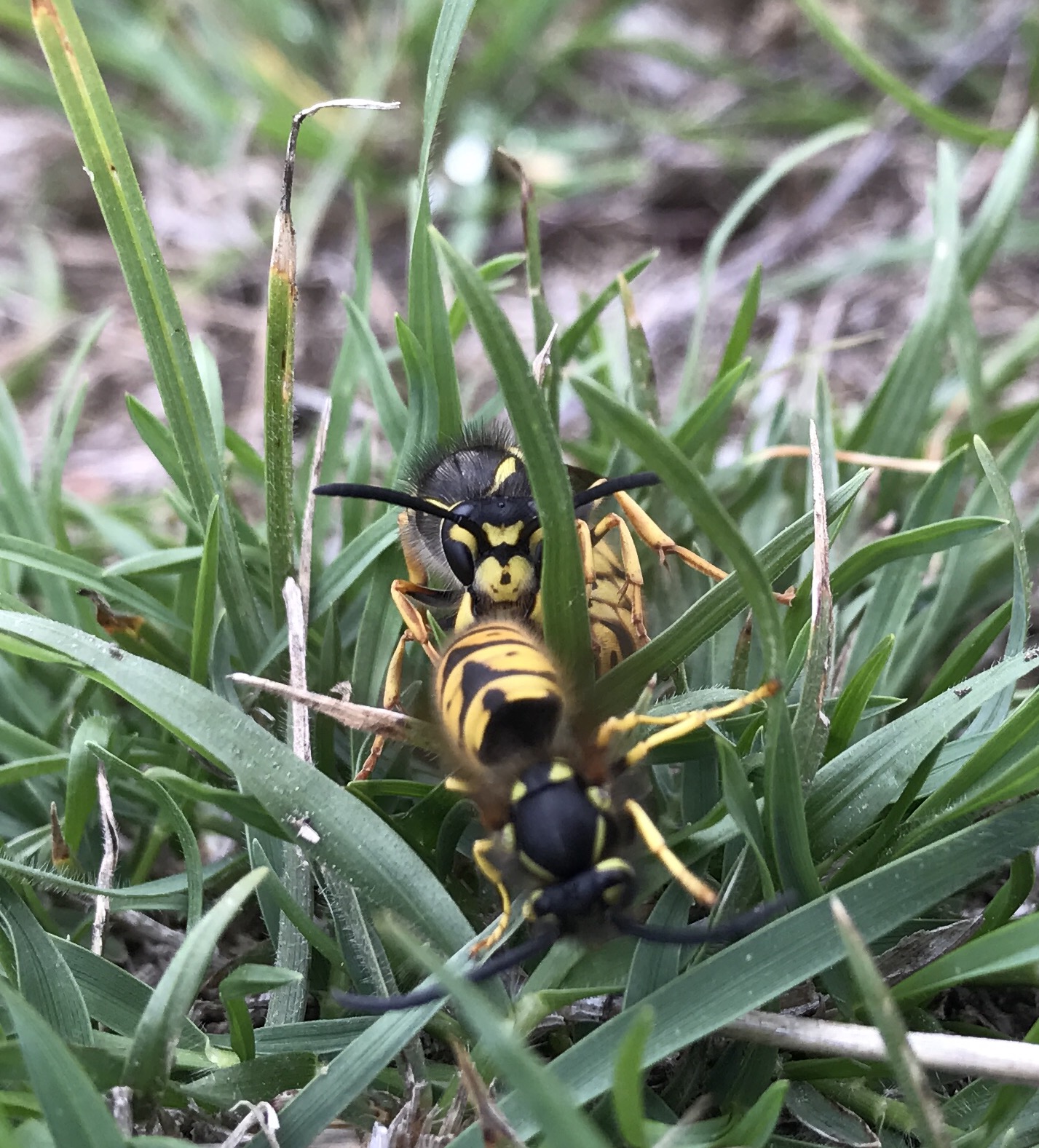
Just like humans, wasps can be social creatures, and just like humans they display different levels of aggression (although most types of wasps are not social). Despite there being around 100,000 described wasp species, only around 1,000 of them are social. Which seems crazy, because when you see one wasp, you always seem to see more.
Vespula wasps are what’s called eusocial, this means that they are organised into groups and all work together under a single queen. Eusociality is impressively efficient. E.O Wilson, a famed ant biologist, once said that humans display a weak form of eusociality, and I have to say I agree with him.
Now, back to how wasps display different levels of aggression. Have you ever noticed that when you walk past a nest or sit near a wasp sometimes you will be harassed while other times they will completely ignore you? That’s because different colonies of wasps display their own levels of aggression!

There are many reasons why wasps may vary in aggression. Some may be more aggressive to drive away predators or outcompete other colonies. Others may be more passive to hide from mammals who could destroy their nests.
A group of brave researchers, including Mateus Detoni from Lincoln University, put themselves in harm’s way to determine what factors cause wasps to display varying levels of aggression.
One hypothesis that they developed was that foraging and temperature could increase aggression because that is when wasps are the most active. The methods used for testing the aggression of the wasps included a target made from two black plastic plates that had been clasped together and a black cloth. Inside the plates was an omnidirectional microphone that had been connected to a camera.
As you may know, wasps are a super invasive pest species in New Zealand. Since the early 1900s they have been having a devastating impact on the beech forests and the native ecosystem as a whole. There are two species in New Zealand Vespula vulgaris and Vespula germanica, both having colonised from Europe in the 20th Century.
To survive, wasps need sugars and protein, so they go hunting. The main thing wasps are foraging for, especially in beech forests, is honeydew. This is a type of sugar that has been pooped out by scale insects, which live on and inside beech trees. The main source of protein for wasps is, well, anything that is soft enough for them to bring back to their nest.

The study found that, surprisingly, neither foraging activity nor temperature seemed to have any role in indicating whether a colony would be particularly more aggressive than another. So, the researchers turned to the next question, could it have something to do with nest and colony size? Unfortunately, this lead was also a bust. Yes, the larger colony size did allow for higher foraging activity but there was still no indication that a larger nest and colony would increase aggression.
Did aggression have something to do with the age of wasps? Eusocial insect colonies span generations of individuals meaning there are both juvenile and mature workers alive simultaneously. This was a topic that Mateus had previously studied. Age can play a role in aggression, as the older wasps have more experience defending the nest, which can cause them to have a more aggressive response when agitated.
Vespula wasp colonies were observed through their life, and it was concluded that the behaviour on a colony level is consistent throughout development. However, one key thing was noted “behaviour can change as an individual, or colony develops” and “consistent differences within a population can still be observed”.
Aggressiveness could depend on the ratio of aggressive to nonaggressive individuals in the colony. Wasps having their own individual personalities is not something that most people consider, as they are often thought of as all being worker drones. But I guess a lot of that can be attributed to the media shaping how we view wasps, bees, and ants.
In Europe, wasps have predators that both keep the population in check and give them a reason to be aggressive. The researchers suggested that external pressures may cause certain behaviour to be passed down through generations. In a place where they do not have predators, such as New Zealand, they can learn to pass on behaviour that is less aggressive.
Wasps are insects that have individual personalities influencing the aggression levels of the colonies that they live in. Eusociality truly is one of the most interesting concepts in the animal kingdom.
This article was prepared by Postgraduate Diploma in Applied Science student Jack Gregorian as part of the ECOL608 Research Methods in Ecology course.
Reference:
Jandt, J. M., Detoni, M., Loope, K. J., & Santoro, D. (2020). Vespula wasps show consistent differences in colony-level aggression over time and across contexts. Insectes Sociaux, 67(3), 367–381. https://doi.org/10.1007/s00040-020-00768-3
Leave a Reply