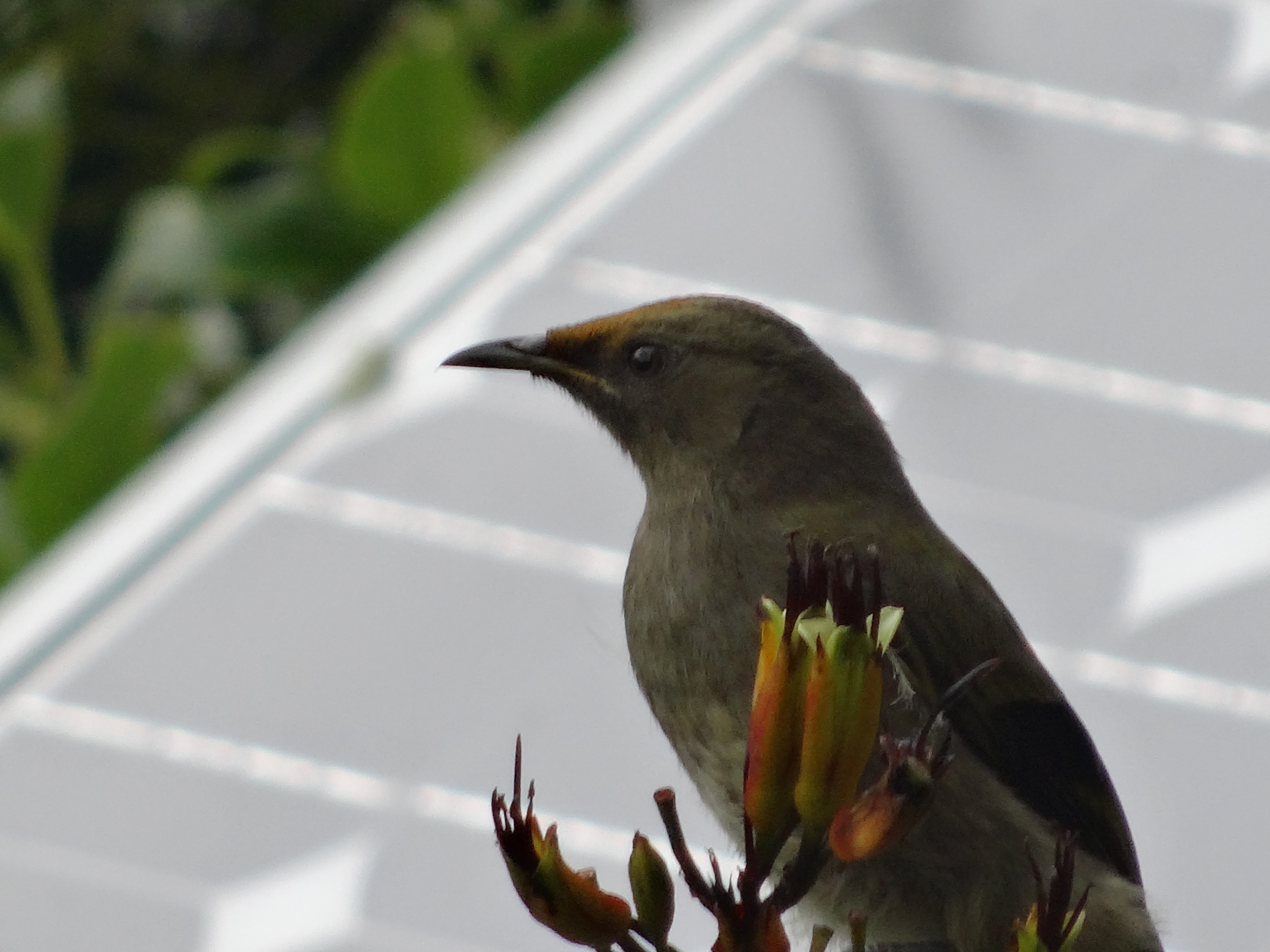
Bellbirds love to sing; they sing for everything that they do. Communicating, courtship, foraging, defending their homes, it’s almost like they’re living in a musical. I’ve always been captivated by the song of bellbirds. Whether I’m on a walk in the Port Hills, or at Willowbank Wildlife Reserve looking at the capybara and otters, I hear bellbirds singing in the background.
The New Zealand Bellbird, or Anthornis melanura, is a honeyeater species and a close relative of New Zealand’s Tūī (Prosthemadera novaeseelandiae). They have a variable diet, feeding primarily on nectar, but also fruits, insects, and scale insect honeydew. In Christchurch, bellbirds spend their summers in the Port Hills, feeding from the large nectar supplies that come from flowering native vegetation. Then, in the winter, some move to the city, where urbanisation creates a warmer environment, and sugar feeders and exotic plantings provide food.
In 2019, PhD student Jennifer Dent studied foraging and migratory patterns of bellbirds in Christchurch for her thesis, using their calls to determine where different groups were. Bellbirds in different areas make different calls, basically a different accent, language, or singing a song in a different key, and this is referred to as dialect.

For this, Jennifer placed DOC AR4 audio recorders at 59 locations. 29 locations were in the Port Hills, where recording took place in autumn. Sites were everywhere from Rapanui Bush in the east to Ahuriri Reserve in the west, totalling 15 km around the Port Hills. The other 30 recording locations were in Christchurch city during winter, from as far north as the Groynes, as far east as Sumner, and as far west and south as Lincoln. From this, Jennifer matched dialects in the Port Hills in autumn to those recorded in Christchurch city in winter.
Christchurch dialects
Jennifer found four different bellbird dialects in Christchurch.
Dialect A was the most common dialect. It was spread across the northern region of the Port Hills, as well as in more central areas, such as the Botanic Gardens.
Dialect B was the next most common. In the Port Hills, it was found in Kennedy’s Bush, and in the city, it was in south-western areas, such as Halswell and Hoon Hay.
Dialect C was the least common dialect that Jennifer observed. In the Port Hills, it was found in Omahu Bush, and in Christchurch, it was found outside of the city, but only as far as Tai Tapu and Lincoln.
Dialect D was the last dialect. This pattern is unusual because it was not found in the autumn Port Hills recordings, but was found in the winter Christchurch recordings around the eastern and northern parts of Christchurch, such as Sumner, the Groynes, and Riccarton Bush, but because it was not found in the autumn recordings, it is not known where they went after winter.

Why don’t the dialects overlap?
It’s surprising that four different dialects were found both so close together and with very little overlap, especially since there are no geographic barriers stopping members of one group from flying to another. Jenny suggested that there could be two main reasons for this: limited dispersal and vocal imitation.
Limited dispersal, or philopatry, is the theory that states that birds remain in the areas where they were born and raised perhaps because it is harder to survive outside their own groups. A second theory is that vocal imitation by bellbirds occurs when birds move between groups, but we don’t notice it because they are so quick to pick up on the new dialect. It is possible that both of these theories are occurring simultaneously.
Following bellbirds into the city
The presence of all Port Hills dialects in the Christchurch recordings suggests that seasonal dispersal from the Port Hills to Christchurch is a shared behaviour among all populations. Furthermore, as shown by the map, dispersing to the nearest suitable location rather than spreading across all of Christchurch also seems to be a shared behaviour.
Bellbirds in Christchurch likely remember foraging areas for different times of the year, but rather than remembering many locations across Christchurch, they remember only a few patches that are close together. This is referred to as patch-scale resource tracking, and it has been shown to be a low-work, high-reward technique for foraging by bellbirds.
Next time you hear a bellbird singing, you aren’t just hearing background noise, you’re hearing a local neighbour. That bellbird might be a Cashmere regular or a member of the Tai Tapu community. It makes Christchurch a more lively city, as it’s not only just a place for us, but for birds following their own routines, singing their songs as they go about their day.
This article was prepared by Master of Science student Max Mulvihill as part of the ECOL608 Research Methods in Ecology course.
Paper reference: Dent, J. M. (2019). Information use during foraging by New Zealand bellbirds (Anthornis melanura) : A thesis submitted in partial fulfilment of the requirements for the Degree of Doctor of Philosophy at Lincoln University. Lincoln University. https://researcharchive.lincoln.ac.nz/server/api/core/bitstreams/82c22265-dec3-419b-8880-4eb37f1aaee2/content
Leave a Reply